


- Home
- Facial aesthetics
- Xanthelasma
- Xanthelasma
Xanthelasma: yellow plaques on the eyelids
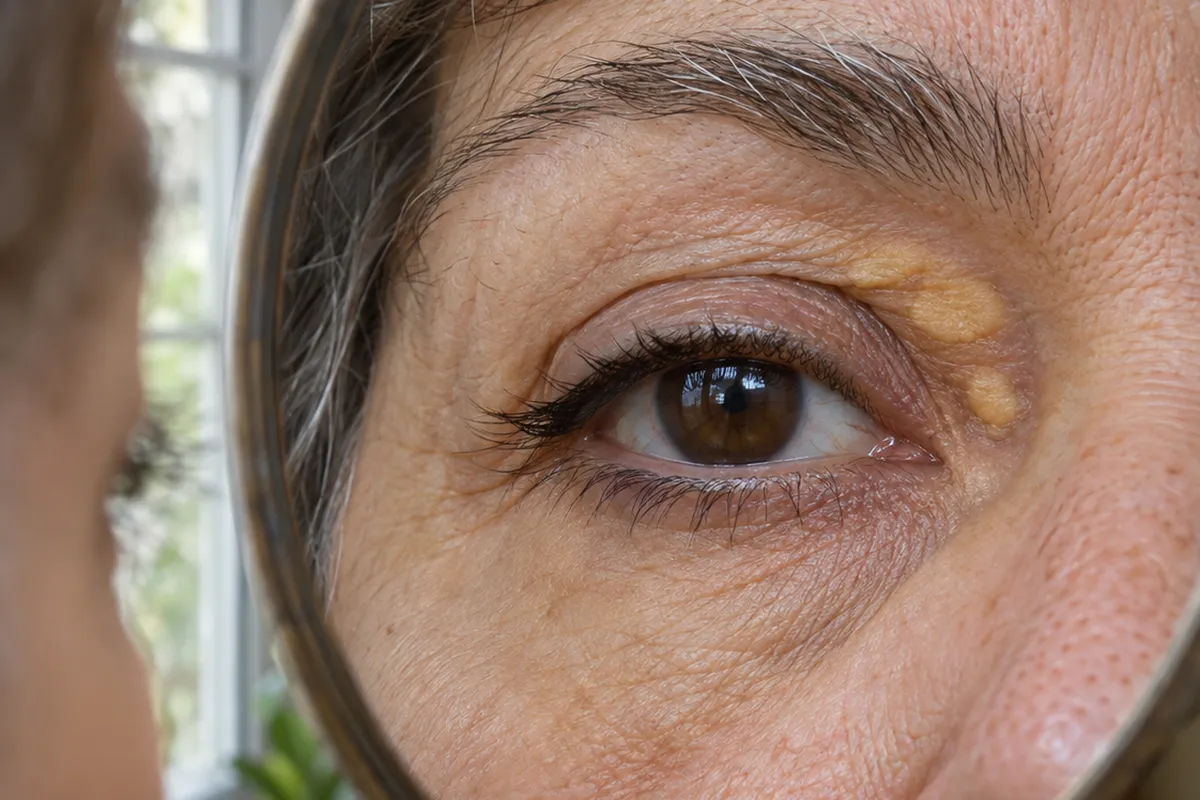
Xanthelasma consists of yellowish, soft plaques, flat or slightly raised, on the eyelids. They are benign and painless, but can be a sign of cholesterol abnormalities.
 Luxmed TeamAuthor
 Dr Michelle CampagnoliClinical review · OM no. 69467
In this article
Xanthelasma consists of yellowish, soft plaques, flat or slightly raised, that appear on the eyelids, mainly near the inner corner of the eye. They are benign and painless, but they are aesthetically bothersome and can be a sign of cholesterol abnormalities worth investigating.
Three ideas to remember.
How to recognise them
- Soft, yellow or orange plaques.
- Most frequent at the inner corner, on the upper and lower eyelids.
- Often in both eyes.
- They grow slowly and do not go away on their own.
- More common from the age of 40 and in women (Nair and Singhal, 2017).
Why they appear
They are accumulations of fat-laden cells in the skin. In about half of cases there are abnormalities of cholesterol or other blood fats; in the other half, blood tests are normal (Nair and Singhal, 2017).
Why they deserve attention
In a Danish study of almost 13,000 people followed for decades, xanthelasma was associated with a higher risk of heart attack, ischaemic heart disease and death, even after accounting for cholesterol and other factors (Christoffersen et al., 2011). For this reason, anyone with xanthelasma should have a cardiovascular risk assessment.
How they are treated
| Option | Note |
|---|---|
| Laser | Removes the plaques; may leave colour changes (Raulin et al., 1999) |
| Surgical excision | For larger plaques; leaves a scar |
| Trichloroacetic acid | Controlled application, on small plaques |
| Radiofrequency or electrosurgery | An option for small plaques |
Recurrence is frequent, whatever the method, especially when cholesterol is not under control.
At Luxmed Clinic
At Luxmed, when faced with xanthelasma, we always recommend a medical assessment and blood tests before treating. We then choose the removal method best suited to the size and location.
Talk to us
The assessment is a conversation, with no obligation. Tell us what concerns you and our team will reply.
This article is for information purposes and does not replace a consultation. The results of any treatment vary from person to person.
Frequently asked questions
Is xanthelasma dangerous?
The plaques themselves are not. But they can be associated with cholesterol abnormalities and a higher cardiovascular risk.
Do they go away if cholesterol goes down?
They rarely go away, but controlling cholesterol may reduce growth and recurrence.
Can I remove them at home?
No. The skin of the eyelids is very delicate and the risk of scarring is high.
Do they come back after removal?
Often, yes.
Scientific references 3
- Nair PA, Singhal R. Xanthelasma palpebrarum: a brief review. Clin Cosmet Investig Dermatol. 2017;11:1-5. doi:10.2147/CCID.S130116 Artigo
- Christoffersen M, Frikke-Schmidt R, Schnohr P, Jensen GB, Nordestgaard BG, Tybjærg-Hansen A. Xanthelasmata, arcus corneae, and ischaemic vascular disease and death in general population: prospective cohort study. BMJ. 2011;343:d5497. doi:10.1136/bmj.d5497 Artigo
- Raulin C, Schoenermark MP, Werner S, Greve B. Xanthelasma palpebrarum: treatment with the ultrapulsed CO2 laser. Lasers Surg Med. 1999;24(2):122-127. Artigo
Editing and development: Rúben Brito · Operial Development
Keep exploring