Algés, Oeiras Mon to Fri · 09:00 to 13:00 and 14:00 to 19:00 · Sat · 09:00 to 14:00
WhatsApp Book a consultation

Facial aesthetics

Face lacking definitionWhen the line of the jaw and chin is no longer as sharp as it used to be and you want to understand what has changed

A face “without definition” is one in which the lower half looks softer, heavier or rounder: the jaw no longer draws a clean line, the chin looks receding or small bulges appear beside the mouth. It is not a disease, and it is almost always a mixture of several changes at the same time, in the bone, fat, muscles and the skin itself, which evolve with age, weight and hormones. This is why not every face calls for the same thing. Here we explain how to recognise it, what is usually behind it, what the evidence says about hyaluronic acid, HIFU and collagen biostimulators, and when a medical assessment is advisable before any treatment, at Clínica Luxmed, in Algés.

Reviewed by Dr Michelle Campagnoli, clinical director

  • 3clinic options for this topic
  • 1assessment, always first
  • Nocommitment
Fotografia · rosto-sem-definicao-hero800 × 1000 px · vertical 4:5Mulher de uns 45 anos, de perfil, sentada junto a uma janela com luz natural suave, com o cabelo apanhado e uma gola alta clara; enquadramento a meio corpo, a linha do maxilar e do pescoço discretamente à vista, sem close do rosto, sem maquilhagem em destaque e sem expressão forçada

How to recognise it

Is it loss of definition in the contour of the face?

The definition of the face depends on several elements, and what you see in the mirror is the sum of them all. These signs help you understand what is going on before the assessment.

Tick what you recognise0/7

Tick the signs you recognise in your case. This is not a diagnosis, it is only meant to give you an idea.

Has the contour changed quickly, with a swollen or rounded face and weight gain, purplish stretch marks, tiredness, dry skin, or do you take corticosteroids? You need a medical assessment, because there may be a hormonal cause or fluid retention. So does swelling on one side only, with pain, fever or redness, a lump that is growing on the jaw or neck, or difficulty opening the mouth or swallowing. If you have missing teeth, pain when chewing or a jaw that “clicks”, start with the dentist. Sudden weakness on one side of the face, a drooping mouth or slurred speech: call 112. If you have already had a filler and have severe pain, skin that is pale, dark or has purplish patches, a change in vision or a severe headache, call 112 and contact the clinic that injected it immediately. Out of hours, SNS 24: 808 24 24 24.

Fotografia · rosto-sem-definicao-consulta1083 × 1300 px · vertical 5:6Médica de bata branca sentada ao lado de uma mulher de uns 45 anos, ambas de perfil, a observar o contorno do maxilar com luz lateral de consultório; enquadramento a meio corpo, com um espelho de mão e um bloco de notas em cima da mesa, sem close do rosto
Frame for the consultation photograph. The dots mark what the doctor assesses.

Why it happens

What may be behind a face without definition

There is almost never a single cause. Choose a situation to see how it fits into the story and what usually helps.

Bone and structure

The bones of the face do not stay the same throughout life. Studies using CT scans show that the jaw and the eye sockets are remodelled and that certain areas are reabsorbed with age, including the area of the lower jaw in front of the angle. When the base loses support, what lies above it also loses shape. In people who were born with a smaller chin or jaw, this can be noticeable earlier.

What weighs on it

Expecting a skincare product to solve a change that lies in the structure, or comparing your face with that of someone from another family.

What helps

Understanding that part of the problem is structural. This is the part that a well-planned filler can compensate for in some cases, without promising the face you had twenty years ago.


Normal or to be assessed

Gradual change or something to be assessed

Most loss of definition is gradual and expected. But some situations call for an assessment before any treatment, because the contour is only the visible part.

  • How it looks. The line of the jaw softens gradually, over months or years, equally on both sides, and comes with less firm skin, with no pain, swelling or other symptoms.

  • When it is noticed. In profile photographs, at the end of the day or after losing weight. It is more visible in side lighting and when you look down.

  • What the clinic does. The doctor listens to your history, examines the face from the front and in profile and works out whether it is mainly volume, structure or skin, before proposing whatever makes sense.

  • At home. Protect the skin from the sun, stop smoking, keep a stable weight and give yourself time for an unhurried decision.

Do you have sudden weakness on one side of the face, slurred speech, difficulty breathing or swallowing, or, after a filler, severe pain, pale or dark skin, or a change in vision? Call 112. If you have a rapid change or doubts, out of hours you can call SNS 24: 808 24 24 24.

Book an assessment

What the clinic may consider

Options for defining the contour of the face

Before any procedure come sun protection, a stable weight, dental health and an assessment of what has changed. Only then is a procedure considered. For this topic, the clinic associates three options: hyaluronic acid, HIFU and collagen biostimulators. Here we show the two most relevant for redefining the contour, hyaluronic acid when volume and structure are lacking and HIFU when the problem is mainly skin and tissues with little support; biostimulators, which stimulate collagen gradually, can also be considered and the doctor will tell you, at the consultation, which makes the most sense. The evidence is limited and of modest quality: reviews describe improvements with these methods, but few studies are large or compare one method with another well, and combinations are based mainly on expert opinion. Results vary from person to person, are not permanent and are generally temporary.

Book an assessment
Dr Michelle Campagnoli, clinical director of Clínica Luxmed

First step

Assessment consultation

The doctor listens to what you are experiencing, examines your case and explains the suitable options. No treatment begins without this consultation.

May be considered when

you want to understand the cause and decide on the best path, with time and without commitment.

Book an assessment
A doctor in gloves applying a syringe next to the chin of a woman lying down, with the jawline in view, in a consulting room with soft light

Restoring volume and structure

Hyaluronic acid

An injectable, absorbable gel that restores volume and gives support at points of the chin and jaw to redefine the line of the contour. Firmer fillers are usually used in this area, and technical descriptions and trials are generally small. There may be bruising, swelling, nodules and asymmetries and, more rarely, vascular compromise of the skin; the risk of vision problems is greater in the nose and between the eyebrows than in the jaw, but only a doctor with anatomical knowledge who is able to use hyaluronidase should inject. Results are temporary.

May be considered when

the contour has lost mainly volume or structure in the chin and jaw, the cause has been assessed, the skin is healthy, and the doctor has explained the risks and what is realistic to expect.

Find out more
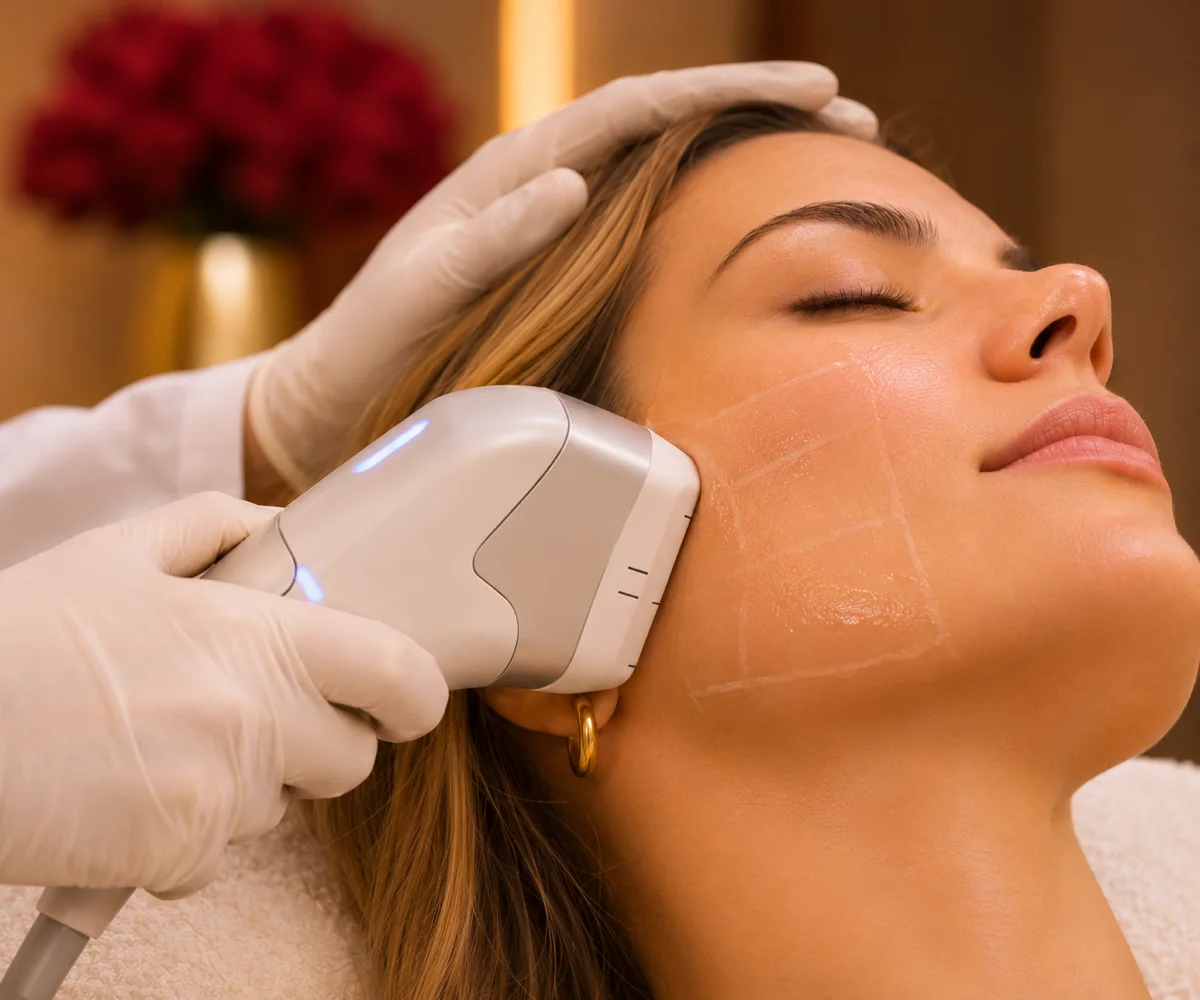
A focused ultrasound applicator held against the face of a woman lying down, with the treatment grid drawn on the skin, next to the jawline

Lifting without surgery

HIFU

High-intensity focused ultrasound that heats deep layers of the skin and supporting tissues and stimulates collagen, to tighten the skin on the jaw and the lower half of the face without surgery. A systematic review of studies described improvements in laxity in the lower face, but protocols vary and the effect is gradual, over months. There may be redness, swelling and discomfort during and afterwards. It does not restore volume or replace a surgical lift when laxity is marked.

May be considered when

the loss of definition is mainly in skin and tissues with little support, with mild to moderate laxity, with no active inflammation or skin infection, and the doctor has explained that the benefit is gradual, variable and temporary.

Find out more

What the journey looks like

From the first conversation to a plan tailored to you

No procedure begins without an assessment by the doctor. Most people start with the simplest approach, and only then is anything further considered.

  1. 01At the clinic

    Telling your story

    The doctor asks since when you noticed the loss of definition, whether it was after weight loss, a pregnancy or the menopause, which medicines you take, how your teeth are and which treatments you have already had on the face.

  2. 02At the clinic

    Examining the face

    The face is examined from the front and in profile, with side lighting, and it is worked out whether a lack of volume, a lack of structure or laxity of the skin predominates. If there are signs of a hormonal, dental or other cause, blood tests are requested or you are referred to the right specialty.

  3. 03At home

    Look after what can be changed

    The skin is protected from the sun, smoking is stopped, weight is stabilised and whatever needs treating is treated. In many cases, this is a necessary foundation before any procedure.

  4. 04Over time

    Decide and follow up

    If the contour continues to bother you, the doctor explains what makes sense, what can be expected and how many sessions are needed, without promising results. The examination is repeated and the plan adjusted, including maintenance.

Day to day

What helps at home

What you do at home matters more than you might think. These are sensible measures to take while you wait for your consultation and alongside the clinic’s plan.

The golden rule

Understanding what has changed before choosing the treatment

A face without definition may be due to bone, fat, skin or a mixture, and each calls for a different response. Treating what is not the problem wastes time and money and can make the appearance worse. And a rapid change, with swelling or other symptoms, should be seen by a doctor rather than “treated” as ageing.

Protect the skin from the sun

The sun degrades collagen and accelerates the loss of skin support. A randomised trial showed less skin ageing with sunscreen used every day.

In practice: sunscreen with an SPF of 30 or higher every day, reapplied, plus shade and a hat when the sun is strong.

Stopping smoking

Smoking damages collagen and is associated with premature skin ageing.

In practice: if you smoke, ask your family doctor or pharmacy for help to stop.

Lose or gain weight steadily

The face follows your weight, and sudden, repeated variations make laxity worse.

In practice: gradual, supervised weight loss, and waiting for your weight to stabilise before deciding on procedures.

Record and bring to the consultation

It helps the doctor to work out when it started and how it is progressing, and to compare afterwards.

In practice: photographs from the front and in profile, in the same light and with your hair tied back, every few months, and a list of medication.

Dr Michelle Campagnoli, clinical director of Clínica Luxmed

Who will look after you

An assessment carried out by the doctor

At Luxmed, in Algés, the first step is always an assessment with Dr Michelle Campagnoli. She examines the face, works out what predominates in the loss of definition, whether there is anything to investigate or refer to another specialty, and works with you to decide what makes sense before any procedure.

  • Physical examination and medical historyA conversation about what has changed, your weight, medication and treatments already carried out, and an examination of the face from the front and in profile.
  • A plan tailored to youA clear plan without unrealistic promises, starting with essential skincare and including follow-up over time.
  • No obligationThe cost of any treatment is confirmed only after the assessment.
Book an assessment

Articles about loss of definition in the face

From our blog
Fotografia · rosto-sem-definicao-blog-11200 × 800 px · horizontal 3:2Mulher de uns 55 anos, de costas e de três quartos, a olhar para um espelho de parede numa casa de banho clara com luz natural, a mão a tocar levemente na linha do maxilar; enquadramento a meio corpo, sem close do rosto

Facial aesthetics

Loss of facial contour: what changes with age

What happens in the bone, fat and skin over the years, why the jaw loses definition and what weighs most in each face.

Fotografia · rosto-sem-definicao-blog-21200 × 800 px · horizontal 3:2Mãos de uma médica de luvas a segurar uma seringa e um modelo anatómico de crânio sobre uma bancada clara, luz suave de consultório; enquadramento só das mãos e do modelo, sem rostos

Facial aesthetics

Jaw contouring with hyaluronic acid

How hyaluronic acid is used on the jaw and chin, what the evidence shows, what is realistic to expect and the risks to be aware of.

Fotografia · rosto-sem-definicao-blog-31200 × 800 px · horizontal 3:2Natureza-morta numa mesa de consultório: três frascos e seringas fechados de ácido hialurónico e bioestimulador alinhados ao lado da ponteira de um aparelho de ultrassons, sobre uma toalha branca, com luz natural; sem pessoas nem rostos

Facial aesthetics

Defining the face: how treatments are combined

When hyaluronic acid, HIFU and biostimulators are combined, in what order, and why the evidence on combinations is still limited.

Book a consultation

Book your consultation

Choose how you prefer to get in touch. We will arrange the assessment consultation with Dr Michelle Campagnoli.

Booking through the websiteAssessment consultationTalk to our assistant on WhatsApp and ask for the current price of the assessment.

New Life Miraflores, Algés · Office Center, R. Santa Teresa do Menino Jesus n.º 6, 9.º C, 1495-048

Your details are used only for this contact. Any treatment depends on a prior medical assessment.

Request an appointmentIt takes less than a minute.
Speciality
You do not need to go into detail. The doctor will talk to you during the consultation.
Request received. Our team will contact you as soon as possible.
Why does the face lose definition and what can be done?

Almost always through a combination of changes: the bone of the jaw and chin is remodelled, fat loses volume in some places and descends in others, and the skin loses collagen and firmness. The sun, smoking, weight changes and hormones accelerate the process, and genetics decides how noticeable it is. What can be done depends on what predominates in your case: basic care (sun protection, smoking, a stable weight), treating the medical or dental cause, where there is one, and, if the contour continues to bother you, considering a procedure. None of this gives back the face you had twenty years ago.

Is loss of contour normal? At what age does it happen?

It is a normal, gradual and highly variable process. Some people notice the change in their thirties and others only after the menopause or weight loss, because age is not the only factor. What is not normal is a rapid change, with swelling, weight gain, tiredness or pain, which deserves a medical assessment. Feeling that your face has changed and wanting to understand what can be done is legitimate, and does not oblige you to have any treatment.

Is it just laxity of the skin or is it loss of volume?

It can be one, the other or both. If the skin hangs and the contour improves when you lift it with your fingers, there is laxity; if there are emptier areas, especially in the midface and chin, there is loss of volume; and part of the change is in the bone. This distinction is the most important part of the consultation, because hyaluronic acid restores volume, HIFU tightens the skin and tissues and biostimulators stimulate collagen gradually. There are other pages in this section on laxity of the skin, the double chin and the thinner face.

Does losing or gaining weight change the contour of the face?

Yes. The fat of the face responds to weight changes. Losing weight quickly can leave the face emptier and the skin in excess, and putting on weight can round the lower half and hide the line of the jaw. This is why it is best to wait for your weight to stabilise before deciding on a procedure. If the change was very rapid or comes with other symptoms, speak to your doctor first.

Does hyaluronic acid define the jaw and chin?

It can help in some cases. Technical descriptions and trials on the contour of the jaw and chin, generally with firmer fillers, describe improvements, but the studies are small and vary widely in technique. Hyaluronic acid is absorbable and the effect is temporary. It restores structure and volume, but does not treat laxity of the skin, and in excess it can give a heavy or artificial look. Only a doctor with anatomical knowledge and experience who is able to use hyaluronidase should inject.

Does HIFU lift the face? How many sessions are needed?

A systematic review of studies described improvements in laxity of between 18% and 30%, mainly in the lower face, the neck and around the eyes, with mild and transient adverse effects in most. But protocols vary, the effect is gradual and takes months to be seen, and long-term studies are few. HIFU does not restore volume and does not replace a surgical lift when laxity is marked. The number of sessions, and whether there is maintenance, is set at the assessment.

What about collagen biostimulators? How do they differ from hyaluronic acid?

Hyaluronic acid fills and gives support immediately. Biostimulators inject a substance that triggers a response in the body and stimulates collagen gradually, over weeks, so the effect is progressive and more natural, but slower. A systematic review of trials with poly-L-lactic acid, one of the biostimulators, described, in some studies, improvements maintained for at least 25 months, but the quality of the studies is low. Another review concluded that there are few quantifiable data on the effect of these products. Which product is used is decided at the consultation.

Can I combine treatments? And what about surgery?

They can be combined, because each treats a different component, and there are reviews that describe biostimulators as an alternative or complement to other methods, and the combination of fillers with skin-tightening devices. But the evidence is mainly expert opinion, and the order and interval are decided case by case. When laxity is marked or there is a lot of excess skin, non-surgical treatments have limits and it may make sense to ask a plastic surgeon for an opinion, which the doctor can suggest.

What are the risks and when is it an emergency?

The most common effects are redness, swelling, bruising and discomfort. Hyaluronic acid can cause nodules and asymmetries, and more rarely compromise the circulation of the skin; the cases of vision loss described are associated mainly with the nose, the glabella and the forehead, more than with the jaw, but no site carries zero risk. After a filler, severe pain, pallor, darkening or purplish patches on the skin, a change in vision, a severe headache or facial weakness are an emergency: call 112 and contact the clinic that injected it immediately. Do not massage the area or take medicines on your own; hyaluronidase should only be used by a doctor.

Are the results permanent? When should I see a doctor first?

There are no guaranteed or permanent results: hyaluronic acid is absorbed, HIFU and biostimulators have a gradual and temporary effect, and the face continues to age. Book a medical consultation before any procedure if the contour has changed quickly, if there is swelling, weight gain, purplish stretch marks or tiredness, if there is pain or a lump on the jaw or neck, or if you have missing teeth or pain when chewing. If in doubt, out of hours call SNS 24 (808 24 24 24); for sudden weakness on one side of the face, slurred speech or difficulty breathing, call 112.

We could not find that question. Ask us on WhatsApp

Scientific references

This page is based on the sources below and was reviewed by Dr. Michelle Campagnoli. Last updated on .

  1. Mendelson B, Wong CH. Changes in the facial skeleton with aging: implications and clinical applications in facial rejuvenation. Aesthetic Plast Surg, 2012.
  2. Shaw RB Jr, Katzel EB, Koltz PF, et al. Aging of the facial skeleton: aesthetic implications and rejuvenation strategies. Plast Reconstr Surg, 2011.
  3. Ugradar S, Kim JS, Massry G. A Review of Midface Aging. Ophthalmic Plast Reconstr Surg, 2023.
  4. Farage MA, Miller KW, Elsner P, Maibach HI. Characteristics of the aging skin. Adv Wound Care (New Rochelle), 2013.
  5. Morita A. Tobacco smoke causes premature skin aging. J Dermatol Sci, 2007.
  6. Hughes MCB, Williams GM, Baker P, Green AC. Sunscreen and prevention of skin aging: a randomized trial. Ann Intern Med, 2013.
  7. Moradi A, Shirazi A, David R. Nonsurgical chin and jawline augmentation using calcium hydroxylapatite and hyaluronic acid fillers. Facial Plast Surg, 2019.
  8. Nikolis A, Metelitsa A, Raco L, Safran T. Safety and effectiveness of two high-G' soft tissue fillers for chin augmentation: a prospective, randomized, comparator-controlled, evaluator-blinded trial. Aesthet Surg J, 2026.
  9. Haykal D, Sattler S, Verner I, Madhumita M, Cartier H. A systematic review of high-intensity focused ultrasound in skin tightening and body contouring. Aesthet Surg J, 2025.
  10. Khan U, Khalid N. A systematic review of the clinical efficacy of micro-focused ultrasound treatment for skin rejuvenation and tightening. Cureus, 2021.
  11. Signori R, Barbosa AP, Cezar-Dos-Santos F, et al. Efficacy and safety of poly-l-lactic acid in facial aesthetics: a systematic review. Polymers (Basel), 2024.
  12. Fisher SM, Borab Z, Weir D, Rohrich RJ. The emerging role of biostimulators as an adjunct in facial rejuvenation: a systematic review. J Plast Reconstr Aesthet Surg, 2024.
  13. Signorini M, Liew S, Sundaram H, et al. Global Aesthetics Consensus: avoidance and management of complications from hyaluronic acid fillers. Plast Reconstr Surg, 2016.
  14. Beleznay K, Carruthers JDA, Humphrey S, Carruthers A, Jones D. Update on avoiding and treating blindness from fillers: a recent review of the world literature. Aesthet Surg J, 2019.
  15. Kapoor KM, Kapoor P, Heydenrych I, Bertossi D. Vision loss associated with hyaluronic acid fillers: a systematic review of literature. Aesthetic Plast Surg, 2020.
  16. NHS. Sunscreen and sun safety. (nhs.uk, acedido 2026-11-11)
CallAssistantAvailableBook