


Scars on the face: how they evolve in the first year
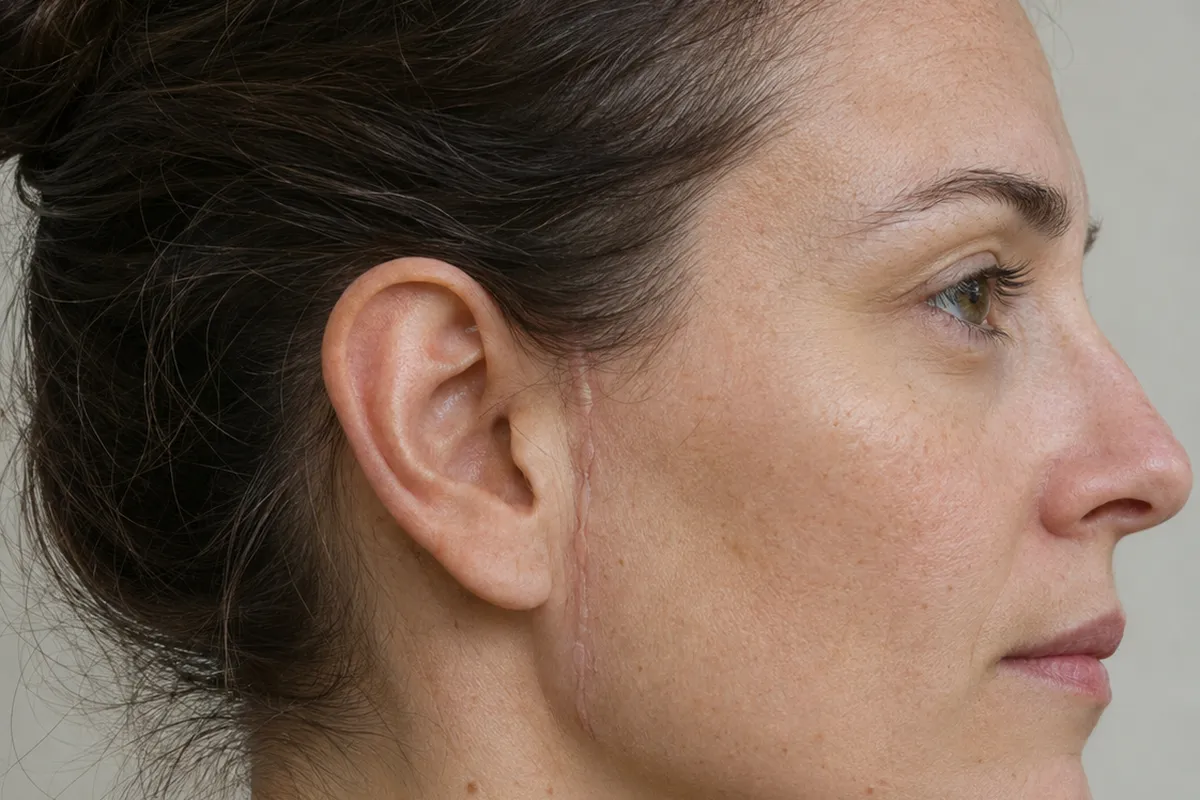
After surgery, a cut or an injury, a scar goes through several stages before reaching its final appearance. Understanding how it develops helps you recognise what is normal.
 Luxmed TeamAuthor
 Dr Michelle CampagnoliClinical review · OM no. 69467
In this article
After surgery, a cut or an injury, a scar goes through several stages before reaching its final appearance. During the first year, it is normal for it to become red, raised or firmer before improving. Understanding how a scar develops helps you recognise what is normal and when to seek advice.
Three ideas to remember.
The stages
| Stage | When | What you see |
|---|---|---|
| Inflammation | First few days | Redness, swelling |
| Proliferation | Weeks 1 to 6 | Pink scar, sometimes raised |
| Remodelling | Months 2 to 18 | The scar gradually becomes flatter, paler and softer |
What helps
International recommendations on scar management include (Gold et al., 2014):
- Silicone gel or sheets as a first-line measure, once the skin has closed.
- Strict sun protection to prevent darkening.
- Gentle massage, in some cases.
- Avoiding tension on the scar.
When to seek help
- A scar that becomes increasingly raised, hard or intensely itchy.
- A scar that extends beyond the boundaries of the wound.
- A scar that contracts and restricts movement.
- Pronounced colour changes.
In these cases, early treatment generally produces better outcomes.
At Luxmed Clinic
At Clínica Luxmed, we monitor facial scars throughout maturation and intervene when they are not developing as expected.
Talk to us
The assessment is a conversation, with no obligation. Tell us what concerns you and our team will reply.
This article is for information purposes and does not replace a consultation. The results of any treatment vary from person to person.
Frequently asked questions
When will the scar reach its final appearance?
Generally after 12 to 18 months.
Can I expose it to the sun?
You should protect the scar from the sun for at least a year.
Do scar creams work?
Silicone has the best evidence. There is less evidence for other products.
Is itching normal?
It is common during the first few months. If it is intense, it should be assessed.
Scientific references 2
- Gold MH, Berman B, Clementoni MT, Gauglitz GG, Nahai F, Murcia C. Updated international clinical recommendations on scar management: part 1, evaluating the evidence. Dermatol Surg. 2014;40(8):817-824. doi:10.1111/dsu.0000000000000049 Guideline
- Gold MH, McGuire M, Mustoe TA, et al. Updated international clinical recommendations on scar management: part 2, algorithms for scar prevention and treatment. Dermatol Surg. 2014;40(8):825-831. doi:10.1111/dsu.0000000000000050 Guideline
Editing and development: Rúben Brito · Operial Development
Keep exploring