


- Home
- Hair medicine
- Stress-related hair loss
- How to lower stress
How to lower stress without effort
Slow breathing, walking, being outdoors: simple, evidence-based strategies to lower stress in a few minutes a day.
 Rúben BritoAuthor
 Dr Michelle CampagnoliClinical review · OM no. 69467
In this article
When you are under stress, the last thing you want is a to-do list to reduce it. That is why this guide brings together only strategies that take little time and little effort, and that have scientific evidence: breathing more slowly for a few minutes, walking, spending time outdoors, protecting your sleep, talking to someone.
None of them makes problems disappear. But, added together, they help the body come out of "alert mode" and reduce the impact of chronic stress on health, including on the skin and hair. In meta-analyses, the effects are moderate and consistent, and the best result comes from repeating them every day.
At the end, we also explain when stress stops being something to deal with on your own and needs professional help.
Three ideas to remember.
Fica por baixo do resumo, se existir uma segunda foto.
Acute and chronic stress
Stress is a normal, useful response. When faced with a challenge, the body releases adrenaline and cortisol: the heart speeds up, the muscles get ready, attention increases. When the challenge passes, everything returns to normal.
The problem arises when the alert does not switch off:
| Feature | Acute stress | Chronic stress |
|---|---|---|
| Duration | Minutes to days | Weeks to months |
| Examples | A presentation, an exam, a fright | Overwork, financial difficulties, caring for someone who is ill, persistent conflicts |
| Effect | Mobilises energy, then recovers | Keeps the body on alert, with no time to recover |
| Signs | Racing heart, sweaty palms, tension | Tiredness, insomnia, irritability, muscle pain, difficulty concentrating |
Why it matters
Chronic stress is associated with poorer sleep, more anxiety and depression, higher blood pressure and poorer eating habits. On the skin and hair:
- intense events can trigger diffuse hair loss 2 to 4 months later (telogen effluvium);
- stress is cited as a trigger of alopecia areata and of flare-ups of skin conditions such as rosacea, psoriasis or atopic dermatitis;
- in mice, the stress hormone put hair follicles into a "pause" (Choi et al., 2021).
We explain this link in Stress and hair loss: what is known.
Seven low-effort, evidence-based strategies
1. Slow down your breathing
It is the quickest and is always available. A meta-analysis of randomised trials found small to moderate reductions in stress, anxiety and depressive symptoms with breathing exercises, compared with control groups (Fincham et al., 2023). The studies have limitations, but the risk is minimal.
How to do it:
- breathe in through your nose for about 4 seconds;
- breathe out slowly, through your mouth or nose, for about 6 seconds;
- repeat for 3 to 5 minutes.
Breathing out for longer than breathing in helps activate the part of the nervous system that calms the body. If you feel dizzy, slow down and breathe normally.
2. Walking
A review of 97 systematic reviews, with more than 1,000 trials and 128,000 participants, concluded that physical activity reduces symptoms of depression, anxiety and psychological distress. All types helped, including walking, and programmes of up to 12 weeks were the most effective (Singh et al., 2023).
Low effort: a 10-minute walk after lunch, getting off the bus one stop earlier, making calls while walking, taking the stairs.
3. Spending time outdoors
In a study of almost 20,000 people in England, those who spent at least 120 minutes a week in natural spaces, such as parks, gardens, beaches or woods, reported better health and wellbeing. It did not matter whether it was two hours in one go or several short outings (White et al., 2019). It is an association, not proof of cause, but it is easy to try.
Low effort: about 20 minutes a day, or two outings at the weekend. Combining walking with nature adds two benefits together.
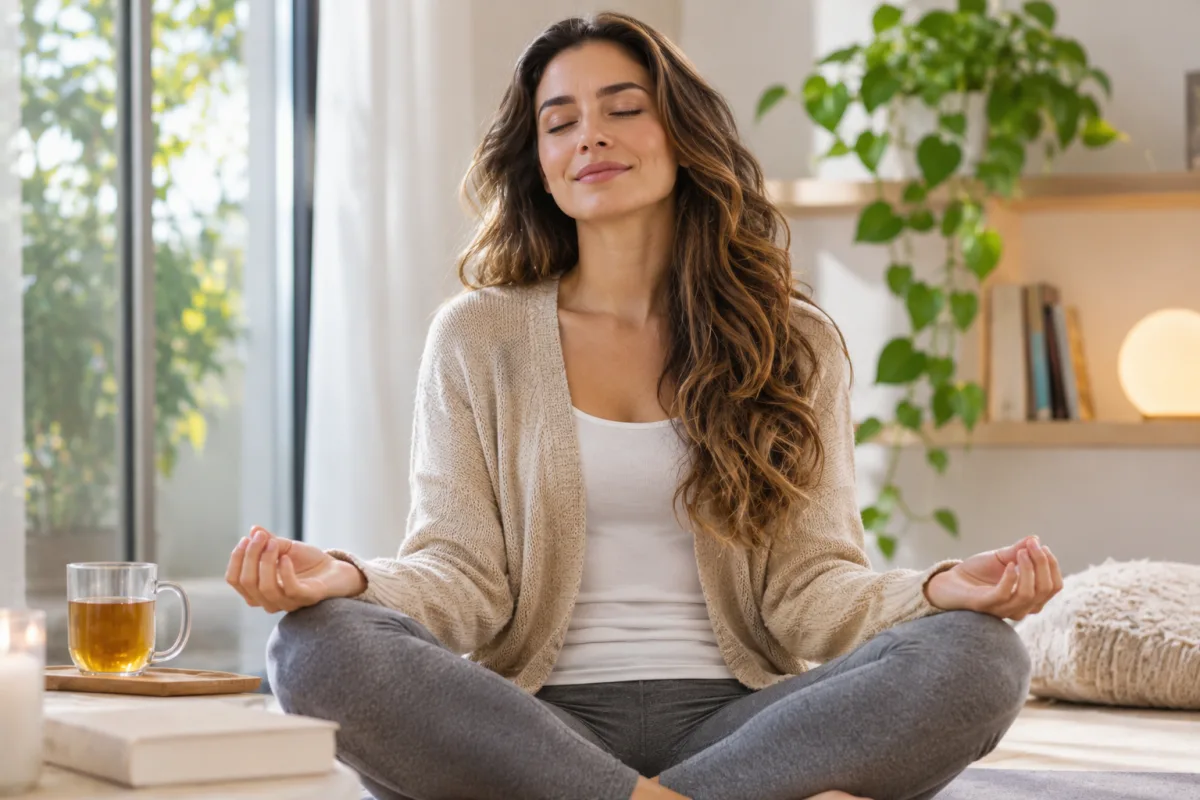
4. Meditation and mindfulness
A meta-analysis of 47 trials, published in JAMA Internal Medicine, found moderate evidence that mindfulness meditation programmes reduce anxiety, depression and pain, with effects similar to those of other behavioural interventions (Goyal et al., 2014).
Low effort: 5 to 10 minutes a day, with an app or a guided audio. Or an informal version: paying full attention to a simple activity, such as having a coffee, washing the dishes or walking.
5. Protecting your sleep
Sleep and stress feed each other. Regular schedules, natural light in the morning, less caffeine in the afternoon and fewer screens before bed are the simplest steps. For people with persistent insomnia, the recommended treatment is cognitive behavioural therapy for insomnia (Riemann et al., 2023). See Sleep and hair: what rest changes.
6. Talking to someone
Social support is one of the most consistent protective factors against the effects of stress. A long conversation is not needed: a 5-minute call to someone you trust, a coffee with a colleague, a message to a friend.
7. Short breaks through the day
Stress builds up when there are no moments of recovery. Breaks of 2 to 5 minutes, away from the screen, every hour or hour and a half of work help break the cycle: stand up, stretch, drink water, look out of the window.
What about music?
Listening to calm music is a popular, risk-free strategy. Studies suggest some benefit in reducing anxiety in specific situations, but the evidence for everyday stress is less robust. If it helps, use it.
A lower-stress day, in micro-habits
You do not need to do everything. Choose two or three and repeat them for a few weeks.
| Moment | Micro-habit | Time |
|---|---|---|
| On waking | Open the windows and get natural light; do not pick up your phone in the first few minutes | 5 min |
| Breakfast | Eat sitting down, with protein, without screens | 10 min |
| Commute | Get off one stop earlier or park further away | 10 min |
| Mid-morning | A break away from the screen, with slow breathing | 3 min |
| Lunch | A short walk, preferably outdoors | 10 min |
| Mid-afternoon | A message or call to someone close; last coffee of the day | 5 min |
| End of work | Write down tomorrow's tasks to "close" the day | 3 min |
| Evening | Guided meditation or reading; screens away in the last hour | 10 min |
| At bedtime | Regular time; dark, cool bedroom | Every day |
At the weekend: a longer walk in a garden, on the beach or in the countryside, ideally with company.
What seems to help but doesn't
When stress needs professional help
The strategies in this guide help with everyday stress, but they do not replace specialist help. Seek support from your family doctor or a psychologist if:
- stress, anxiety or sadness have lasted more than two weeks and affect your work, relationships or sleep;
- you have panic attacks, constant worry or difficulty controlling your thoughts;
- you have lost interest in things you used to enjoy;
- you use alcohol, medication or other substances to cope;
- you have persistent physical symptoms with no explanation.
In Portugal, the SNS 24 line (808 24 24 24) offers psychological counselling. Psychotherapy, in particular cognitive behavioural therapy, has good evidence in anxiety and chronic stress.
If you have thoughts of harming yourself, seek help immediately: call 112 or go to the emergency department.
Stress, skin and hair
Skin and hair are often where stress becomes visible. If you came to this article because of that, these guides may help:
- Stress and hair loss: what is known: what the studies show and why the loss appears months later;
- Sleep and hair: what rest changes: sleep, melatonin and night-time care;
- Hair loss: why it happens and what to do: the main causes and treatments;
- Rosacea: what it is, causes and treatments: emotional stress is one of the most commonly reported triggers;
- Diet and hair loss: what the hair needs when you eat irregularly.
Reducing stress does not immediately stop hair loss that has already begun, because the hairs that will fall entered a resting phase months earlier. But it reduces new episodes and helps recovery.
When to seek an assessment at Luxmed
At Luxmed, the Hair Medicine consultation assesses the cause of the hair loss with trichoscopy and, when indicated, blood tests, and sets out a plan that takes stress, sleep and diet into account.
Talk to us
The assessment is a conversation, with no obligation. Tell us what concerns you and our team will reply.
Telephone 214 044 241 · info@luxmed.pt
This article is for information only and does not replace a medical or psychological consultation.
Frequently asked questions
What is the fastest way to lower stress?
Slow breathing, with the out-breath longer than the in-breath, for 3 to 5 minutes. It is always available and has evidence of benefit.
How much exercise do I need to notice a difference?
There is no magic minimum. Regular walks already help, and programmes lasting a few weeks have shown clear effects on anxiety and psychological distress.
Does meditating for just 5 minutes work?
A little time, but every day, is better than long, irregular sessions. The studies used programmes lasting several weeks.
Can stress make hair fall out?
Yes. Intense events can trigger diffuse hair loss 2 to 4 months later, and stress is cited as a trigger of alopecia areata. See Stress and hair loss.
Do "anti-stress" supplements work?
The evidence for most of them is weak. Some interact with medication. Talk to your doctor before taking them.
When should I see a psychologist?
When stress, anxiety or sadness last more than two weeks and affect daily life, or when you feel that simple strategies are no longer enough.
I have little time. Where do I start?
Choose one habit: for example, 3 minutes of slow breathing after lunch, or a 10-minute walk. Repeat it for two weeks before adding another.
Scientific references 6
- Fincham GW, Strauss C, Montero-Marin J, Cavanagh K. Effect of breathwork on stress and mental health: a meta-analysis of randomised-controlled trials. Sci Rep. 2023;13:432. Artigo
- Singh B, Olds T, Curtis R et al. Effectiveness of physical activity interventions for improving depression, anxiety and distress: an overview of systematic reviews. Br J Sports Med. 2023;57(18):1203-1209. Artigo
- White MP, Alcock I, Grellier J et al. Spending at least 120 minutes a week in nature is associated with good health and wellbeing. Sci Rep. 2019;9:7730. Artigo
- Goyal M, Singh S, Sibinga EM et al. Meditation programs for psychological stress and well-being: a systematic review and meta-analysis. JAMA Intern Med. 2014;174(3):357-368. PubMed
- Riemann D et al. The European Insomnia Guideline: an update on the diagnosis and treatment of insomnia 2023. J Sleep Res. 2023;32(6):e14035. Artigo
- Choi S et al. Corticosterone inhibits GAS6 to govern hair follicle stem-cell quiescence. Nature. 2021;592(7854):428-432. Registo
Keep exploring