


- Home
- Hair medicine
- Thinning hair at the crown
- Seeing the crown
How to see your crown: the two-mirror method
How to see your crown properly, always in the same way: the two-mirror method, alternatives with a phone, what to look for and the light and angle errors that mislead.
 Rúben BritoAuthor
 Dr Michelle CampagnoliClinical review · OM no. 69467
In this article
The crown, the area at the top of the back of the head where the hair forms its whorl, is the part of the scalp we know least. We do not see it in the mirror, we do not see it in photographs taken from the front, and when someone shows us a photograph taken from above the shock is common: "Do I look like that?".
Often, the scare comes from the light and the angle, not from a real change. At other times, the crown really is getting thinner, and noticing early makes a difference. To find out, you need to see it properly, always in the same way.
Three ideas to remember.
Fica por baixo do resumo, se existir uma segunda foto.
Why the crown is hard to assess
- We do not see it directly. Only with mirrors, cameras or another person.
- The whorl deceives. At the point where the hair spirals, the hairs come out in different directions and it is normal to see a small circle of skin. Some people have two whorls.
- Light exaggerates. Strong light from above, as in lifts, bathrooms or flash photographs, makes the scalp shine and look more visible. Reviews of hair assessment methods stress that light, angle and hair preparation must always be the same for images to be comparable (Rubin et al., 2023).
- Wet hair deceives. Water clumps the hairs into strands and lets more skin show.
- The change is slow. Thinning of the crown, whether in male pattern baldness or female hair loss, advances over years, and memory does not keep a good "before picture".
That is why the best way to see your crown is not to look often, but to look well and always in the same way.
The two-mirror method
What you need
- A large wall mirror (for example, the bathroom one or a full-length mirror).
- A hand mirror, preferably large and without magnification.
- Diffuse natural light: near a window, in the daytime, without direct sun on your head.
- A fine comb.
Preparing the hair
- Hair washed the day before and dry, without volumising products, gel or fibres.
- Style your hair as usual, with the parting in the usual place.
- If your hair is long, leave it loose or make a central parting all the way to the crown.
Step by step
- Stand with your back to the large mirror, about 30 to 50 cm away.
- Hold the hand mirror in front of your face, slightly above eye level.
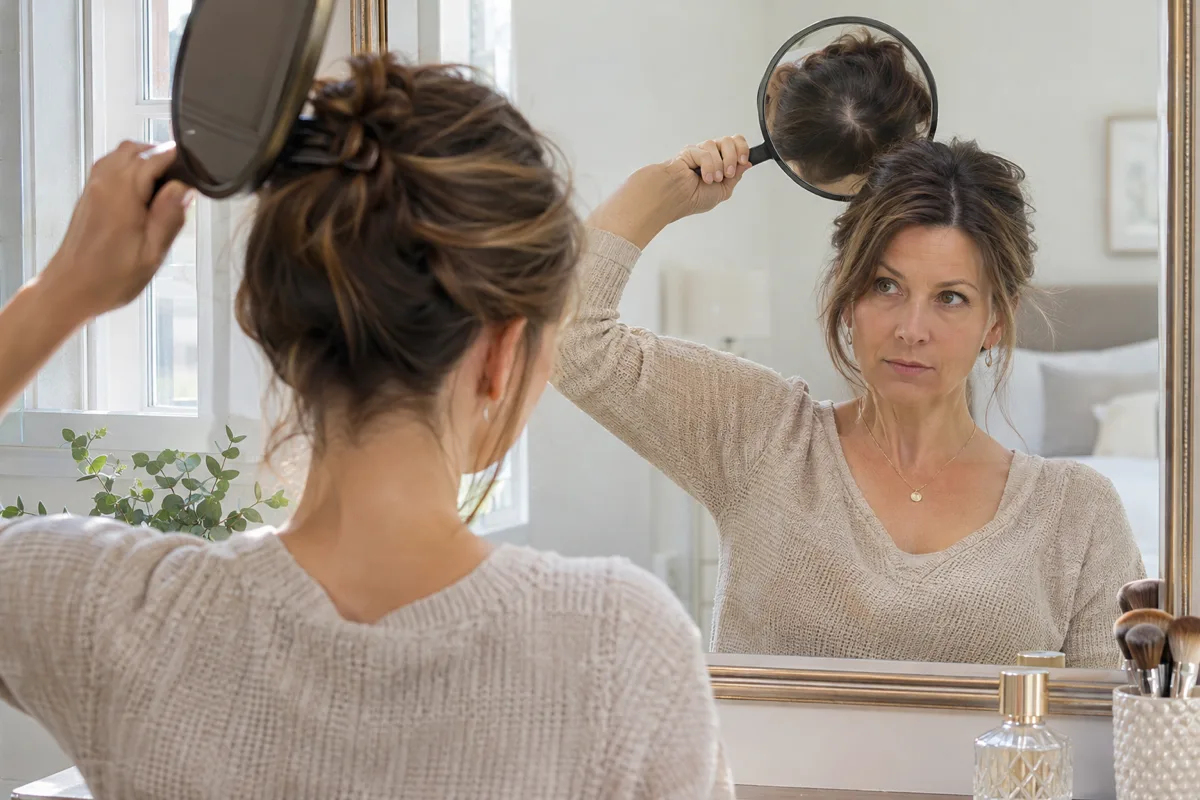
- Tilt the hand mirror until you see in it the reflection of the large mirror showing the back of your head.
- Lower your chin slightly so that the crown faces the large mirror.
- Adjust the angle until you see the whorl centred. Move the hand mirror, not your head.
- Observe calmly for a few seconds, without pulling or moving the hair aside.
- If you wish, part the hair with a comb in two or three parallel partings over the crown, to see the density and the skin.
So that it is comparable
- Same place, same light, same time of day.
- Same distance from the large mirror.
- Same hairstyle and hair in the same conditions.
The mirror method is great for looking in the moment, but the image is not saved. To compare over time, it is better to photograph.
Alternatives
Phone with a timer
- Use the rear camera, with a 3 to 10 second timer and burst mode, if you have it.
- Hold your phone above your head, with your arm stretched out, pointing downwards, or rest it on a higher shelf.
- Lower your chin slightly.
- Take several photographs and choose the one with the whorl centred.
- No flash and no zoom.
Video
Record a short video moving your phone slowly over your head, from front to back. Then pause on the frame that shows the crown best. It is easier than getting a single photograph right.
Help from someone
The simplest and most reliable way: ask someone to photograph your crown from above, standing, with the phone parallel to the head, about 30 to 40 cm away, with the person seated. Repeating with the same person always helps.
At the hairdresser or barber
Your hairdresser sees your crown regularly. Ask them to take a photograph, always at the same point in the cut, or to tell you if they notice differences.
For a complete protocol of photographs over time, see Photos every 3 months: how to track the crown.
What to look at
| What to look at | What is usual | What thinning can indicate |
|---|---|---|
| Whorl | Small circle or well-defined spiral, stable over the years | Larger visible area, diffuse, that increases over time |
| Density around | Same as at the sides and back of the head | Fewer hairs around the whorl than in other areas |
| Hair thickness | Hairs similar to those on the rest of the head | Many finer, shorter, paler hairs (miniaturisation) |
| Parting to the crown | Similar width along the whole parting | Parting wider on top and on the crown than at the back |
| Skin | Normal colour, no scaling | Redness, scaling, spots, crusts, smooth, shiny areas (deserve assessment) |
| Patches | None | Round, smooth patch with clear edges (may be alopecia areata) |
In men
Thinning of the crown is one of the typical signs of male pattern baldness and can appear before the temples. See Thinning crown: when it is worth assessing.
In women
Female hair loss mainly affects the top and the central parting, with the crown sometimes thinner as well. Thinning that starts in the centre of the top and widens in a circle, with itching or burning, may be a central scarring alopecia and should be assessed. See Female hair loss: what it is and how to recognise it.
Mistakes that mislead
- Looking in bathroom or lift light, coming from above.
- Looking with wet hair or freshly washed.
- Pulling the hair to the sides looking for skin: any scalp looks thin that way.
- Comparing a photograph with flash with one without flash.
- Comparing with photographs of other people or of when you were 18 with long hair.
- Checking every day. Changes are slow, and daily checking only feeds anxiety.
When to seek an assessment
See also Thinning crown: when it is worth seeing a doctor.
At Luxmed, the hair medicine consultation includes examination of the crown, trichoscopy compared with the back of the head and standardised photographs, which serve as a reference. You no longer have to guess in the mirror.
Talk to us
The assessment is a conversation, with no obligation. Tell us what concerns you and our team will reply.
Telephone 214 044 241 · info@luxmed.pt
This article is for information only and does not replace a medical consultation.
Frequently asked questions
Is it normal to see skin at the whorl?
Yes, a small circle is normal. The warning sign is if that area is growing and the hairs around it are thinner.
Why does the crown look worse in photographs with flash?
Flash and overhead light make the scalp shine and exaggerate visible skin. Use diffuse natural light.
How often should I check my crown?
To track it, every three months is enough. Checking every day does not help.
Does the method work for women?
Yes. In women, it is also worth observing the central parting from the top to the crown.
I have two whorls. Is that a problem?
No. It is a normal variation and can make it look as if there is more visible skin.
Can I use a magnifying glass or my phone's magnifier?
It can give an idea of hair thickness, but does not replace trichoscopy at a consultation.
Scientific references 4
- Rubin A, Shah RR, Khan S, Haroon A, Rao B. Imaging tools for noninvasive hair assessment. Cutis. 2023;112(1):E52-E57. doi:10.12788/cutis.0834 Artigo
- Canfield D. Photographic documentation of hair growth in androgenetic alopecia. Dermatol Clin. 1996;14(4):713-721. Artigo
- Norwood OT. Male pattern baldness: classification and incidence. South Med J. 1975;68(11):1359-1365. Artigo
- Ramos PM, Miot HA. Female pattern hair loss: a clinical and pathophysiological review. An Bras Dermatol. 2015;90(4):529-543. Artigo
Keep exploring