


- Home
- Hair medicine
- Thinning hair at the crown
- Thinning crown: seeing a doctor
Thinning crown: when it is worth seeing a doctor
When to wait and watch, when to book a consultation and when not to delay, and what happens at a hair medicine consultation, step by step.
 Rúben BritoAuthor
 Dr Michelle CampagnoliClinical review · OM no. 69467
In this article
Noticing that your crown is thinner almost always leads to the same question: is it too early to see a doctor? Is it worth it? Could it just be the light? Many people put it off for months or years, and others worry about something that is just the normal whorl.
This article helps to decide, for men and women: when it makes sense to wait and observe, when it is worth booking a consultation and when it should not be delayed. And it explains, step by step, what happens at a hair medicine consultation and how to get the most out of it.
Three ideas to remember.
Fica por baixo do resumo, se existir uma segunda foto.
Wait, consult or do not delay?
| Condition | What to do |
|---|---|
| The crown looked thinner in a photograph with flash or overhead light; in the standardised photographs it is the same | Observe. Take photographs every three months. See Photographs every 3 months |
| Small circle of skin at the whorl, always the same | Observe. It is probably the normal whorl |
| Intense diffuse hair loss, 2 to 3 months after childbirth, illness, diet or stress | Observe for 3 to 6 months (probable effluvium); seek advice if it is very heavy or does not slow down |
| The crown is more open in photographs over 6 to 12 months | Seek advice |
| Thinner, shorter hairs around the whorl | Seek advice |
| Family history of baldness or female hair loss and first signs | Seek advice (acting early gives better results) |
| Temples and crown receding at the same time, or the parting widening | Seek advice |
| Itching, burning, pain, tenderness to touch on the crown | Do not delay |
| Redness, scaling, spots or crusts | Do not delay |
| Smooth, shiny areas, no visible pores | Do not delay |
| Round patch, appearing quickly | Do not delay |
| Rapid hair loss, over weeks | Do not delay |
When scalp symptoms accompany thinning, speed is justified: some alopecias destroy the follicles and lost hair does not grow back. Early treatment can halt that loss.
Why does the crown get thinner?
| Cause | More common in | Clues | Reversible? |
|---|---|---|---|
| Male pattern baldness | Men | Crown and temples; miniaturised hairs; family history. See Thinning crown: when it is worth assessing | It can be halted with treatment |
| Female hair loss | Women | Top and central parting, sometimes crown; front hairline preserved. See Female hair loss: what it is and how to recognise it | It can be halted with treatment |
| Telogen effluvium | Both | Diffuse hair loss across the whole scalp, 2 to 3 months after a trigger | Yes, in 6 to 12 months |
| Hair ageing | Both, after the age of 50 to 60 | Diffuse, uniform thinning. See Thinner hair with age: what is normal | No, but it is slow |
| Alopecia areata | Both | Round, smooth patch, rapid onset. See Alopecia areata: what it is and how to recognise it | Often, yes |
| Central centrifugal cicatricial alopecia | Mainly women of African descent | It starts in the centre of the top of the head and widens in a circle; itching, burning, pain; broken hairs; later, smooth, shiny areas | No; early treatment halts it |
| Lichen planopilaris | Mainly middle-aged women | Redness and scaling around the follicles, itching, burning, irregular patches | Not in areas with scarring |
| Traction | Those who wear tight buns on top or wigs fixed at the crown | Relationship with the hairstyle; broken hairs | Yes, if caught early |
| Deficiencies, thyroid, medicines | Both | Diffuse hair loss, sometimes with other symptoms | Yes, once the cause is corrected |
Central centrifugal cicatricial alopecia
It deserves a special note because it is often mistaken for female hair loss. It is an alopecia that destroys the follicles, more common in women of African descent, which starts in the centre of the top of the head and widens in a circle. The first signs are broken hairs, itching, burning, pain or changes in sensation on the crown. There is a hereditary component in about a quarter of cases. Lost hair does not grow back, but early anti-inflammatory treatment can halt progression (Feschuk et al., 2024). That is why symptoms on the crown should never be ignored.
What happens at a hair medicine consultation
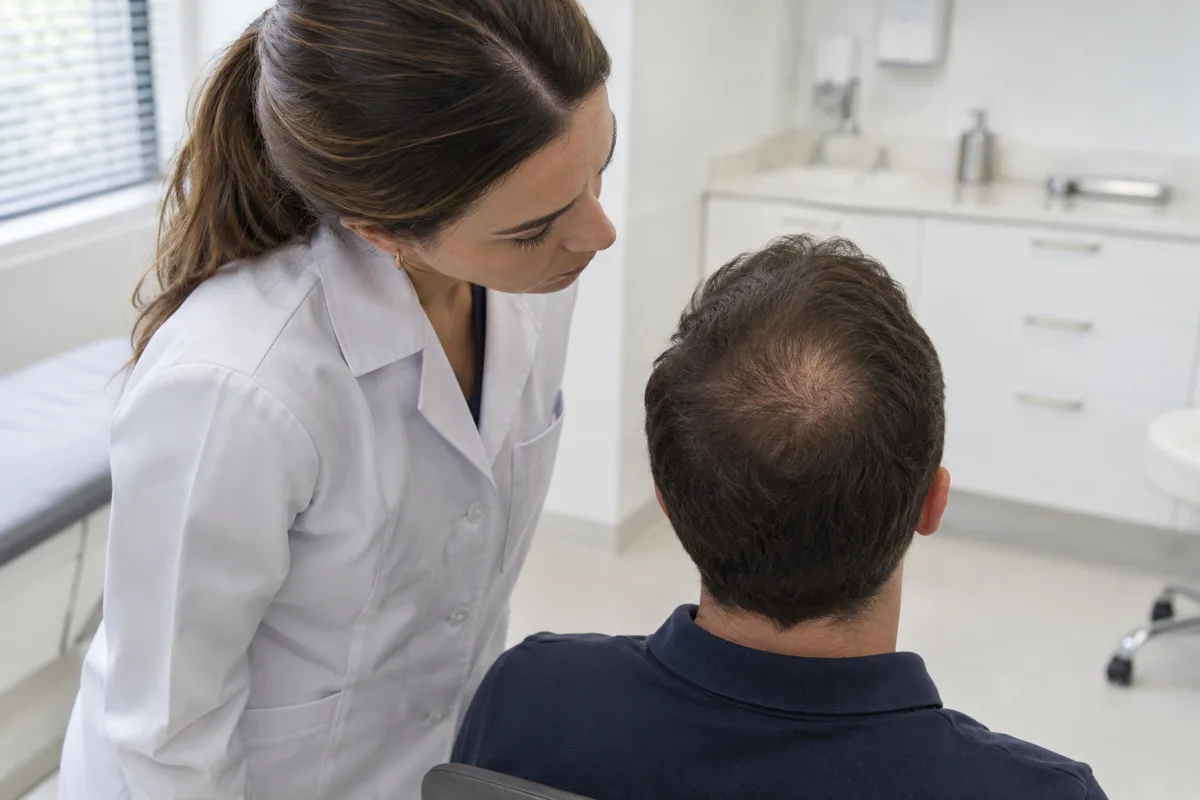
A consultation dedicated to hair loss usually follows these steps:
- Clinical history. When it started, how it has progressed, whether there is hair loss or just less volume, family history, illnesses, medicines and supplements, pregnancies and menstrual cycles, diet, stress, hairstyles and cosmetic treatments, scalp symptoms.
- Examination. The doctor examines the crown, top, parting, front hairline, sides, back, eyebrows, beard and nails. They may do the pull test, gently pulling a small lock of hair.
- Trichoscopy. Magnified examination of the scalp and hairs, in several areas. It shows miniaturisation, density, and signs of inflammation, scarring, alopecia areata or traction. Comparing the crown with the back of the head helps a great deal. See Trichoscopy: the examination that shows the scalp.
- Standardised photographs. To document the starting point and compare at later consultations.
- Blood tests, when indicated: full blood count, ferritin, thyroid, vitamin D and, in women with signs of excess androgens, a hormone work-up. See Blood tests for hair loss: what to ask for.
- Biopsy, in selected cases, especially when scarring alopecia is suspected.
- Diagnosis and plan. The doctor explains what was found, the options (including not treating), the benefits, the risks and the time until there are results.
- Follow-up. A further consultation, usually at six months, to compare with the baseline photographs.
How to prepare for the consultation
What to bring
- Photographs of the crown and top, preferably from several moments, and old photographs in which your hair can be seen.
- A list of medicines and supplements, including vitamins, the pill, hormone therapy, testosterone or anabolic steroids.
- Recent blood tests, if you have them.
- Family history: who in the family has thin hair, on which side, at what age it started.
- A simple timeline: when you noticed, whether there were triggers (birth, illness, surgery, diet, stress), treatments you have already tried.
On the day
- Come with hair washed the day before and dry, without products, fibres or sprays.
- If you can, do not colour your hair in the days beforehand.
- Use your usual hairstyle.
Questions you can ask
- What is the most likely cause? Is there more than one?
- Is it a reversible situation or is the aim to stabilise?
- What options do I have, and what happens if I do nothing?
- How long until I see results? How will we measure?
- Which adverse effects should I watch for?
- Do I need blood tests or other examinations?
- When should I come back?
Realistic expectations
- Diagnosis: in most people, the consultation makes it possible to reach a probable diagnosis the same day. In some, blood tests or a biopsy are needed.
- Androgenetic alopecia (male or female): it is chronic and progressive. The realistic aim is to halt progression and, in some people, to recover some volume. In men, the crown is the area that responds best. Results are assessed at 6 to 12 months and require maintenance.
- Telogen effluvium: usually recovers on its own in 6 to 12 months; the consultation serves to confirm it and look for correctable causes.
- Scarring alopecias: the aim is to stop the inflammation and stabilise; lost hair does not grow back. The earlier, the less is lost.
- Not treating is also an option when the cause is not dangerous. A good consultation should leave you informed enough to decide.
Be wary of promises of a "cure" or guaranteed results.
At Luxmed, the hair medicine consultation follows the steps described above, with trichoscopy and standardised photographs, and ends with a plan that is explained and decided with you.
Talk to us
The assessment is a conversation, with no obligation. Tell us what concerns you and our team will reply.
Telephone 214 044 241 · info@luxmed.pt
This article is for information purposes and does not replace a medical consultation. The results of any treatment vary from person to person.
Frequently asked questions
Is it too early to see a doctor?
If photographs show a change over months, no. In androgenetic alopecia, the earlier, the more hair there is to preserve.
Does the consultation hurt?
No. Examination and trichoscopy are not invasive. Only a biopsy, when needed, requires local anaesthesia.
Do I need blood tests first?
It is not compulsory. If you have recent test results, bring them. The doctor will request whichever are needed.
Should I wash my hair first?
Wash the day before and come without products, fibres or sprays.
Is a thin crown in women different from in men?
It can be. In women, female hair loss mostly affects the top and the parting; thinning in the centre of the top with itching or burning may be a scarring alopecia and should be seen without delay.
How long does the consultation last?
It varies, but a full first consultation, with trichoscopy and photographs, takes longer than a follow-up consultation.
What if the doctor says it is normal?
Great: you now have a documented starting point to compare against in the future.
Scientific references 6
- Feschuk A, Palmer V, Valdebran M, Green M. Central centrifugal cicatricial alopecia: overview of disease and management. The Dermatologist. Fevereiro de 2024. HMP Global Learning Network. Artigo
- Kanti V, et al. Evidence-based (S3) guideline for the treatment of androgenetic alopecia in women and in men, short version. J Eur Acad Dermatol Venereol. 2018;32(1):11-22. Guideline
- Ramos PM, Miot HA. Female pattern hair loss: a clinical and pathophysiological review. An Bras Dermatol. 2015;90(4):529-543. Artigo
- Ho CH, Sood T, Zito PM. Androgenetic alopecia. In: StatPearls. 2024. Artigo
- Rudnicka L, Olszewska M, Rakowska A, Slowinska M. Trichoscopy update 2011. J Dermatol Case Rep. 2011;5(4):82-88. Artigo
- Rubin A, Shah RR, Khan S, Haroon A, Rao B. Imaging tools for noninvasive hair assessment. Cutis. 2023;112(1):E52-E57. Artigo
Keep exploring