


- Home
- Facial aesthetics
- Enlarged pores
- Enlarged pores
Enlarged pores: why they appear and whether they can close
Pores do not open and close, but they can become less visible. See why they become enlarged, what types there are and what helps at home and in the clinic.
 Luxmed TeamAuthor
 Dr Michelle CampagnoliClinical review · OM no. 69467
In this article
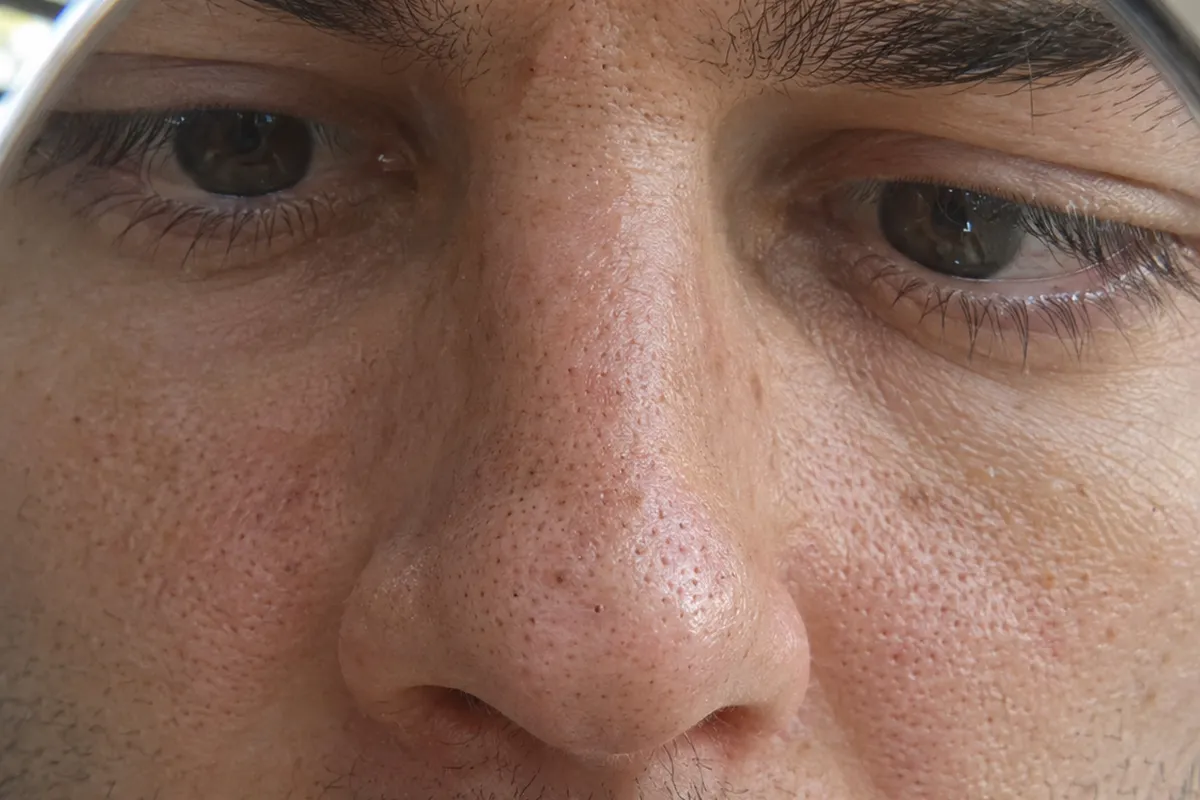
Pores are the openings of the hair follicles and sebaceous glands on the surface of the skin. Everyone has them. They become an aesthetic concern when they are visible to the naked eye, especially on the nose, cheeks and forehead, giving the skin an uneven appearance. The phrase ‘closing the pores’ is popular but not very accurate: pores do not open and close. What is possible is to make them less visible.
Three ideas to remember.
Why they become enlarged
A review of facial pores identified three main factors (Lee et al., 2016):
- High sebum productionOily skin has more active sebaceous glands and more visible pores.
- Loss of elasticity around the poreWith age and sun, the skin loses collagen and firmness, and pores become more open and elongated.
- Larger hair folliclesIn some people, the follicle itself is wider.
Other factors:
- Genetics, which determines skin type and pore size.
- Hormones, which influence sebum production.
- Acne, which dilates and may scar the area around the pores.
- Comedones and blackheads, which fill and stretch the pore.
- Sun, which degrades the collagen that supports the pore.
Types of enlarged pores
| Type | How to recognise it | Main cause |
|---|---|---|
| Oily pores | Round, on the nose and T-zone, with shine | Excess sebum |
| Pores due to laxity | Elongated, teardrop-shaped, on the cheeks | Loss of elasticity with age |
| Pores with comedones | Dark or with small bumps | Blocked follicle |
What helps at home
- Regular, gentle cleansing, without scrubbing hard.
- Salicylic acid, which penetrates the pore and helps unblock it.
- Retinoids, which regulate skin renewal, reduce comedones and improve firmness over time.
- Sunscreen daily, to protect collagen.
- Non-comedogenic moisturiser, even on oily skin.
What is done in the clinic
- Chemical peels, especially with salicylic or glycolic acid, which unblock and renew the surface (Soleymani et al., 2018).
- Microneedling, which stimulates collagen around the pore (Alster and Graham, 2018).
- Microneedling radiofrequency, which combines microneedling and heat at depth, with an effect on firmness and sebum production. There is a dedicated article: Microneedling radiofrequency for pores: what to expect.
- Laser, in selected cases.
A 2023 review of treatments for facial pores concluded that repeated sessions and combinations of treatments reduce the area and number of visible pores. In younger people, the priority is to control sebum; in older people, treatment of skin firmness is added (J Cosmet Dermatol, 2023).
Realistic expectations
Treatments make pores less visible, but do not eliminate them. In oily skin, results also depend on controlling sebum production in the long term. Maintenance is important.
At Luxmed Clinic
At Luxmed, we identify the type of pore before proposing treatment: oily, due to laxity or with comedones. Often, we combine cleansing, peels and microneedling or radiofrequency, with a simple routine at home.
Talk to us
The assessment is a conversation, with no obligation. Tell us what concerns you and our team will reply.
This article is for information purposes and does not replace a consultation. The results of any treatment vary from person to person.
Frequently asked questions
Does cold water close the pores?
No. It may give a temporary feeling of firmer skin, but it does not change the size of the pore.
Does squeezing blackheads help?
Generally, no. It may inflame and widen the pore. Extraction should be done by professionals.
Do primers solve it?
They disguise it temporarily, by filling the pore. They do not treat the cause.
Do pores get bigger with age?
Pores due to laxity do, because the skin loses elasticity. Oily ones tend to be more visible in adolescence and young adulthood.
How many sessions are needed?
Generally several, a few weeks apart. The number depends on the technique and the type of pore.
Scientific references 4
- Lee SJ, Seok J, Jeong SY, Park KY, Li K, Seo SJ. Facial pores: definition, causes, and treatment options. Dermatol Surg. 2016;42(3):277-285. doi:10.1097/DSS.0000000000000657 Artigo
- Soleymani T, Lanoue J, Rahman Z. A practical approach to chemical peels: a review of fundamentals and step-by-step algorithmic protocol for treatment. J Clin Aesthet Dermatol. 2018;11(8):21-28. Artigo
- Alster TS, Graham PM. Microneedling: a review and practical guide. Dermatol Surg. 2018;44(3):397-404. doi:10.1097/DSS.0000000000001248 Artigo
- The efficacy and adverse effects of treatment options for facial pores: a review article. J Cosmet Dermatol. 2023;22(3):763-775. doi:10.1111/jocd.15502. Artigo
Editing and development: Rúben Brito · Operial Development
Keep exploring