
Algés, Oeiras Mon to Fri · 09:00 to 13:00 and 14:00 to 19:00 · Sat · 09:00 to 14:00
WhatsApp Book a consultation

Facial aesthetics

Cheeks lacking volumeWhen the cheeks look flatter or hollow and the face has taken on a more tired look

The cheeks are the area that supports the rest of the face. When they lose volume, the cheek flattens or hollows, the eyes look more sunken, the line from the nose to the mouth deepens and the face takes on a tired look, even without any tiredness. In many cases it is normal ageing, which affects bone, fat and skin; in others, it is the structure you were born with, weight loss or, more rarely, a medical cause that should not be missed. Here we explain what is usually behind it, what a hyaluronic acid filler, a collagen biostimulator or PRF can (and cannot) do, what risks fillers carry and when urgent medical help is needed, at Clínica Luxmed, in Algés.

Reviewed by Dr Michelle Campagnoli, clinical director

  • 3options the clinic may consider
  • 1assessment, always first
  • Nocommitment
Woman facing forwards by a window, with flat cheekbones and little volume

How to recognise it

Is it loss of volume in the cheeks?

Not all cheeks “without volume” are the same: some have always been flat, others have lost volume with the years or after weight loss. These signs help you understand what is going on before the assessment.

Tick what you recognise0/7

Tick the signs you recognise in your case. This is not a diagnosis, it is only meant to give you an idea.

Have you noticed that only one side of the face has sunk, and that the process was progressive or rapid? Have you lost weight without trying, or do you have tiredness, fever or other complaints? Has a patch, a lump or a hard area appeared on the cheek? You need a medical assessment before any treatment. If you have already had a filler and have severe pain, skin that is pale, dark or has purplish patches, a change in vision, a severe headache or weakness on one side of the face, it is an emergency: call 112 straight away and tell the clinic that injected it. Out of hours, for other doubts, call SNS 24: 808 24 24 24.

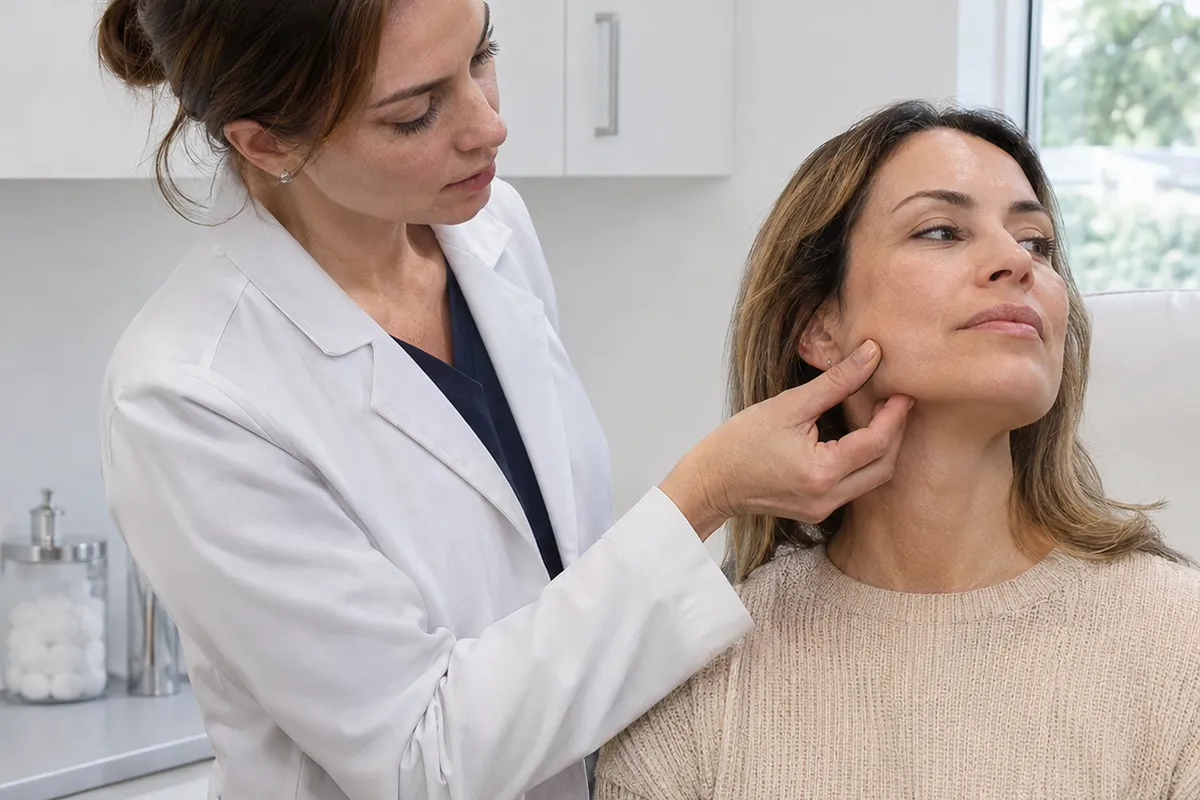
Doctor standing beside a seated patient, with her hand on the patient's jawline
Photograph of a consultation. The dots mark what the doctor is assessing.

Why it happens

What may be behind cheeks without volume

There is almost always more than one cause at the same time. Choose a situation to see how it may contribute and what usually helps.

Age and the structure of the face

With the years, the bone of the face is slightly reabsorbed, the fat that filled the cheek descends and is redistributed, and the skin loses elasticity. A review on ageing of the middle third describes the descent of the fat compartments, which deepens the dark circle and the line from the nose to the mouth, although studies do not always agree with one another. The result is a cheek that is less full and more sagging.

What weighs on it

Expecting a single treatment to solve a process that is of the bone, fat and skin at the same time.

What helps

Understanding that volume is only part of the change, and assessing the face as a whole before choosing what to do.


Normal or to be assessed

Ordinary loss of volume or something to be assessed

Most cheeks “without volume” have a simple cause. But there are situations that call for an assessment before any treatment, because the face is only the visible part.

  • How it looks. Less full cheeks on both sides, gradually, with a more marked fold and dark circle, or a face that has always had flat cheeks.

  • When it is noticed. In overhead light, in profile photographs and at the end of the day. Often only people who see you up close notice.

  • What the clinic does. The doctor listens to your history, examines the face from the front and in profile and explains, honestly, what can improve and what stays the same.

  • At home. Daily sun protection, stopping smoking, regular sleep, simple skincare and a stable weight, with realistic expectations.

Have you already had a filler and have severe pain, pale, dark or purplish skin, a change in vision, a severe headache or weakness in the face? Call 112 and tell the clinic that injected it. Only the clinic and the doctor can decide about hyaluronidase. For other concerns, out of hours, call SNS 24: 808 24 24 24.

Book an assessment

What the clinic may consider

Options for restoring volume in the cheeks

The first steps are the simplest: protecting the face from the sun, stopping smoking, sleeping well, looking after the skin and treating the medical cause, if there is one. Only then, and after an assessment, is a procedure considered. The clinic may consider hyaluronic acid, which restores volume immediately, and collagen biostimulators, which act more slowly. There is also PRF, made from the person’s own blood, which is used mainly to improve the texture and firmness of the skin and not to fill the cheek. The evidence is reasonable for hyaluronic acid in this area, more limited for biostimulators and more limited still for PRF. Results vary, are generally temporary and call for maintenance, and no treatment gives back the face you had in the past.

Book an assessment
Dr Michelle Campagnoli, clinical director of Clínica Luxmed

First step

Assessment consultation

The doctor listens to what you are experiencing, examines your case and explains the suitable options. No treatment begins without this consultation.

May be considered when

you want to understand the cause and decide on the best path, with time and without commitment.

Book an assessment
A doctor applying hyaluronic acid with a syringe to a patient’s face, in a consulting room with soft light

Immediate volume

Hyaluronic acid

An injectable gel that restores volume and redefines the contour of the cheek, with the advantage that it can be dissolved with hyaluronidase if necessary. The effects last from months to about two years, depending on the product and the person, and are not permanent. In the cheeks there is a risk of rare but serious vascular complications, so it requires a doctor with experience in facial anatomy.

May be considered when

the cheek has clearly lost volume, the cause has been assessed, the skin is healthy, there is no infection or pregnancy, and the doctor has explained the risks and what is realistic to expect.

Find out more
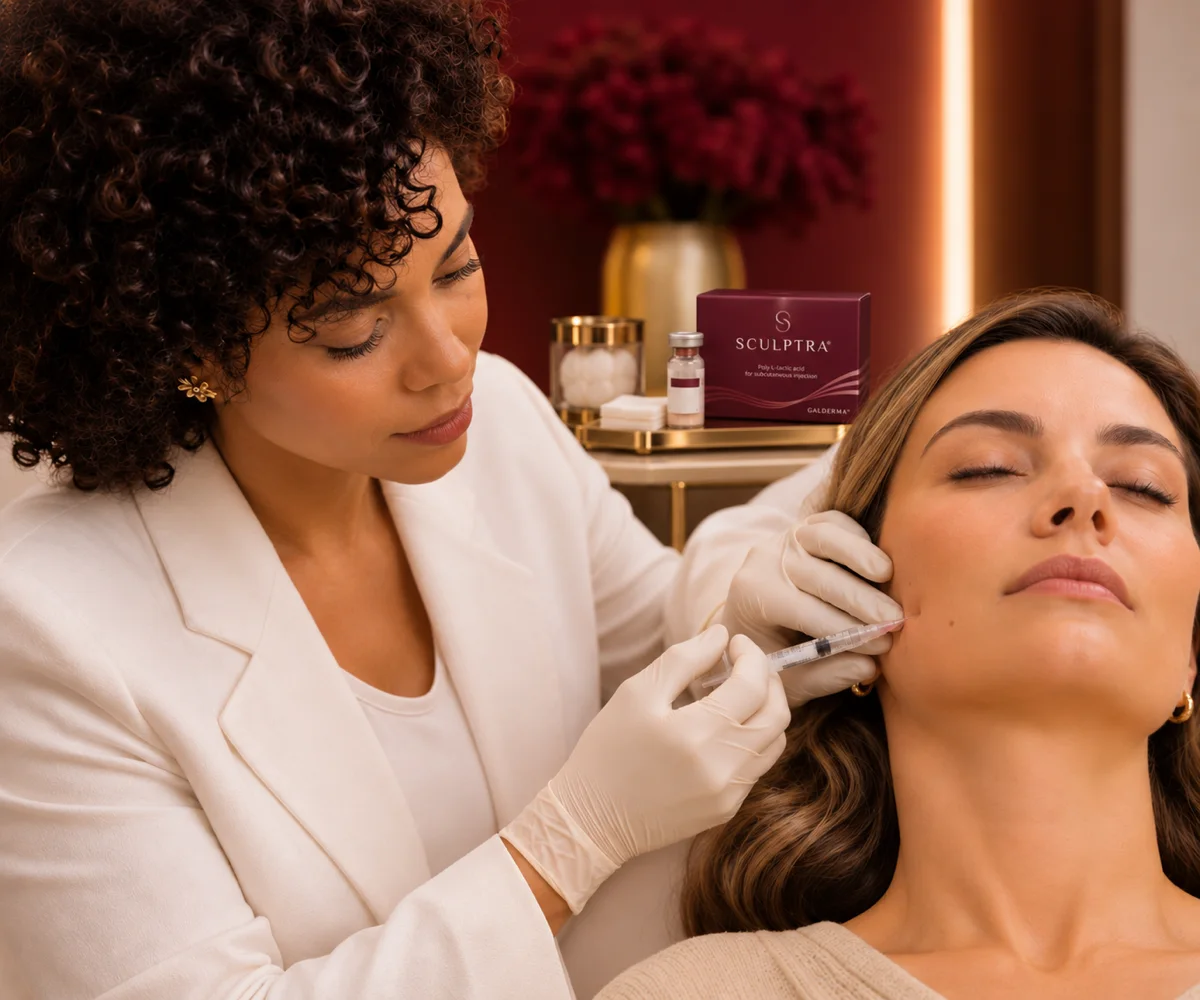
A doctor applying a collagen biostimulator near the contour of the face of a patient with her eyes closed

Firmness and contour

Collagen biostimulators

Injectables that stimulate the body to produce collagen progressively, improving the firmness and contour of the face over several sessions, with no immediate volume effect. The data are more limited than for hyaluronic acid, and the gain in volume measured in studies is small.

May be considered when

the skin and the support of the cheek are less firm, the loss of volume is mild to moderate, you have the patience to wait weeks or months, and expectations are moderate.

Find out more

What the journey looks like

From the first conversation to a plan tailored to you

No procedure begins without an assessment consultation with the doctor. Many people start with the simplest measures, and only then is anything more considered.

  1. 01At the clinic

    Telling your story

    The doctor asks what bothers you, since when you noticed the change, whether it was gradual or rapid, whether your weight, menopause or medicines have changed and which treatments you have already had on the face.

  2. 02At the clinic

    Examining the face

    The face is looked at from the front, in profile and at three-quarters, in different light, and the bone, fat, skin and symmetry are assessed. If there are signs of a medical cause, blood tests are requested or you are referred.

  3. 03At home

    Treat first what can be treated

    The face is protected from the sun, smoking is stopped, the skin and sleep are looked after and weight is stabilised. In some cases, this alone, with patience, already improves the overall appearance of the face.

  4. 04Over time

    Decide and follow up

    If it continues to bother you, the doctor explains the options, what can be expected, how long it lasts, the risks and maintenance, without promising results, and follows progress over time.

Day to day

What helps at home

What you do at home matters more than you might think. These measures are appropriate while you wait for your consultation and alongside the clinic’s treatment plan.

The golden rule

Protect what you still have, before restoring what you have lost

No treatment makes up for sun without protection, smoking and lack of sleep. Looking after the skin and habits protects what the face still has, and gives the doctor a better basis for deciding. And sinking on one side only, rapid or accompanied by other complaints, should be seen by a doctor before any filler.

Using sunscreen every day

Repeated sun accelerates the loss of elasticity and the tired look of the skin.

In practice: high-factor sunscreen on the face, in the morning, even in winter, reapplying if you are outdoors for a long time.

Stop smoking

Smoking reduces collagen and the quality of the skin of the face.

In practice: ask your doctor for support to stop smoking; your face will thank you, and so will the rest of your body.

Keeping a stable weight

Large weight swings empty and refill the face.

In practice: if you are losing weight, do so with supervision and wait for your weight to stabilise before thinking about treatments.

Record and bring to the consultation

It helps the doctor to see whether the change is recent, rapid or long-standing.

In practice: photographs from the front and in profile, from time to time, in the same light, and a list of medicines and treatments already carried out.

Dr Michelle Campagnoli, clinical director of Clínica Luxmed

Who will look after you

An assessment carried out by the doctor

At Luxmed, in Algés, the first step is always an assessment with Dr Michelle Campagnoli. She examines the face, works out whether the loss of volume is simple or whether there is a cause to be investigated, and works with you to decide what makes sense before any procedure.

  • Physical examination and medical historyA conversation about the change, weight, the menopause, medication and previous treatments, and an examination of the face from the front and in profile.
  • A plan tailored to youA clear plan, without promises, with the cause treated first and follow-up over time.
  • No obligationThe cost of any treatment is confirmed only after the assessment.
Book an assessment

Book a consultation

Book your consultation

Choose how you prefer to get in touch. We will arrange the assessment consultation with Dr Michelle Campagnoli.

Booking through the websiteAssessment consultationTalk to our assistant on WhatsApp and ask for the current price of the assessment.

New Life Miraflores, Algés · Office Center, R. Santa Teresa do Menino Jesus n.º 6, 9.º C, 1495-048

Your details are used only for this contact. Any treatment depends on a prior medical assessment.

Request an appointmentIt takes less than a minute.
Speciality
You do not need to go into detail. The doctor will talk to you during the consultation.
Request received. Our team will contact you as soon as possible.
How can I restore the volume of my cheeks?

It depends on the cause. First, habits and skin are addressed: daily sunscreen, stopping smoking, sleeping well and keeping a stable weight, and an assessment is made of whether there is a medical cause. If it continues to bother you, the clinic may consider a hyaluronic acid filler, which restores volume on the spot, a collagen biostimulator, which acts more slowly, or PRF, which is more related to skin quality. Results vary, are generally temporary and no treatment gives back the face you had before. The doctor explains at the consultation what makes sense in your case.

Why do the cheeks lose volume with age?

Because several things change at the same time: the bone of the face is slightly reabsorbed, the fat that filled the cheek descends and is redistributed, and the skin loses elasticity. A review on ageing of the middle third describes these changes, but notes that studies do not always agree. This is why the face looks more hollow and the cheek “falls” towards the line from the nose to the mouth, rather than simply “losing fat”.

I lost weight and my face looked hollow and older: is this normal?

It is common. The fat of the face follows that of the body in part, and the skin does not always retract at the same pace. It is best to wait for your weight to stabilise before thinking about a treatment and to confirm with your doctor that the weight loss is safe. If you lost weight without trying, or there is tiredness, fever or other complaints, a medical assessment comes first, before any filler.

Always had flat cheeks: what can be done?

When the volume was never there, there is no “loss”, but some people want more cheek projection. It is a personal decision. The doctor examines the face from the front and in profile, explains what a filler can and cannot change, and says frankly when the gain would be small or when it is better to do nothing. It is never obligatory to change a face that looks fine.

How long does a cheek filler last?

In a trial of 235 people treated with a hyaluronic acid filler, 79% rated their cheeks as improved at two years, but only 49% said they had reached their treatment goal by then. These are results reported by the people themselves and refer to one product, so they cannot be generalised. In practice, the effect lasts months to about two years, depending on the product, the area, the dose and each person’s metabolism, and eventually disappears.

How do collagen biostimulators work and when do results appear?

They stimulate the body to produce collagen, and so the effect is gradual, over weeks and months, and they generally call for several sessions. In a 3D analysis of a trial with a poly-L-lactic acid biostimulator, the increase in cheek projection was around 1 to 1.6 mm at nine months, in people with severe cheek wrinkles. A systematic review states that there are few quantifiable data and that more controlled studies are needed. They are better for firmness and contour than for filling.

Is PRF suitable for giving volume to the cheeks?

That is not its function. PRF is prepared from the person’s own blood and used to improve the texture and firmness of the skin. A systematic review of seven small studies, 130 people in total, reports improvements in texture and elasticity, but the data are limited and do not measure cheek volume. It can be considered as a complement, but does not replace a filler when what is lacking is volume.

What are the risks of a cheek filler?

The most common are swelling, bruising, tenderness and small nodules, most of them mild and temporary. Rarer, but serious, are vascular complications: if the product is injected into a blood vessel, there can be skin necrosis, changes in vision and, very rarely, loss of vision or stroke, as the FDA warns. For this reason the treatment should be carried out by a doctor with experience in facial anatomy, in a setting prepared to treat complications, and with hyaluronidase available when the product is hyaluronic acid.

What should I do if I have severe pain or a change in vision after filler treatment?

It is an emergency. If, during or after a filler, you have severe pain, skin that is pale, dark or has purplish patches, a change in vision, a severe headache or weakness on one side of the face, call 112 straight away and contact the clinic that injected it immediately. Do not wait for it to pass, do not massage the area or take medication on your own. Hyaluronidase, which dissolves hyaluronic acid, should only be used by a doctor. For less serious doubts out of hours, you can call SNS 24: 808 24 24 24.

When should I see a doctor first?

Book a consultation before any treatment if only one side of the face has sunk, if the change was rapid or progressive, if you have lost weight without trying, if there is tiredness, fever or other complaints, or if you have noticed a patch, a lump or a hard area on the cheek. If you are pregnant or breastfeeding, you should also speak to your doctor first. If in doubt, out of hours call SNS 24 (808 24 24 24). If there are signs of a complication after a filler, call 112.

We could not find that question. Ask us on WhatsApp

Scientific references

This page is based on the sources below and was reviewed by Dr. Michelle Campagnoli. Last updated on .

  1. Coleman SR, Grover R. The anatomy of the aging face: volume loss and changes in 3-dimensional topography. Aesthet Surg J, 2006.
  2. Ugradar S, Kim JS, Massry G. A review of midface aging. Ophthalmic Plast Reconstr Surg, 2023.
  3. Few J, Cox SE, Paradkar-Mitragotri D, Murphy DK. A multicenter, single-blind randomized, controlled study of a volumizing hyaluronic acid filler for midface volume deficit: patient-reported outcomes at 2 years. Aesthet Surg J, 2015.
  4. Elrosasy A, Abo Zeid M, Hindawi MD, et al. Efficacy and safety of different hyaluronic acid fillers on cheek volume augmentation: systematic review and network meta-analysis. Arch Dermatol Res, 2024.
  5. Beleznay K, Carruthers JDA, Humphrey S, Carruthers A, Jones D. Update on avoiding and treating blindness from fillers: a recent review of the world literature. Aesthet Surg J, 2019.
  6. U.S. Food and Drug Administration (FDA). Dermal fillers (soft tissue fillers). fda.gov, 2026.
  7. Fabi SG, Le JHTD, Prygova I, Bråsäter D. Midface projection using biostimulatory poly-L-lactic acid injectable implant: a subgroup analysis of the cheek wrinkle trial. Dermatol Surg, 2024.
  8. Fisher SM, Borab Z, Weir D, Rohrich RJ. The emerging role of biostimulators as an adjunct in facial rejuvenation: a systematic review. J Plast Reconstr Aesthet Surg, 2024.
  9. Mohale SA, Thakare PV, Gaurkar SS, Bharadia G, Acharya S. Effectiveness of injectable platelet-rich fibrin therapy in alopecia and facial rejuvenation: a systematic review. Cureus, 2024.
CallAssistantAvailableBook