Algés, Oeiras Mon to Fri · 09:00 to 13:00 and 14:00 to 19:00 · Sat · 09:00 to 14:00
WhatsApp Book a consultation

Body aesthetics

Adhesions and a stuck scarWhen the scar from a surgery pulls, sticks or dimples and you want to understand what is going on beneath the skin

After surgery, the body closes the wound with scar tissue. In most cases this tissue settles well, but sometimes it joins layers that should slide over one another. On the surface, the skin becomes stuck to the planes beneath, pulls when you move and may form a dimple or a fold. This is the adherent scar, and it is the one this page deals with. Adhesions that form inside the abdomen are a different situation, which surgery assesses and not aesthetics. Here we explain how to tell the two apart, what is usually behind a stuck scar, what you can do yourself and what Clínica Luxmed, in Algés, may consider after a medical assessment.

Reviewed by Dr Michelle Campagnoli, clinical director

  • 2procedures for this topic
  • 1assessment, always first
  • Nocommitment
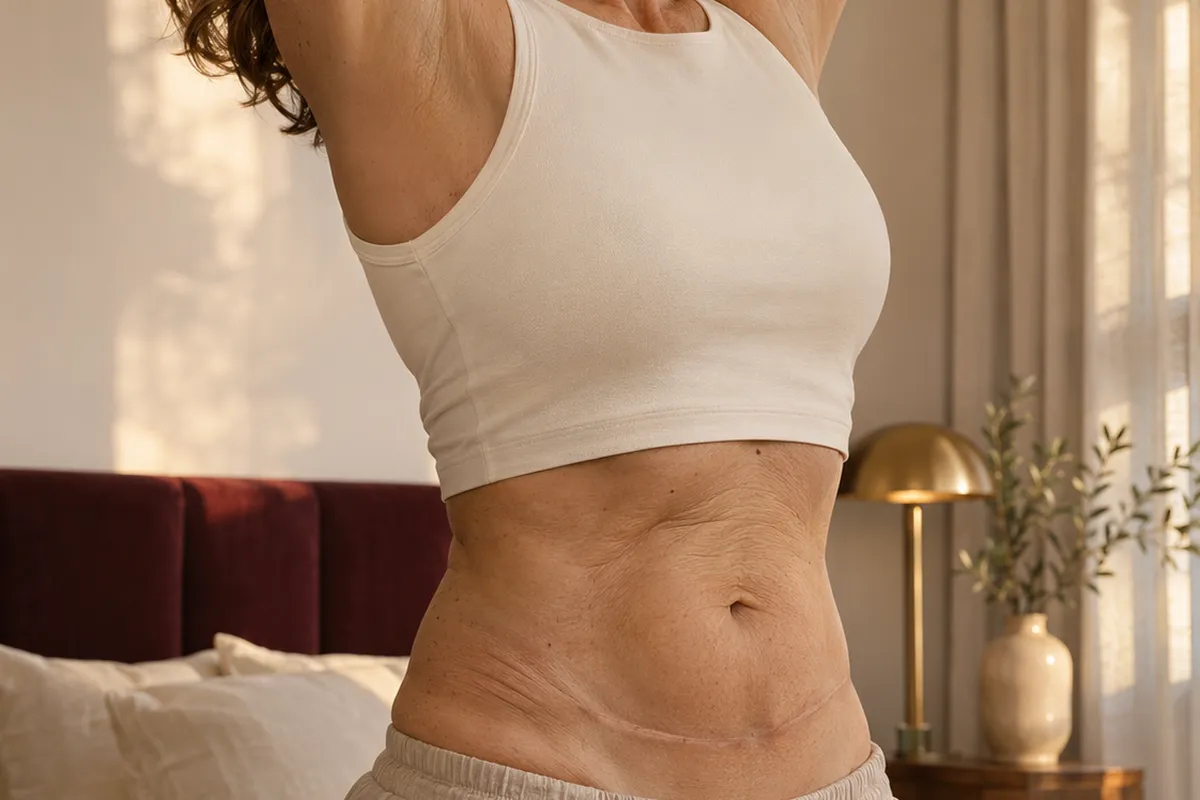
Woman stretching her torso with her arms raised, with a scar on her abdomen

How to recognise it

Is it a stuck or adherent scar?

A stuck scar is noticed more in movement than to the eye. These signs help to understand whether that is what you feel, before the assessment with the doctor.

Tick what you recognise0/7

Tick the signs you recognise in your case. This is not a diagnosis, it is only meant to give you an idea.

Do you have severe abdominal pain, vomiting, a distended abdomen and have stopped passing gas or stools? Call 112 immediately. Is the scar hot, swollen, red or painful, does it discharge pus, or do you have a fever? Has the wound not yet fully closed? Is the scar growing beyond the line of the surgery, opening or bleeding? It needs a medical assessment before any treatment. Out of hours, call SNS 24: 808 24 24 24.

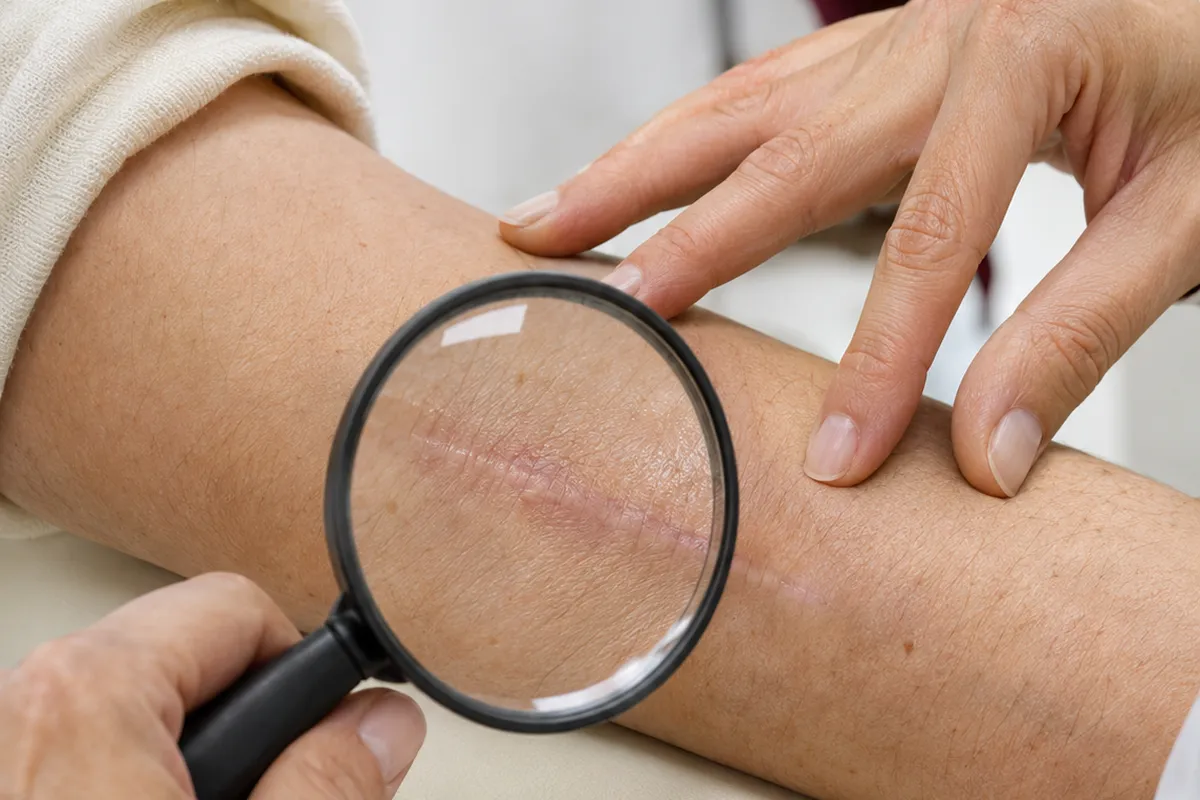
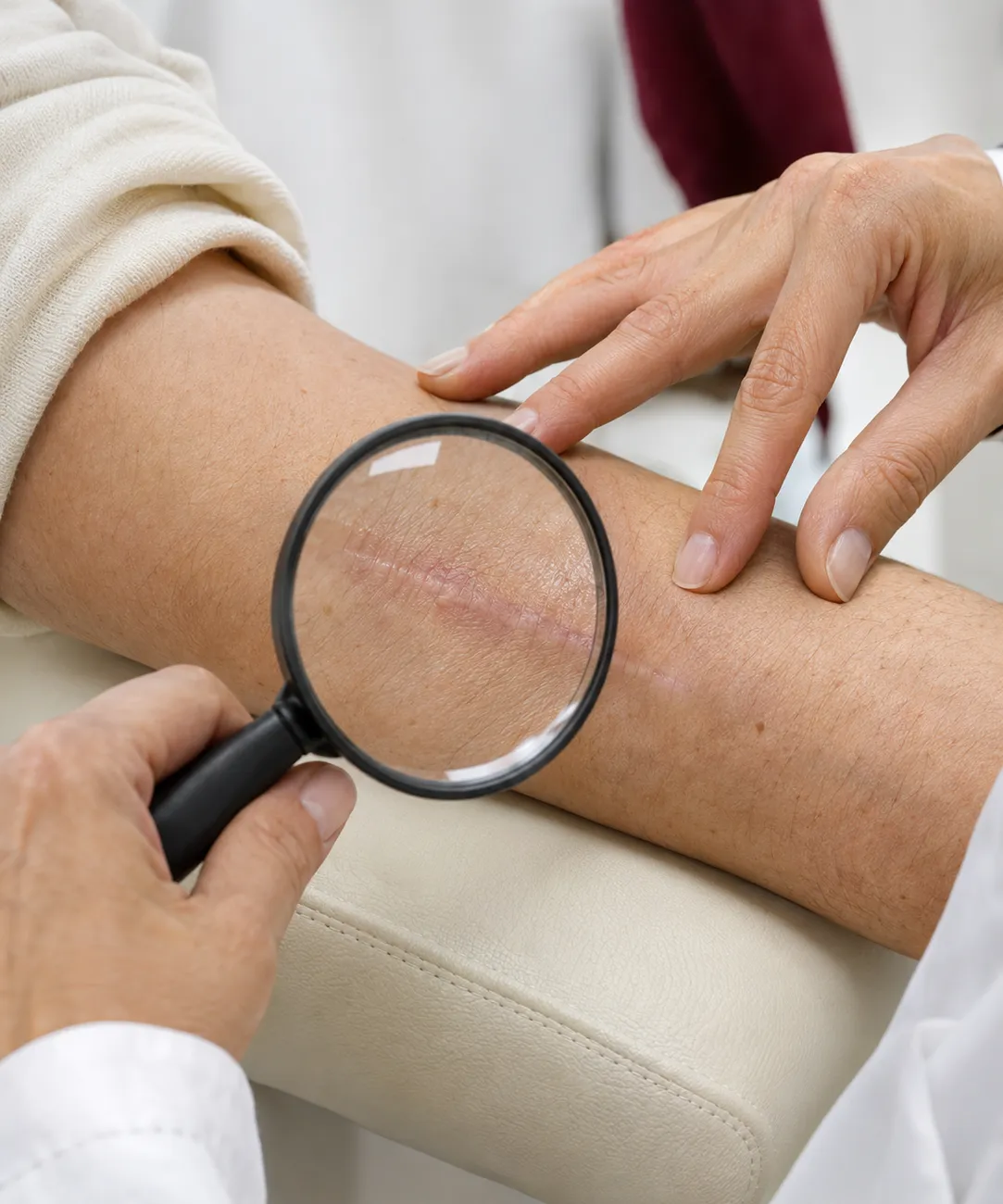
Female doctor closely examining a scar on the forearm with an examination magnifier
Photograph of a consultation. The dots mark what the doctor is assessing.

Why it happens

What may be behind a stuck scar

There is almost always more than one cause at the same time. Choose a situation to see how it may contribute and what usually helps.

The fibrosis of healing

When the wound heals, the body fills it with collagen. If this collagen is organised in dense, short bundles, the scar becomes firmer and less elastic, and may become attached to the planes beneath. This is the most common reason for a scar that pulls.

What weighs on it

Ignoring a scar that pulls for years, or stretching it hard when it is still healing.

What helps

Guided massage once the wound is fully closed and, when indicated, in-clinic procedures that remodel the tissue.

Normal or to be assessed

Scar stuck at the surface or something to assess

Most stuck scars are a matter of the skin and the tissues just beneath. But there are situations that call for medical assessment before any treatment, because what you see is only part of the problem.

  • What it looks like. A scar that has been closed for months, which pulls on movement, with a dimple, fold or hard band to the touch, without signs of inflammation and without abdominal symptoms.

  • When it is noticed. On stretching the body, when putting on certain clothes or when exercising. The discomfort is local, in the skin and the tissues beneath.

  • What the clinic does. The doctor listens to the history, examines and palpates the scar, confirms that it is closed and mature and proposes whatever makes sense.

  • At home. Guided massage once the scar is closed, moisturising, sun protection and gradual resumption of movement.

Do you have severe abdominal pain with vomiting, a distended abdomen and no gas or stools? Call 112. If you have doubts or symptoms that worry you, out of hours you can call SNS 24: 808 24 24 24.

Book an assessment

What the clinic may consider

Options to free the scar

A stuck scar is treated first with what is simplest: waiting for maturation, guided massage and resuming movement. Only then, and with an assessment, is a procedure considered. For this problem, the clinic proposes radiofrequency (Sectum) and carboxytherapy, and intradermotherapy as a local complement, in which some drugs are used outside the approved indication (off-label), so the doctor explains case by case. The evidence is limited: international recommendations on scars rely mainly on other techniques and on other types of scar, and few studies look at the adherent scar from surgery in particular. Results are gradual, vary from person to person, do not promise a scar the same as the rest of the skin and call for several sessions. There are cases in which the solution is surgical, and the doctor tells you when.

Book an assessment
Dr Michelle Campagnoli, clinical director of Clínica Luxmed

First step

Assessment consultation

The doctor listens to what you are experiencing, examines your case and explains the suitable options. No treatment begins without this consultation.

May be considered when

you want to understand the cause and decide on the best path, with time and without commitment.

Book an assessment
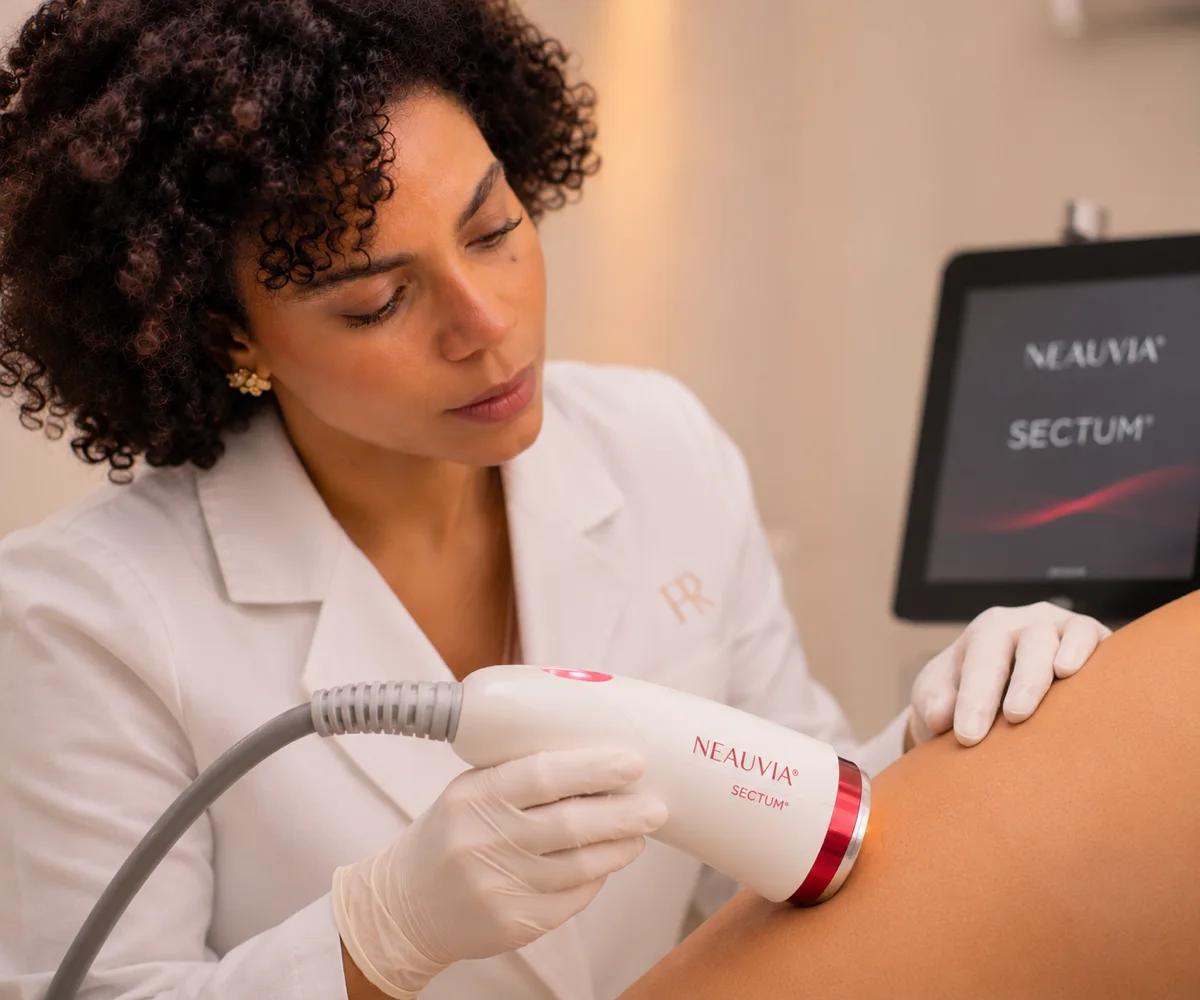
Radiofrequency tip gliding over the thigh or arm, in a bright consulting room

Remodelling the tissue

Sectum radiofrequency Neauvia

Application of controlled heat in depth to make the tissue more flexible and stimulate collagen. In an adherent scar, the aim is to make the tissue more pliable and the skin more mobile, and recommendations for this purpose in particular are limited.

May be considered when

the scar is fully closed and mature, with no signs of infection or inflammation, and the doctor has ruled out a cause that calls for surgery or another treatment first.

Find out more
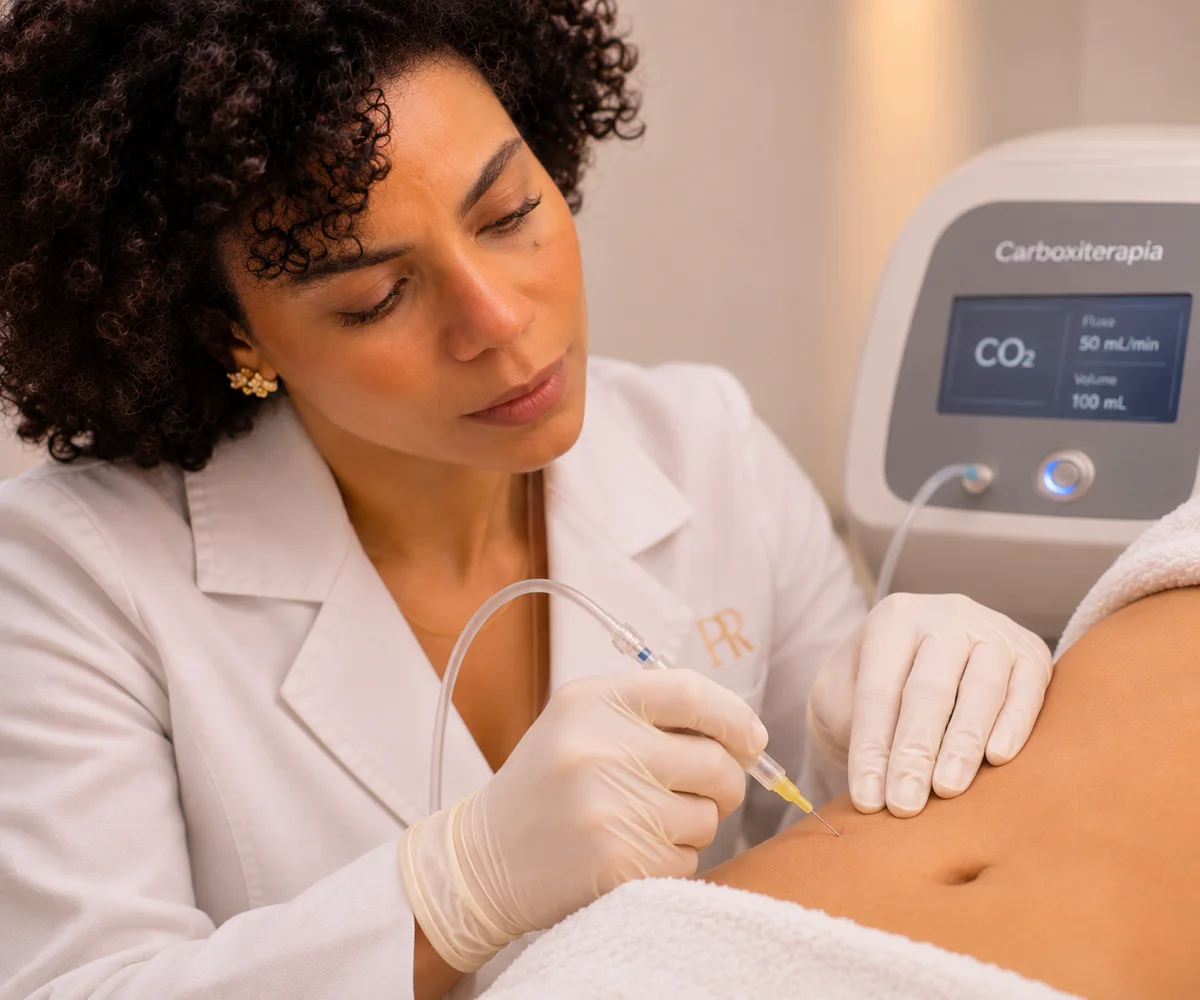
The doctor applying the treatment over the abdomen of a patient who is dressed, with the device in the background

Microcirculation and texture

Carboxytherapy

Small applications of carbon dioxide beneath the skin, to improve microcirculation and the elasticity of the tissue, as a complement in scars. Existing studies are small and most were done on atrophic scars, such as acne scars.

May be considered when

the scar is closed and mature, the skin has no infection, and the doctor has explained that it is a complement with limited evidence and that results vary.

Find out more

What the journey looks like

From the first conversation to a plan tailored to you

No procedure begins without an assessment by the doctor. Most people start with the simplest approach, and only then is anything further considered.

  1. 01At the clinic

    Telling your story

    The doctor asks which surgery it was and when, how healing went, since when the scar has been pulling, whether there is pain, tingling or limited movement, and whether there are abdominal symptoms.

  2. 02At the clinic

    Examining and palpating the scar

    The doctor sees whether the scar is closed and mature, whether it slides or is stuck, whether there is a hard band or dimple. If there are signs of infection, abdominal symptoms or suspicion of another cause, the first step is the surgeon or A&E.

  3. 03At home

    Massage, moisturising and movement

    With the scar already closed and with guidance, you massage, moisturise, protect from the sun and resume movement gradually. If there is limitation, physiotherapy is considered.

  4. 04Over time

    Decide and follow up

    If the scar remains stuck, the doctor explains whether a procedure makes sense, what can be expected and how many sessions are needed, without promising results. If surgery is the case, she refers you to the surgeon.

Day to day

What helps at home

This care makes sense once the scar is closed and while you wait for the consultation, always alongside the surgeon’s and the clinic’s plan.

The golden rule

First letting the wound heal, then freeing the scar

Fiddling with, massaging or treating a scar that has not yet healed may delay it or worsen the adhesion. And a scar that hurts, is hot or discharges pus, or abdominal pain after abdominal surgery, should be seen by a doctor rather than “treated”.

Waiting for the scar to close

Massage and procedures only make sense with the wound fully closed.

In practice: confirm with the surgeon when you can start and only then begin.

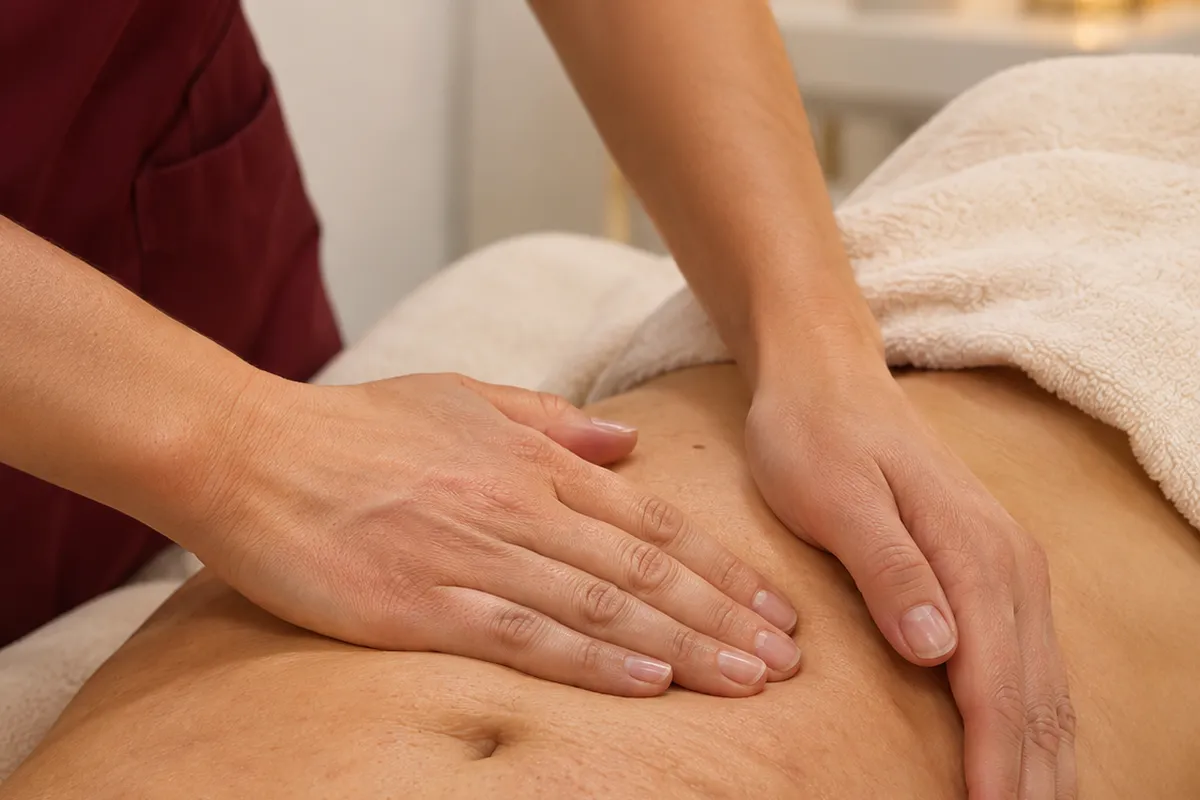
Massaging with guidance

Gentle massage may help to free the tissue and reduce discomfort, although the evidence is limited.

In practice: with a simple moisturising cream, in small, firm but painless movements, a few minutes a day, as you are taught.

Resuming movement gradually

Stretching the area gradually stops the tissue from setting in a short position.

In practice: follow the surgeon’s plan and, if movement is limited, ask a physiotherapist for guidance.

Protecting and moisturising the skin

Healed skin is more sensitive to the sun and becomes darker if exposed.

In practice: moisturiser every day, sun protection on the exposed scar and, if you use silicone, as a sheet or gel, as you are advised.

Dr Michelle Campagnoli, clinical director of Clínica Luxmed

Who will look after you

An assessment carried out by the doctor

At Luxmed, in Algés, the first step is always an assessment with Dr Michelle Campagnoli. She is the one who examines the scar, understands whether it is a skin adhesion or whether there is something to refer and defines with you what makes sense, before any procedure.

  • Physical examination and medical historyA conversation about the surgery and recovery, and examination and palpation of the scar.
  • A plan tailored to youA clear plan, without promises, with the essentials done first and follow-up over time.
  • No obligationThe cost of any treatment is confirmed only after the assessment.
Book an assessment

Book a consultation

Book your consultation

Choose how you prefer to get in touch. We will arrange the assessment consultation with Dr Michelle Campagnoli.

Booking through the websiteAssessment consultationTalk to our assistant on WhatsApp and ask for the current price of the assessment.

New Life Miraflores, Algés · Office Center, R. Santa Teresa do Menino Jesus n.º 6, 9.º C, 1495-048

Your details are used only for this contact. Any treatment depends on a prior medical assessment.

Request an appointmentIt takes less than a minute.
Speciality
You do not need to go into detail. The doctor will talk to you during the consultation.
Request received. Our team will contact you as soon as possible.
What are adhesions after surgery?

They are bands of scar tissue that join layers that should slide over one another. There are two types. In scar adhesions, the skin is stuck to the planes beneath, pulls and may dimple. In internal adhesions, in the abdomen, scar tissue joins organs to one another. Many people have internal adhesions after abdominal surgery without any symptom, but, in some cases, they may cause pain and, more rarely, an intestinal obstruction. This page deals mainly with the stuck scar, and internal adhesions are assessed by a surgeon.

What is the difference between a scar adhesion and an internal adhesion?

A scar adhesion is seen and felt at the surface: stuck skin, pulling, a dimple, a hard band. An internal one cannot be seen, and may cause abdominal pain, distension and, sometimes, obstruction. The approaches are different: those of the scar may be treated with techniques on the skin, and internal ones call for surgical assessment. A massage on the abdomen does not resolve internal adhesions, and there is no solid evidence that it helps.

How do I know whether the scar is stuck?

Frequent signs are skin that pulls when you stretch the body, a dimple or fold that appears with movement, a hard band to the touch and difficulty pinching the skin over the scar. There may also be tingling or tenderness. The doctor confirms by examining and palpating the scar, and sees whether there is limited movement or another cause.

Stuck, pulling scar: what helps?

With the scar already closed and mature, guided massage, moisturising, sun protection and gradually resuming movement help, with physiotherapy if there is limitation. In the clinic, radiofrequency, carboxytherapy and other techniques may be considered, and the choice depends on the type of scar. The evidence is limited for the adherent scar in particular, results vary and, in some cases, the solution is surgical. The doctor assesses first.

When can I start massaging the scar?

When the wound is fully closed and with the authorisation of whoever is following you, in general the surgeon. Doing it earlier may open the wound or worsen the adhesion. The UK health service (NHS) suggests massage with a water-based cream, a few times a day, up to about 10 minutes at a time, after the wound has healed completely.

Does an old scar still improve?

It may improve, although it usually responds less than a recent one, because the tissue is more mature. What can be achieved depends on the type of scar, the area and what has already been done. There is no promise of a result, and the doctor tells you at the assessment what is realistic to expect.

Does radiofrequency help with adhesions?

Radiofrequency heats the tissue in depth and is used in aesthetic dermatology to firm and remodel. In an adherent scar, the aim is to make the tissue more flexible, but the evidence for this particular use is limited and results vary. The clinic uses Sectum Neauvia, after assessing the scar and confirming that it is closed and mature.

Does carboxytherapy free scars? And intradermotherapy?

Carboxytherapy seeks to improve microcirculation and elasticity, as a complement. Studies are small and most were done on atrophic scars, such as acne scars, so the evidence for the adherent scar is limited. Intradermotherapy is a local complement and, with some drugs, is used outside the approved indication (off-label), which the doctor explains beforehand. The clinic also performs microneedling and fractional CO2 laser on the body, and the doctor says whether they make sense in your case.

How many sessions are needed and are the results permanent?

Several spaced sessions are normally needed, and improvement is gradual, over months. There is no guaranteed or permanent result, and the scar does not become the same as the rest of the skin. In more serious cases, or when there is significant limitation of movement, a surgical procedure may be needed, and the doctor refers you if that is the case.

When is it an emergency and when should I see a doctor first?

Severe abdominal pain with vomiting, a distended abdomen and no gas or stools is an emergency: call 112. Ask for assessment without waiting if the scar is hot, red, swollen, discharges pus or there is fever, if the wound has not yet closed, if the scar grows beyond the line of the surgery, opens or bleeds, or if there is pain or limited movement that does not improve. If in doubt, out of hours call SNS 24 (808 24 24 24). No procedure is carried out “to see if it goes away”.

We could not find that question. Ask us on WhatsApp

Scientific references

This page is based on the sources below and was reviewed by Dr. Michelle Campagnoli. Last updated on .

  1. ten Broek RP, Issa Y, van Santbrink EJ, Bouvy ND, Kruitwagen RF, Jeekel J, Bakkum EA, Rovers MM, van Goor H. Burden of adhesions in abdominal and pelvic surgery: systematic review and met-analysis. BMJ, 2013.
  2. ten Broek RPG, Krielen P, Di Saverio S, et al. Bologna guidelines for diagnosis and management of adhesive small bowel obstruction (ASBO): 2017 update of the evidence-based guidelines from the World Society of Emergency Surgery ASBO working group. World J Emerg Surg, 2018.
  3. Gold MH, Berman B, Clementoni MT, et al. Updated international clinical recommendations on scar management: part 1 - evaluating the evidence. Dermatol Surg, 2014.
  4. Gold MH, McGuire M, Mustoe TA, et al. Updated international clinical recommendations on scar management: part 2 - algorithms for scar prevention and treatment. Dermatol Surg, 2014.
  5. Seago M, Shumaker PR, Spring LK, et al. Laser treatment of traumatic scars and contractures: 2020 international consensus recommendations. Lasers Surg Med, 2020.
  6. Alster TS, Graham PM. Microneedling: a review and practical guide. Dermatol Surg, 2018.
  7. Beasley KL, Weiss RA. Radiofrequency in cosmetic dermatology. Dermatol Clin, 2014.
  8. Moftah NH, El Khayyat MAM, Ragai MH. Carboxytherapy versus skin microneedling in treatment of atrophic postacne scars: a comparative clinical, histopathological, and histometrical study. Dermatol Surg, 2018.
  9. NHS (National Health Service). Scars. (NHS, acedido 2026-11-11)
CallAssistantAvailableBook