


Melasma in pregnancy: what you can do and what to expect
Melasma is common in pregnancy, does not harm the baby and usually fades after birth. See what you can do now, what to avoid and what to expect.
 Rúben BritoAuthor
 Dr Michelle CampagnoliClinical review · OM no. 69467
In this article
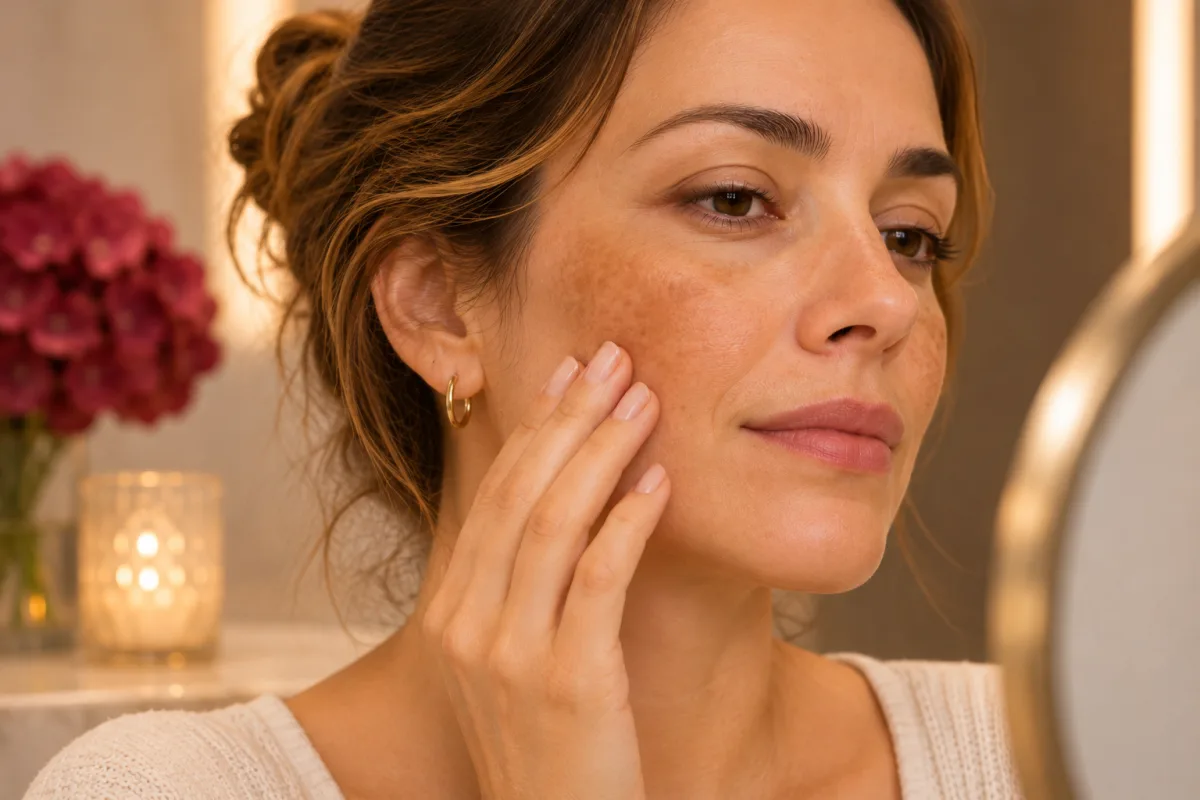
The brownish patches that appear on the forehead, cheekbones or upper lip during pregnancy have a name: melasma, also called chloasma or the «mask of pregnancy». They are common, do not harm the baby or the mother and, in most cases, fade within the year after birth.
During pregnancy, what works best is also the simplest: protect your skin from the sun every day with a broad-spectrum sunscreen, ideally a tinted one. Several treatments for dark patches should wait, but there are safe measures you can start right away. We explain why it appears, what you can do now and what to expect after birth.
Three ideas to remember.
Fica por baixo do resumo, se existir uma segunda foto.
Why it appears in pregnancy
Melasma results from three factors that add up: hormones, sunlight and genetic predisposition. Pregnancy brings all three together.
- Hormones. Estrogen and progesterone rise sharply in pregnancy and stimulate melanocytes, the cells that produce pigment. This is why melasma is also linked to the pill and to hormone replacement therapy.
- Light. Hormones make the melanocyte more reactive, but it is light that triggers the patch. Both UV radiation and visible light count.
- Genetics and skin type. It is more common in darker skin (phototypes III to VI). In a Turkish study, 37.6% of pregnant women with melasma had a mother who had also had it during pregnancy.
How many pregnant women have melasma?
It depends a great deal on the country and skin type: studies report figures of around 5% in France and 11% in Brazil, up to more than 50% in India and Pakistan (Majid and Aleem, 2021). It usually appears in the second trimester.
Who is at higher risk
| Factor | What is known |
|---|---|
| Melasma in a previous pregnancy | The strongest factor: about 44 times higher risk |
| Mother or sister with melasma | Clearly increases the risk |
| Darker skin (phototypes III to VI) | More frequent and more persistent patches |
| A lot of outdoor sun exposure | Increases the risk |
| Older age at first pregnancy | About 8% higher risk for each year |
| Several pregnancies | Higher cumulative risk |
Source: synthesis of Zhao, Fu and Cheng, 2024.
What you can do during pregnancy
1. Sun protection every day, from the start
It is the measure with the best evidence. In a study of 200 pregnant women who used a broad-spectrum SPF 50+ sunscreen daily, only 2.7% developed melasma, far below what was expected (Lakhdar et al., 2007). Starting in the first trimester is ideal.
Mineral filters (zinc oxide, titanium dioxide) are the most conservative option in pregnancy, because they are practically not absorbed. Some chemical filters, such as benzophenone-3, pass into the bloodstream in small amounts. There is no record of malformations, but caution favors mineral filters (Putra et al., 2022).
Tinted. Iron oxides also protect against visible light, which worsens melasma. We explain it all in Tinted sunscreen: how to choose and how to apply it.
Amount and reapplication. A generous layer in the morning and reapplication every 2 hours outdoors.
2. Physical protection
A wide-brimmed hat, sunglasses and shade during the hours of peak intensity. Sunscreen alone never blocks everything.
3. Skin care compatible with pregnancy
According to a recent review on aesthetics in pregnancy and breastfeeding (Kovacs et al., 2026), the following are generally acceptable:
- Azelaic acid, with low absorption (3% to 8%). It is one of the most widely used depigmenting actives in pregnancy, preferably on limited areas and on medical advice;
- Vitamin C, an antioxidant with some effect on pigmentation;
- Niacinamide, which helps even out skin tone and is well tolerated;
- Glycolic or lactic acid at low concentration, in daily-use products, with caution.
4. Avoid what irritates
Harsh exfoliants, hot wax on the face and products that sting cause inflammation. In skin prone to melasma, inflammation can darken the patches even further.
What to avoid in pregnancy and breastfeeding
Some of the most effective treatments for melasma are not suitable at this stage. This is no cause for alarm: melasma can wait, and it often improves on its own after birth. Choose the stage to highlight the column that interests you.
| Treatment | Pregnancy | Breastfeeding | Why |
|---|---|---|---|
| Hydroquinone | Avoid | Decide with your doctor | High absorption, about 45% of an application within 24 hours |
| Topical retinoids (tretinoin, adapalene, tazarotene) | Avoid | Tazarotene: avoid; the others: decide with your doctor | A family of medicines with known fetal risk when taken orally |
| Oral tranexamic acid | Contraindicated | Relative contraindication | Interferes with clotting; pregnancy already increases the risk of thrombosis |
| Salicylic acid peels | Avoid | With caution | Risk of absorption over large areas |
| Medium and deep peels | Postpone or avoid | Postpone or avoid | Little data; phenol has systemic toxicity |
| Lasers and intense pulsed light | Postpone | Some possible, case by case | Besides safety, they can worsen melasma at this stage |
| Microneedling | Postpone | May be acceptable | Little data in pregnancy |
Sources: Kovacs et al., 2026; Putra et al., 2022; Forbat et al., 2019.
If you used any of these products without knowing you were pregnant, do not panic. Absorption of most topical products is low, and two prospective studies of tretinoin in the first trimester found no malformations. Stop applying it and talk to your obstetrician.
What to expect after birth
In most women, melasma gradually fades over the first year after birth, as hormones return to their usual levels. But up to 30% of cases persist, some for many years (Zhao et al., 2024).
What makes persistence more likely:
- darker skin and deeper patches;
- sun exposure without protection after birth, especially if the baby is born in spring or summer;
- starting or resuming hormonal contraception. The pill is linked to melasma, so it is worth talking to your family doctor or gynecologist about the most suitable method;
- new pregnancies, which increase the risk again.
A practical rule: keep up daily sun protection and wait 6 to 12 months. If the patches have not faded, or if they bother you before then, it is time for an assessment. Once breastfeeding has ended, the most effective treatments become available, such as hydroquinone or depigmenting combinations, peels and tranexamic acid, always on medical advice.
When to seek a medical assessment
During pregnancy, your obstetrician's care comes first. Ask for a specific assessment if:
At Luxmed, the Facial Aesthetics consultation starts with diagnosis and adapts the plan to the stage you are in: pregnancy, breastfeeding or afterwards.
Talk to us
The assessment is a conversation, with no obligation. Tell us what concerns you and our team will reply.
Telephone 214 044 241 · info@luxmed.pt
This article is for information only and does not replace the care of your doctor or obstetrician.
Frequently asked questions
Does melasma harm the baby?
No. It is a change in skin pigmentation, with no effect on the pregnancy or the baby.
Does melasma go away on its own after birth?
In most cases it fades over the first year. Up to 30% persist, especially without sun protection.
Can I use chemical sunscreen in pregnancy?
There is no record of malformations, but some chemical filters are absorbed in small amounts. Mineral filters are the more prudent choice.
What cream can I use for patches during pregnancy?
Azelaic acid, vitamin C and niacinamide are generally considered acceptable. Hydroquinone and retinoids should be avoided.
If I had melasma in one pregnancy, will I get it again in the next?
It is very likely: it is the strongest risk factor. Start daily sun protection before getting pregnant or right at the start.
Can I have a peel while breastfeeding?
Superficial glycolic or lactic acid peels have the most favorable profile, but the decision should be medical and case by case.
Scientific references 7
- Lakhdar H et al. Evaluation of the effectiveness of a broad-spectrum sunscreen in the prevention of chloasma in pregnant women. J Eur Acad Dermatol Venereol. 2007;21(6):738-742. PubMed
- Zhao L, Fu X, Cheng H. Prevention of melasma during pregnancy: risk factors and photoprotection-focused strategies. Clin Cosmet Investig Dermatol. 2024;17:2301-2310. Artigo
- Majid I, Aleem S. Melasma: update on epidemiology, clinical presentation, assessment, and scoring. J Skin Stem Cell. 2021;8(4):e120283. Artigo
- Putra IB, Jusuf NK, Dewi NK. Skin changes and safety profile of topical products during pregnancy. J Clin Aesthet Dermatol. 2022;15(2):49-57. PMC
- Kovacs T et al. Cosmetic dermatology in pregnancy and lactation: a risk-benefit framework for clinical practice. Int J Dermatol. 2026. Artigo
- Forbat E, Al-Niaimi F, Ali FR. The emerging importance of tranexamic acid in dermatology. Clin Exp Dermatol. 2020;45(4):445-449 (publicado online em outubro de 2019). Resumo
- Gan C, Rodrigues M. An update on new and existing treatments for the management of melasma. Am J Clin Dermatol. 2024. Artigo
Keep exploring