Algés, Oeiras Mon to Fri · 09:00 to 13:00 and 14:00 to 19:00 · Sat · 09:00 to 14:00
WhatsApp Book a consultation

Body aesthetics

Photoageing of the bodyWhen the skin of the body shows years of sun and you want to understand what is expected and what should be seen

Much of the visible ageing of the skin is caused by the sun rather than by age. Simply compare the skin on your forearms with the skin on the inner upper arms, which is almost never exposed to the sun. On the body, photoageing is not limited to wrinkles: it also causes brown patches, thin and dry skin, roughness, visible small blood vessels, easy bruising and small white patches. Some of these signs are purely cosmetic, but others, such as a persistent rough area or a changing mole, require medical assessment before any treatment. Here, we explain what commonly causes sun damage, what can be done, what can improve and what cannot be reversed, and when your skin should be monitored more closely at Clínica Luxmed, in Algés.

Reviewed by Dr Michelle Campagnoli, clinical director

  • 2main procedures for this topic
  • 1assessment, always first
  • Nocommitment
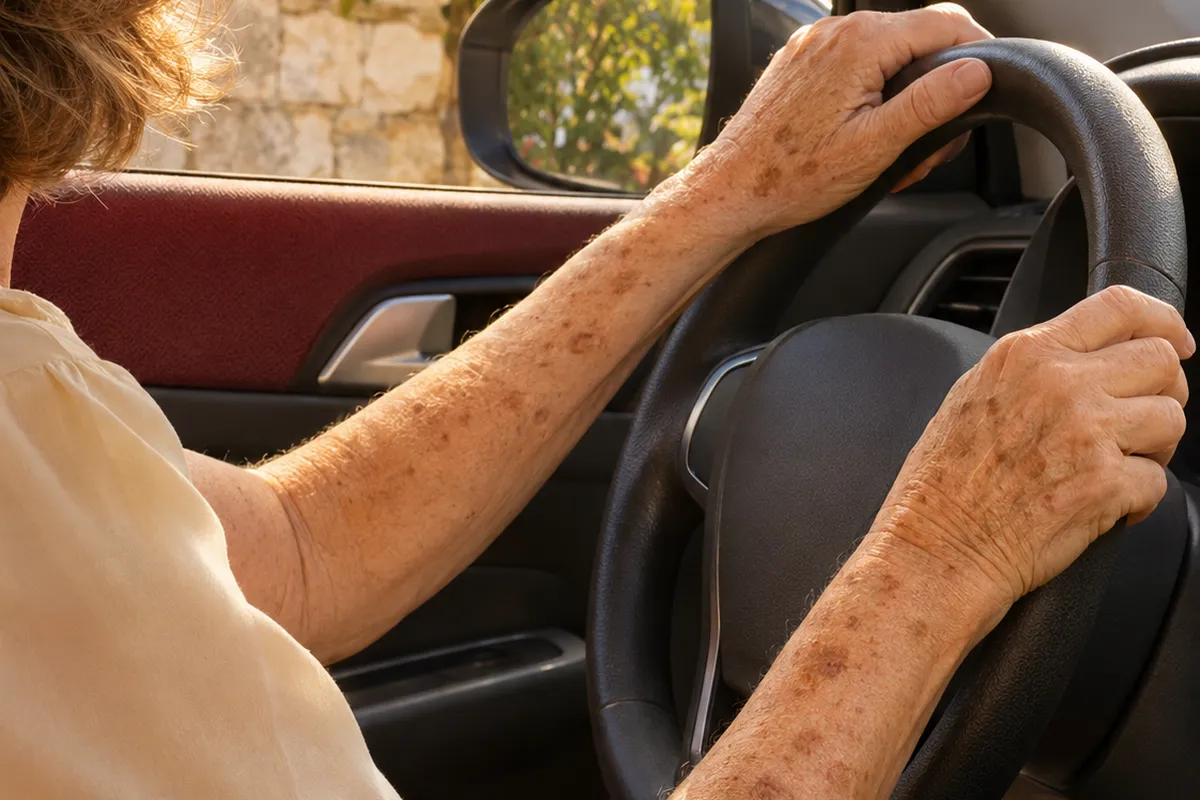
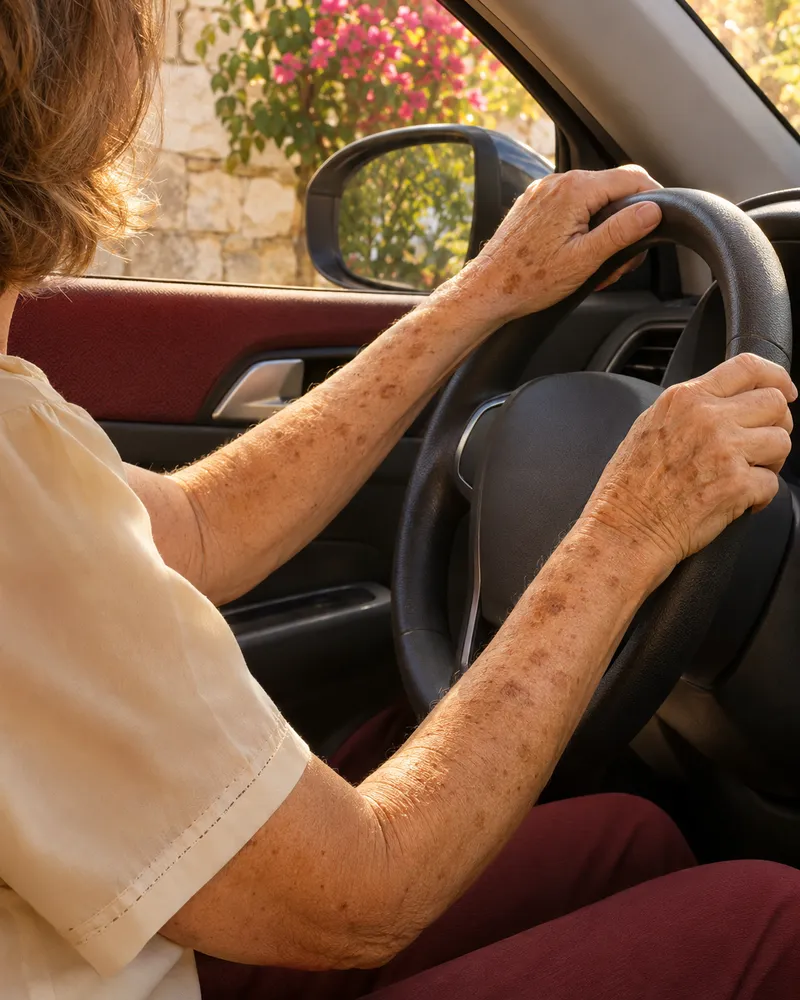
Forearms and hands of a woman at the wheel, with sun spots

How to recognise it

Could it be cumulative sun damage to the body?

Sun damage appears differently depending on the area of the body and the skin type. These signs can help you understand what may be happening before your assessment and which changes need closer attention.

Tick what you recognise0/7

Tick the signs you recognise in your case. This is not a diagnosis, it is only meant to give you an idea.

Do you have a rough or scaly area that does not pass, a sore that does not heal, or a new mole that changes shape, colour, outline or size, that bleeds, itches, hurts or forms a crust? Is there a mole that is different from all the others? It needs a medical assessment before any treatment. Out of hours, call SNS 24: 808 24 24 24.

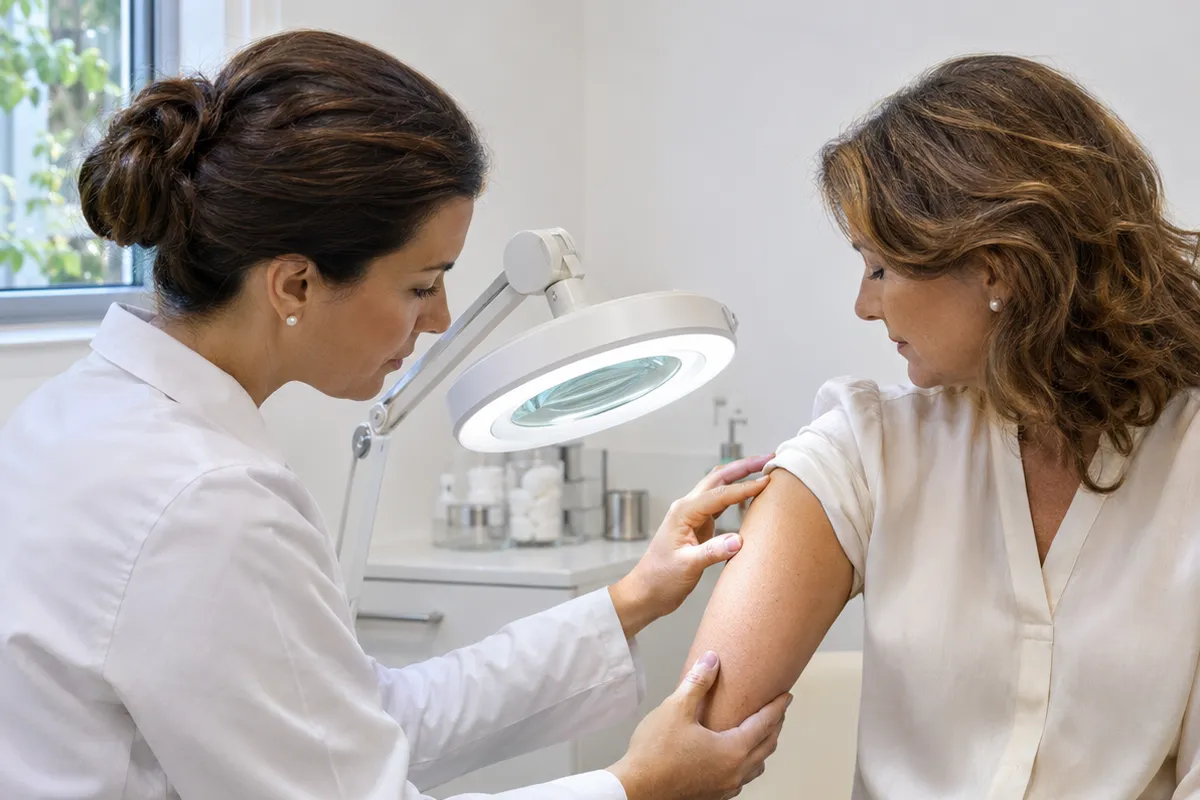
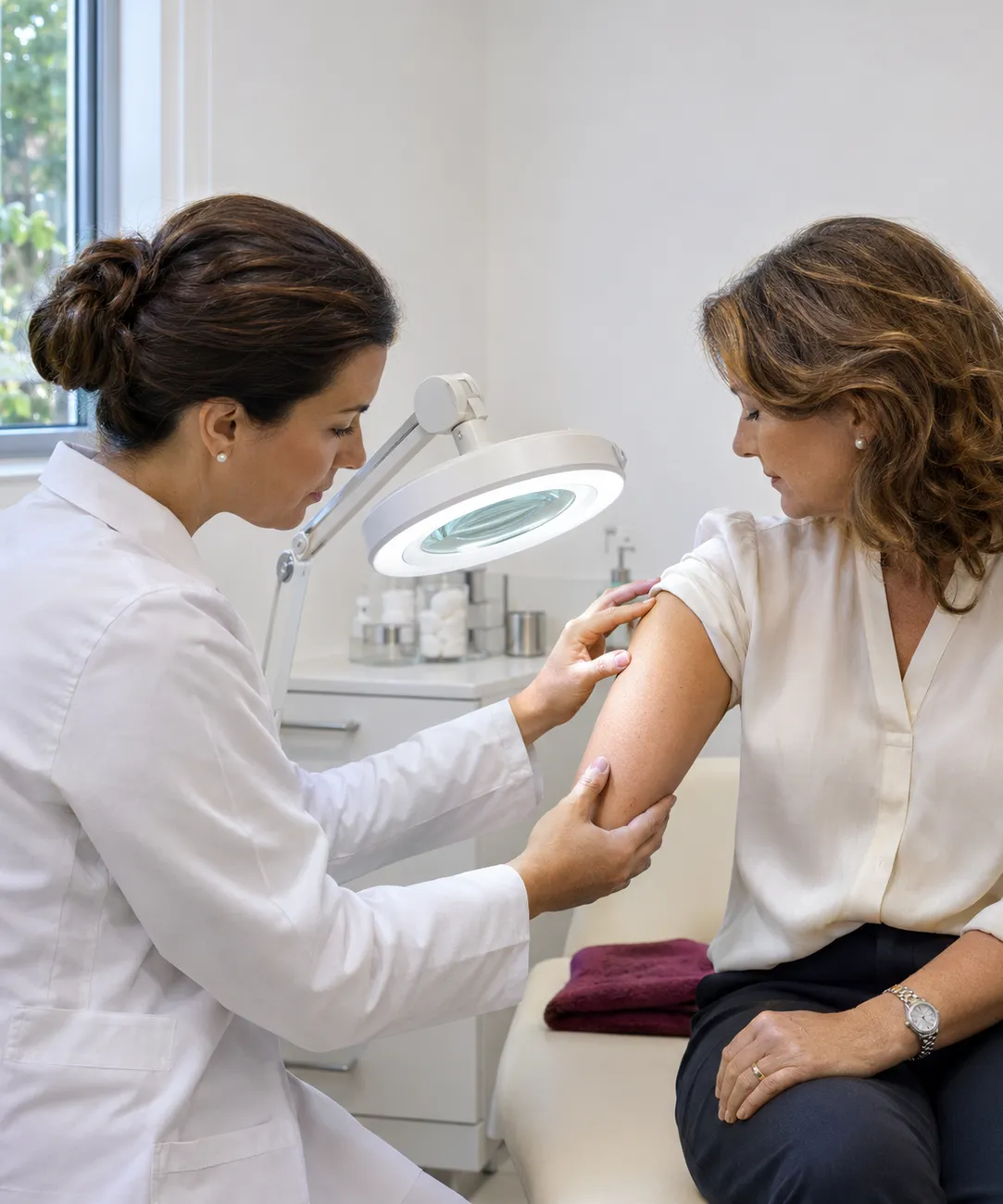
Female doctor assessing a patient's arm with an examination magnifier
Photograph of a consultation. The dots mark what the doctor is assessing.

Why it happens

What may be behind sun damage

Sun damage is cumulative: it builds up over a lifetime and often only becomes noticeable decades later. Select a situation to see how it may contribute to sun damage and what usually helps.

Years of exposure to the sun

Ultraviolet radiation damages collagen, elastic fibres and melanocytes, and this damage accumulates over time. That is why the forearms, hands, neck and décolletage show more sun damage than covered areas. The more time spent outdoors over the years, the more noticeable the damage becomes.

What weighs on it

Hours of unprotected sun exposure when the sun is at its strongest, whether at work, during sport or at leisure.

What helps

Use shade, protective clothing and sunscreen from now on: existing damage cannot be erased, but further damage can be prevented.

Expected or to be assessed

Expected sun damage or something to assess

Most signs of sun damage are benign. But some call for assessment before any treatment, because a suspicious lesion is not treated “to see if it goes away”.

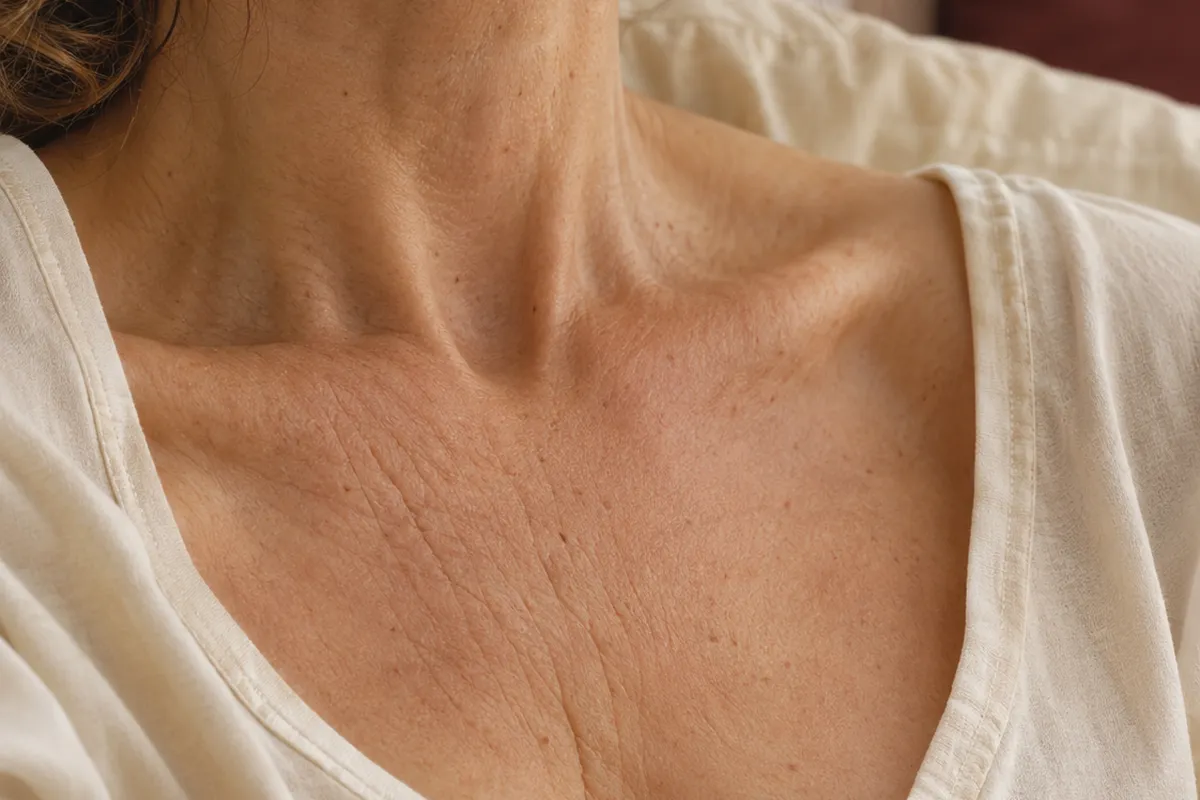
  • What it looks like. Flat, well-defined brown patches; thin, dry skin; visible small blood vessels and redness on the neck and décolletage; bruises on the forearms; or small white patches that developed gradually and do not change quickly.

  • When it is noticed. In areas exposed for years, such as the hands, forearms, neck and décolletage, and often after summer.

  • What the clinic does. The doctor listens to the history, examines the skin and, if it is benign sun damage, explains what can be done and what is realistic to expect.

  • At home. Sun protection every day, moisturising and monitoring the skin with a regular self-examination.

Do you have extensive sunburn with blisters, fever, vomiting, confusion or fainting? Call 112. If you have a changing lesion, a sore that does not heal or any concerns, you can call SNS 24 out of hours: 808 24 24 24.

Book an assessment

What the clinic may consider

Options for sun-damaged skin

Sun-damaged skin can improve, provided that further damage is prevented. First-line measures therefore include daily sun protection, clothing, shade, moisturising and, where appropriate, prescription topical treatments such as retinoids, which should be discussed with a doctor and must not be used during pregnancy. Rough or suspicious lesions must first undergo dermatological assessment. Only then, and only on skin with no lesions awaiting assessment, should a procedure be considered. For patches and uneven texture, the clinic offers chemical peels and microneedling. Intradermotherapy (neck and hands), Sectum Neauvia radiofrequency (firmness) and carboxytherapy (microcirculation) are also among the clinic’s body treatments, and the doctor will advise whether any are appropriate for you. The evidence is limited: many studies were conducted on the face or in other contexts, results vary and are gradual, generally partial and temporary, and deep damage to elastic fibres improves only to a limited extent. No procedure can erase years of sun exposure.

Book an assessment
Dr Michelle Campagnoli, clinical director of Clínica Luxmed

First step

Assessment consultation

The doctor listens to what you are experiencing, examines your case and explains the suitable options. No treatment begins without this consultation.

May be considered when

you want to understand the cause and decide on the best path, with time and without commitment.

Book an assessment
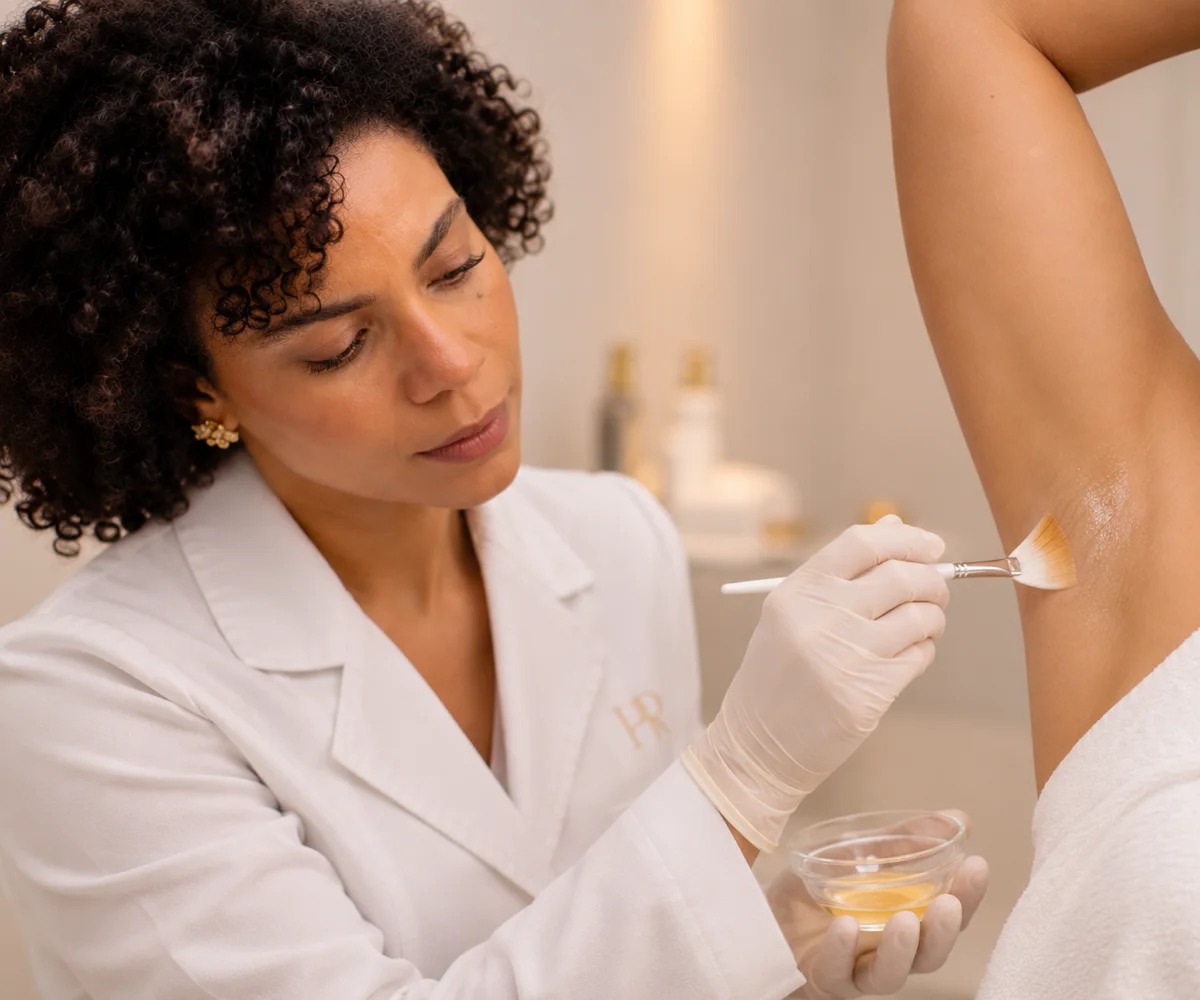
Consulting-room brush applying a peel solution to the skin, in bright consulting-room light

Skin renewal

Chemical peel

An acid is applied to the skin to renew its superficial layers, even out skin tone and soften thickened or darkened skin. In areas with sun-induced patches, the strength and agent are selected carefully because irritation may leave a new mark, and sunscreen is essential afterwards.

May be considered when

the lesions have been assessed and suspicion ruled out, the skin is not irritated, broken or sunburnt, you are not pregnant or breastfeeding, and the doctor has explained the risks and what is realistic to expect.

Find out more
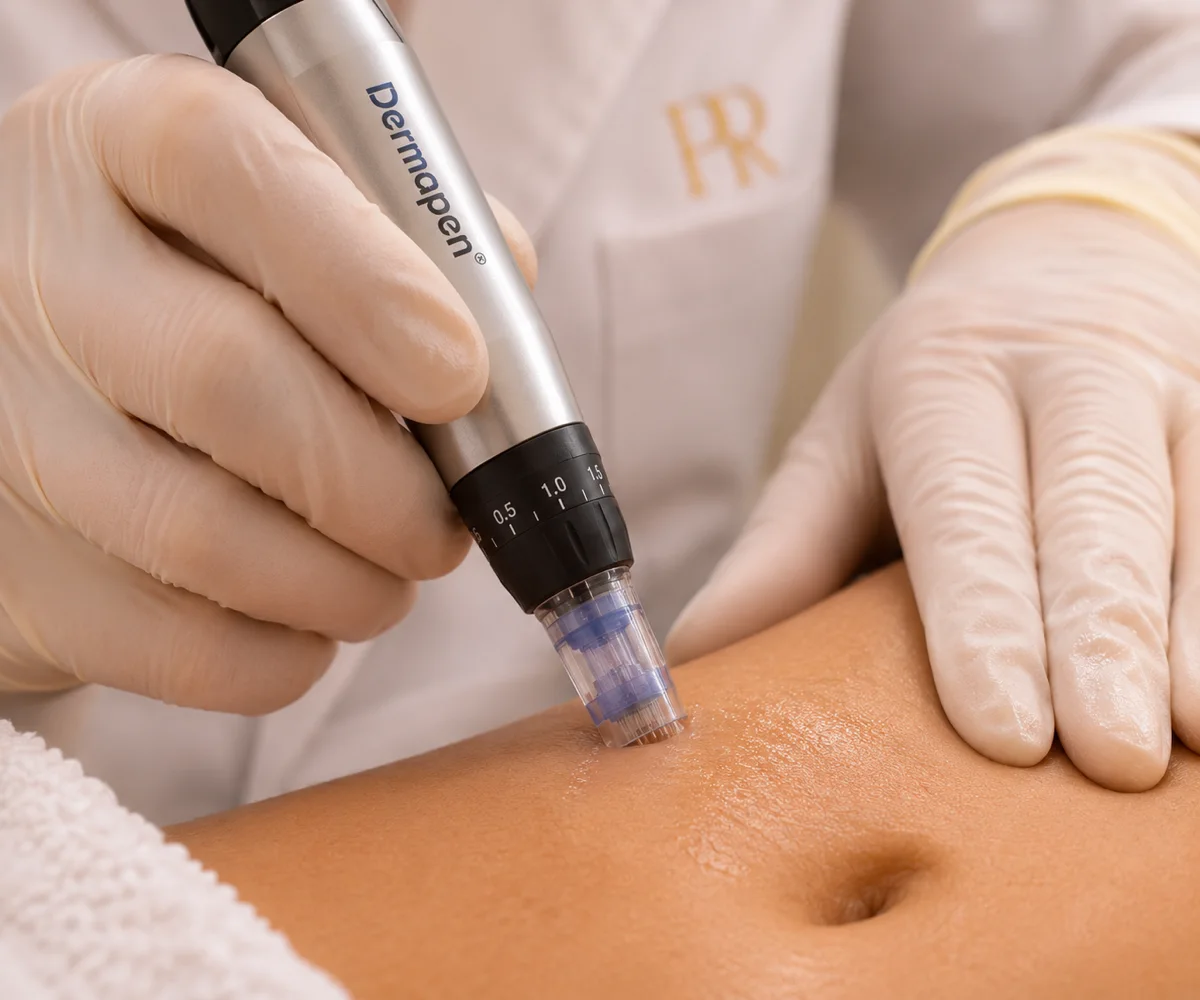
Microneedling pen gliding over the skin of the abdomen, in bright consulting-room light

Skin stimulation

Microneedling

Microneedling uses very fine needles to create small, controlled micro-injuries that stimulate collagen and elastin production and improve skin texture and evenness. It is performed over several sessions spaced weeks apart, and results are gradual.

May be considered when

the skin is rough or uneven in texture but has no lesions awaiting assessment, infection or irritation, and the doctor has explained that results for sun damage vary and that evidence for treatment on the body is limited.

Find out more

What the journey looks like

From the first conversation to a plan tailored to you

No procedure is carried out without a medical assessment. The doctor first examines all of your skin and determines what needs monitoring; only then are possible improvements considered.

  1. 01At the clinic

    Telling your story

    The doctor asks about years of sun, sunburn and sunbeds, protective measures, occupation and sport, moles that have changed and a family history of skin cancer.

  2. 02At the clinic

    Examining the skin

    The patches, thickness, texture and moles are examined, in several areas of the body. If there are suspicious lesions, persistent rough ones or moles that change, the doctor refers you for dermatological assessment before any aesthetic treatment.

  3. 03At home

    Protecting and monitoring the skin

    Sunscreen every day, shade and clothing, moisturising, and a regular self-examination with a mirror. It is this combination that halts the damage and, in many cases, improves the appearance of the skin.

  4. 04Over time

    Decide and follow up

    If there is damage that bothers you, the doctor explains whether a procedure makes sense, what can be expected and how many sessions are needed, without promising results. The examination is repeated and the plan adjusted.

Day to day

What helps at home

What you do at home matters more than you might think. These measures are worthwhile now, while you wait for your consultation and alongside the clinic’s treatment plan.

The golden rule

Stopping adding damage, monitoring and only then treating

The best treatment for photoageing is one that prevents further damage from accumulating. A rough lesion, a sore that does not heal or a changing mole should not be treated for cosmetic reasons: it must first be examined by a doctor.

Protecting the skin every day

Sun damage also accumulates on cloudy days and on short outings.

In practice: broad-spectrum sunscreen with factor 30 or higher on exposed areas, reapplied, and shade between 11 and 15 h.

Covering the arms and neck

Clothing and a hat protect without depending on the amount of product applied.

In practice: light long-sleeved clothing and a wide-brimmed hat in the hours of most sun.

Self-examining your skin

Looking at the skin regularly helps to notice a new mole or one that changes.

In practice: once a month, in the mirror, over the whole body, including the back, scalp and soles of the feet, or with help from another person, and photographs in the same light.

Moisturising the skin

Thin, dry skin is injured more easily.

In practice: moisturiser after bathing, lukewarm, quick baths, and care with knocks on the forearms.

Dr Michelle Campagnoli, clinical director of Clínica Luxmed

Who will look after you

An assessment carried out by the doctor

At Luxmed, in Algés, the first step is always an assessment with Dr Michelle Campagnoli. She will examine your skin, distinguish benign sun damage from changes that require monitoring or dermatological assessment, and work with you to decide what is appropriate before any procedure.

  • Physical examination and medical historyA conversation about the sun, sunburn, protection and family history, and examination of the skin, sometimes with a dermatoscope.
  • A plan tailored to youA clear plan, without promises, with monitoring and protection first, and follow-up over time.
  • No obligationThe cost of any treatment is confirmed only after the assessment.
Book an assessment

Book a consultation

Book your consultation

Choose how you prefer to get in touch. We will arrange the assessment consultation with Dr Michelle Campagnoli.

Booking through the websiteAssessment consultationTalk to our assistant on WhatsApp and ask for the current price of the assessment.

New Life Miraflores, Algés · Office Center, R. Santa Teresa do Menino Jesus n.º 6, 9.º C, 1495-048

Your details are used only for this contact. Any treatment depends on a prior medical assessment.

Request an appointmentIt takes less than a minute.
Speciality
You do not need to go into detail. The doctor will talk to you during the consultation.
Request received. Our team will contact you as soon as possible.
What is photoageing of the body and what are the signs?

It is skin ageing caused by years of sun exposure and is distinct from natural ageing. On the body, it goes beyond wrinkles: flat brown patches (solar lentigines) on the hands, forearms, shoulders and décolletage; thin, dry and fragile skin; bruising after minor knocks; redness and visible small blood vessels on the neck and décolletage (poikiloderma of Civatte); small white patches on the legs and forearms; and rough areas (actinic keratoses). Reviews attribute most of the visible ageing in exposed areas to the sun.

Do sunbeds age the skin? And can patches and thin skin be cured?

Yes, sunbeds age the skin and increase the risk of skin cancer. As for patches and thin skin, there is no cure that can erase years of sun exposure: deep damage to the elastic fibres improves only partially. Protecting and moisturising the skin and, where appropriate, undergoing treatment under medical supervision can make the skin tone more even, but results are partial and vary from person to person.

What is the difference between sun damage and skin cancer?

Sun damage is the set of changes caused by the sun and most of it is benign, such as patches, thin skin and tiny vessels. Skin cancer is a disease, and accumulated sun damage increases the risk. Some intermediate lesions, such as actinic keratoses, are pre-malignant. So anything that changes, bleeds, does not heal or is different from the rest should be seen by a doctor, and only a doctor can tell one from the other.

Who is at higher risk and how is a skin self-examination done?

People at higher risk include those with fair skin, light eyes or red hair; a history of childhood sunburn or sunbed use; many or atypical moles; a personal or family history of skin cancer; or immunosuppression. During a monthly self-examination, examine all of your skin, including your back, scalp and the soles of your feet, using a mirror or asking someone to help, and compare photographs. Look for any new or changing mole using the ABCDE rule: asymmetry, irregular borders, varied colour, diameter and evolution.

How is sun-damaged skin of the body treated?

First, prevent further damage by using sunscreen every day, seeking shade, wearing protective clothing and moisturising. Prescription topical treatments such as retinoids may then be considered with a doctor and must not be used during pregnancy; in a trial involving the arms of older people, retinol improved fine wrinkles. Rough or suspicious lesions are treated by a dermatologist. If sun damage is causing concern and the skin has no lesions awaiting assessment, the clinic may consider a chemical peel, microneedling or other body treatments, depending on the individual case.

Can a chemical peel improve sun-induced patches on the body?

It may help even out skin tone and soften thickened skin, and is one of the procedures the clinic offers for sun-damaged skin. However, the evidence is limited: many studies were conducted on the face or in other contexts, and irritation may leave a new mark, particularly in darker skin. The decision is made after the skin has been assessed; the procedure must never be performed over a lesion awaiting assessment, during pregnancy or while breastfeeding, and strict sun protection is required afterwards.

Do microneedling and other technologies improve sun-damaged skin?

Microneedling creates small, controlled micro-injuries to stimulate collagen and elastin, and reviews show improvements in scars, stretch marks and wrinkles. There is less evidence specifically for sun damage on the body. Intradermotherapy, Sectum Neauvia radiofrequency and carboxytherapy are also among the clinic’s body treatments, targeting skin quality, firmness and microcirculation. Results vary, are gradual and rarely restore the skin to the condition of skin that has not been exposed to the sun.

How long does it take to see results? Do they last for ever?

In general, improvement is gradual over several weeks to months and depends on the condition being treated and each person’s skin. Results are neither guaranteed nor permanent, and if sun exposure continues, damage will accumulate again. Daily sun protection and maintenance are therefore as important as the procedure itself. At the assessment, the doctor will define the treatment plan and set expectations without promising results.

Are retinoids safe? And does sunscreen prevent skin cancer?

Topical retinoids are prescribed and introduced gradually, because they may irritate, and are not used in pregnancy or when breastfeeding without medical advice. Broad-spectrum sunscreen used every day led to less progression of skin ageing in an Australian trial, and follow-up of the same population showed fewer melanomas in the group that used it daily, although it is only one part of protection, which should include shade and clothing.

When should I see a doctor? How often should I check my skin?

Book a consultation if you have a rough area that persists, a sore that does not heal in about four weeks, a new mole or one that changes, or that bleeds, itches or hurts. The frequency of monitoring depends on risk: people at high risk benefit from regular medical examination. If in doubt, out of hours call SNS 24 (808 24 24 24). 112 is for an emergency, such as severe sunburn with fever, vomiting or confusion.

We could not find that question. Ask us on WhatsApp

Scientific references

This page is based on the sources below and was reviewed by Dr. Michelle Campagnoli. Last updated on .

  1. Krutmann J, Bouloc A, Sore G, Bernard BA, Passeron T. The skin aging exposome. J Dermatol Sci, 2017.
  2. Hughes MCB, Williams GM, Baker P, Green AC. Sunscreen and prevention of skin aging: a randomized trial. Ann Intern Med, 2013.
  3. Green AC, Williams GM, Logan V, Strutton GM. Reduced melanoma after regular sunscreen use: randomized trial follow-up. J Clin Oncol, 2011.
  4. Kafi R, Kwak HSR, Schumacher WE, Cho S, Hanft VN, Hamilton TA, King AL, Neal JD, Varani J, Fisher GJ, Voorhees JJ, Kang S. Improvement of naturally aged skin with vitamin A (retinol). Arch Dermatol, 2007.
  5. Alster TS, Graham PM. Microneedling: a review and practical guide. Dermatol Surg, 2018.
  6. de Berker D, McGregor JM, Mohd Mustapa MF, Exton LS, Hughes BR. British Association of Dermatologists' guidelines for the care of patients with actinic keratosis 2017. Br J Dermatol, 2017.
  7. Abbasi NR, Shaw HM, Rigel DS, Friedman RJ, McCarthy WH, Osman I, Kopf AW, Polsky D. Early diagnosis of cutaneous melanoma: revisiting the ABCD criteria. JAMA, 2004.
  8. DermNet NZ. Actinic keratoses (solar keratosis): diagnosis and treatment. (DermNet, acedido 2026-11-11)
  9. DermNet NZ. Solar lentigo. (DermNet, acedido 2026-11-11)
  10. DermNet NZ. Poikiloderma of Civatte. (DermNet, acedido 2026-11-11)
  11. DermNet NZ. Senile purpura. (DermNet, acedido 2026-11-11)
  12. DermNet NZ. Idiopathic guttate hypomelanosis. (DermNet, acedido 2026-11-11)
  13. NHS. Actinic keratoses (solar keratoses). (NHS, acedido 2026-11-11)
  14. NHS. Sunscreen and sun safety. (NHS, acedido 2026-11-11)
  15. NHS. Symptoms of melanoma skin cancer. (NHS, acedido 2026-11-11)
  16. American Academy of Dermatology Association. How to perform a skin self-exam. (AAD, acedido 2026-11-11)
  17. American Academy of Dermatology Association. What to look for: ABCDEs of melanoma. (AAD, acedido 2026-11-11)
CallAssistantAvailableBook