Algés, Oeiras Mon to Fri · 09:00 to 13:00 and 14:00 to 19:00 · Sat · 09:00 to 14:00
WhatsApp Book a consultation

Treatment · Body aesthetics

Botulinum toxin for excessive sweatingSmall injections into the skin to reduce excessive underarm sweating, after the doctor has confirmed that it is primary hyperhidrosis

Botulinum toxin type A, injected into the skin in small doses, blocks the nerve signal that tells the sweat glands to produce sweat. Its use in the underarms is the best studied and most widely recognised for excessive sweating, or hyperhidrosis. The effect is temporary and treatment is repeated. It is also known as a neuromodulator. Like all treatments at Clínica Luxmed, it begins with an assessment consultation with the doctor, the cost of which is deducted if you decide to proceed.

  • Underarmsthe area with the most studies and a recognised indication
  • Monthsof effect, as a rule, and treatment is repeated
  • 1assessment, deducted if you go ahead
Botulinum toxin for excessive sweating (hyperhidrosis): body aesthetics treatment · Luxmed Clinic, Algés

How it works

Less signalling to the gland, less sweat

Primary hyperhidrosis is not a disease of the glands, but of the signal that tells them to work. Choose one of the stages to see what happens and what it means for you.

The sweating signal

Sweating begins with a command. The nerves release a substance called acetylcholine, which tells the sweat glands to work. In primary hyperhidrosis, the glands are normal but receive too much of this signal.

What happens

The person sweats far more than the body needs to cool down, particularly in the underarms, hands, feet or face, usually on both sides and from an early age.

What this means

The problem lies in the signal, not in hygiene or the glands. Treatment therefore acts on the transmission of the signal, after first ruling out a condition or medicine that may be causing the sweating.

What the journey looks like

It all starts with an assessment

At Clínica Luxmed, no treatment is decided over the phone or from what is seen in a photograph. The first step is always an assessment consultation with the doctor.

The assessment fee is deducted. If you decide to go ahead with the treatment, the cost of the assessment is deducted. If you prefer not to go ahead, nothing further is asked of you.

Book an assessment
  1. 01At the clinic

    Assessment with the doctor

    The doctor listens to your history, examines your skin, asks about medication and previous treatments, and explains what it is realistic to expect.

  2. 02At the clinic

    A plan tailored to you, with no commitment

    The areas, the number of sessions, the intervals and the aftercare are defined. You can think it over calmly and come back whenever you wish: nothing is started until you have fully understood what is going to be done.

  3. 03At the clinic

    Sessions

    The number of sessions and the interval between them are determined by the doctor only after the assessment. This is not a treatment with a fixed number of sessions: it is repeated when sweating becomes bothersome again. In trials, injections were repeated only when the effect wore off and never before 8 weeks. The doctor reassesses the area each time and adjusts the plan.

  4. 04Over time

    Result and maintenance

    Sweating decreases during the first few weeks and the effect usually lasts for several months. When the sweating becomes bothersome again, the doctor will reassess you and advise whether repeating the treatment makes sense. Results vary from person to person.

Who it is for

When it makes sense and when it is necessary to wait

The decision always rests with the doctor, after examining your skin and getting to know your history. These are the most common scenarios.

  • Primary axillary hyperhidrosis. Excessive sweating in both underarms that began early in life and recurs several times a week, after an assessment has ruled out a medical cause or a medicine that could explain it.

  • When antiperspirant was not enough. When antiperspirant containing aluminium chloride, the usual first step, did not work or irritated the skin. In more severe cases, Canadian guidelines accept toxin treatment as an initial option alongside antiperspirant.

  • Sweating that affects everyday life. Stains on clothes, changing your shirt halfway through the day, avoiding shaking hands or raising your arm. The doctor considers the impact on your life, not just the amount of sweat.

  • People who prefer a non-surgical option. The effect of the toxin is reversible and can be adjusted each time, unlike surgery, which is difficult to reverse.

  • Hands and feet. These areas can also be treated with Botulinum toxin or, in some cases, Radiofrequency microneedling. The use of the toxin in these areas is less well studied than in the underarms and is outside the approved indication in the product information. The doctor will explain what the evidence shows and what you can realistically expect.

Comparing options

Botulinum toxin or sweat gland surgery?

Local surgery is also available for underarm sweating, although Clínica Luxmed does not provide it. We compare the two options honestly, so that you can understand what each does better. It is not a choice between ‘good’ and ‘bad’: it depends on how severe the sweating is, what has already been tried and what the person is willing to accept, and the doctor decides this with you during the assessment.

At LuxmedBotulinum toxin for excessive sweating
6of 7
criteria
Curettage, excision or
underarm liposuction
Sweat gland surgery
1of 7
criteria
Without surgery
Local surgery
Quick return to your routine
Days to weeks
No surgical scar
Small scars
Generally mild
Those of surgery
Yes, each time
A decision that is difficult to reverse
Moderate for the underarms
Less robust
Months; repeated treatment
Longer-lasting
Luxmed does not perform surgery

It marks the side with the advantage in each criterion. Tap a criterion to see the detail.

In summary. If you want to reduce underarm sweating without surgery, using a reversible option that can be adjusted each time, botulinum toxin may make sense. If you want a longer-lasting effect and are prepared to have surgery, that may be the more appropriate option, and guidelines recommend it after other treatments have failed. We will tell you plainly during the assessment.

This compares types of treatment, not professionals, clinics or brands. The scoring is simple and does not weight the importance of each criterion: for someone seeking a longer-lasting effect, duration may matter more than everything else. Results and risks vary from person to person and depend on the technique and equipment used.

Where it can help

Problems for which the clinic may consider it

Botulinum toxin is not suitable for every case of sweating, nor is it the only option. These are the problems for which the clinic may recommend it, after an assessment has ruled out a medical cause. Open each page to see the causes and the other options.

What a session is like

From preparation to recovery

Each session has three stages. The timings and care are the usual ones, and the doctor adjusts them to your case: the protocol is only defined at the assessment.

Book an assessment

Swipe to see the three stages →

Before

Preparation

The doctor confirms again that nothing has changed in your health or medication. The area is cleaned and, if the doctor decides it is needed, the starch–iodine test is performed to mark where the skin sweats most.

Worth remembering

If the test is performed, the procedure information specifies shaved underarms with no antiperspirant or deodorant used in the previous 24 hours: the doctor will tell you what to do. Mention any allergies and all medicines you take, including anticoagulants.

Book an assessment

During

The session

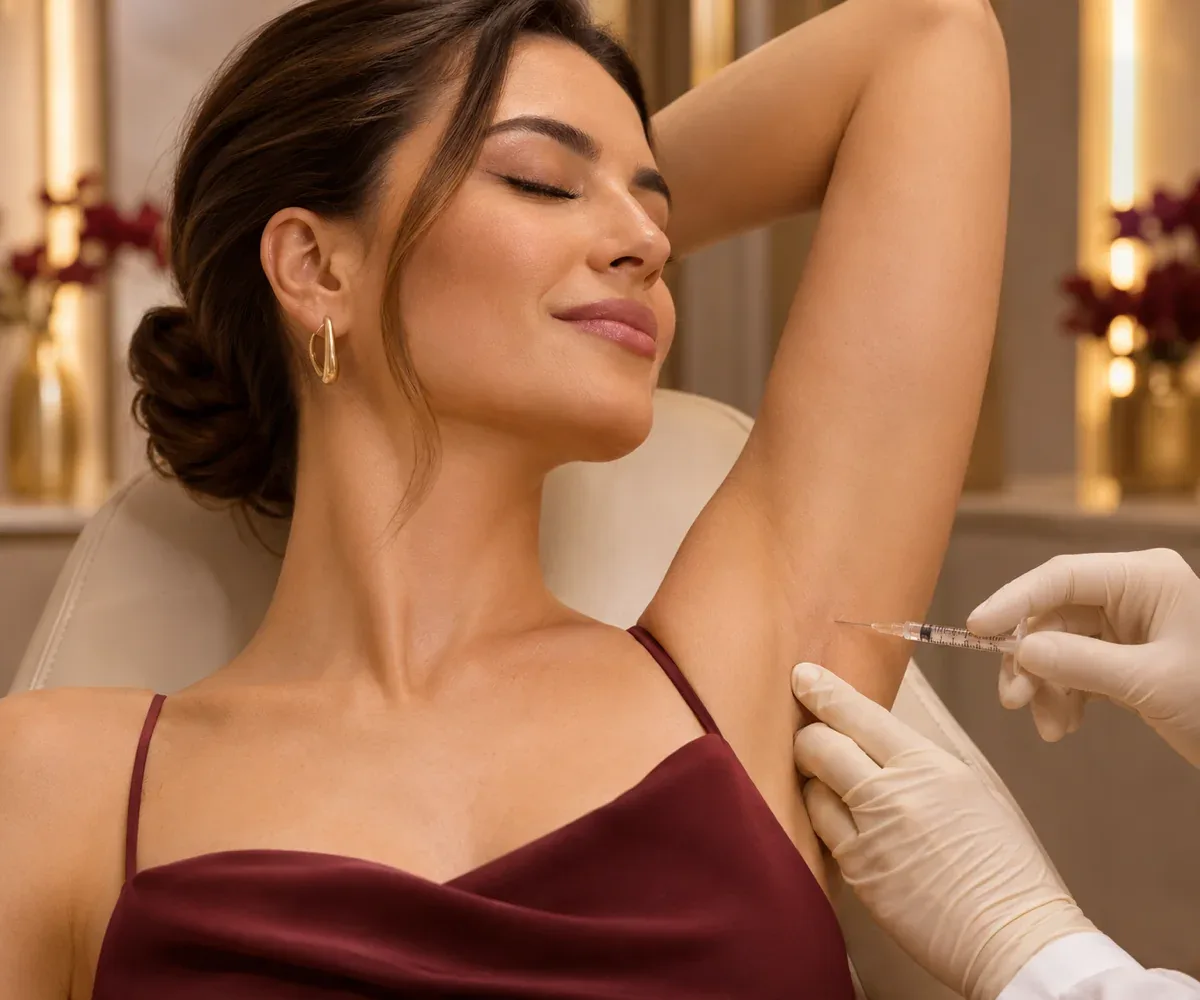
Several very small, superficial injections are made into the skin of the marked area using a fine needle. The duration depends on the area and is discussed during the assessment.

What you feel

Pricks and some discomfort, which vary from person to person. In the underarms, it is usually tolerable. The skin on the palms and soles is more sensitive and the pain tends to be greater, and the doctor will explain how it can be reduced, for example with anaesthesia.

Book an assessment

Afterwards

Recovery and follow-up

Small red marks or a bruise may remain at the injection points and fade within a few days. The effect begins to become noticeable during the first few weeks.

When to return to your routine

You can usually return to your routine on the same day, and the doctor will advise you on the precautions appropriate for your case. If you develop severe pain, fever, spreading redness or pus, contact the clinic. If you have difficulty swallowing or breathing, generalised weakness or double vision, call 112.

Book an assessment
Dr Michelle Campagnoli, clinical director of Clínica Luxmed

Who will look after you

An assessment carried out by the doctor

At Luxmed in Algés, the first step is always an assessment with Dr Michelle Campagnoli. She will examine your skin, determine whether botulinum toxin for excessive sweating is the right option for you and agree a plan with you before any procedure. The assessment fee is deducted if you decide to proceed with treatment.

  • Physical examination and medical historyA conversation about your skin, medication, previous treatments and what you would like to improve, and a careful examination of the area to be treated.
  • A plan tailored to youAreas, number of sessions, intervals and aftercare, explained clearly and without promises.
  • Deducted if you go aheadIf you decide to go ahead with the treatment, the cost of the assessment is deducted. If you prefer not to go ahead, nothing further is asked of you.
Book an assessment

Book a consultation

Book your consultation

Choose how you prefer to get in touch. We will arrange the assessment consultation with Dr Michelle Campagnoli.

Booking through the websiteAssessment consultationTalk to our assistant on WhatsApp and ask for the current price of the assessment.

New Life Miraflores, Algés · Office Center, R. Santa Teresa do Menino Jesus n.º 6, 9.º C, 1495-048

Your details are used only for this contact. Any treatment depends on a prior medical assessment.

Request an appointmentIt takes less than a minute.
Speciality
You do not need to go into detail. The doctor will talk to you during the consultation.
Request received. Our team will contact you as soon as possible.
What is botulinum toxin for excessive sweating?

It is the same family of medicine used for wrinkles, applied in a different way: it is injected into the skin in small doses and blocks the release of acetylcholine, the substance that tells the sweat glands to produce sweat (Heckmann 2001). It reduces sweating only in the treated area, for a few months. Its use in the underarms is the best studied and most widely recognised. It has been studied less in other areas, such as the hands and feet. It is also called a neuromodulator.

How do I know whether my sweating is primary or secondary?

Primary hyperhidrosis, the most common form (around 93 per cent of cases, according to the review by Nawrocki and Cha, 2019), is usually localised and symmetrical, begins early in life and stops during sleep. Secondary hyperhidrosis is more generalised and asymmetrical, and is caused by conditions such as thyroid disease or diabetes, the menopause, infections or medicines. The product information recommends assessing secondary causes before treatment, to avoid treating the symptom alone. This is why the assessment comes first, and the doctor may request tests or refer you to another specialist. New, night-time sweating or sweating accompanied by fever, weight loss or palpitations requires timely medical assessment; outside normal hours, you can call SNS 24 (808 24 24 24).

How does it differ from antiperspirants, tablets and iontophoresis?

Antiperspirant containing aluminium chloride is generally the first step. Tablets (anticholinergics) are reserved for cases that do not respond or for generalised sweating, and have their own side effects. Iontophoresis is the standard option for the hands and feet (Nawrocki and Cha, 2019). Toxin treatment is considered when antiperspirant is not enough or is not tolerated; in severe cases, Canadian guidelines accept it as an initial option alongside antiperspirant (Solish 2007). The doctor will explain the sequence that makes sense in your case.

What about miraDry or surgery?

These are options that the clinic does not provide. They include energy-based technologies, such as microwaves, ultrasound or laser, that damage the glands, and local underarm surgery (curettage, excision or liposuction). Thoracic sympathectomy, surgery on the nerves, is reserved as a last resort and can cause compensatory sweating in other areas of the body (Nawrocki and Cha, 2019; Solish 2007). These options may have a longer-lasting effect, but involve greater risks and the overall evidence is limited (Wade 2018). If the doctor believes one of them is better suited to you, she will tell you frankly.

Botox, Dysport or Xeomin: is there a difference?

These are brand names for botulinum toxin type A. The units of each product are not equivalent, so the doses used in studies cannot be transferred from one product to another. For the underarms, the most frequently cited trials and the product information that recognises the indication relate to one particular product. The product and brand are chosen during the assessment, and the doctor will explain what you can realistically expect.

What happens during the session?

The procedure begins by cleaning the area and, if the doctor considers it appropriate, performing an iodine-starch test to show where the skin sweats most. Several very superficial injections are then given in that area (10 to 15 per underarm in the large underarm trials). Details such as the length of the session are established at the assessment.

Does it hurt?

There are needle pricks and some discomfort, and pain at the injection site is among the most commonly reported reactions in the product information. It is usually tolerable in the underarms. The skin on the palms and soles is more sensitive and may hurt more. The doctor may suggest ways to ease the discomfort, such as anaesthesia, and will tailor them to your case.

How many sessions are needed, and at what intervals?

The doctor decides after the assessment. There is no fixed number of sessions: treatment is repeated when the effect wears off. In trials, injections were repeated only when sweating became bothersome again and never before 8 weeks. In practice, the interval is usually a few months and varies from person to person.

What about the hands and feet?

The clinic also treats the hands and feet with Botulinum toxin or, in some cases, Radiofrequency microneedling, depending on the doctor’s assessment. Use of the toxin in these areas is less well studied and outside the approved indication: the product information states that safety and efficacy in areas other than the underarms have not been established and that treatment of the palms may cause weakness of the hand muscles. The studies are small (for example, 19 people, with no loss of grip strength, in Lowe 2002), and treatment is generally more painful. Canadian guidelines include the toxin for the palms and soles, alongside iontophoresis, depending on severity (Solish 2007). The doctor will assess with you whether it is appropriate and what you can realistically expect.

What about sweating on the face, forehead and scalp?

That is a different situation, with different risks: on the face, the toxin can cause a drooping eyelid, as stated in the product information. This page is about the body. There is a separate page about excessive sweating on the face in the facial aesthetics section, and during the consultation the doctor will assess which area is bothering you.

When will I see the effect, how long does it last, and does it work for everyone?

During the first few weeks. In a European trial involving 320 people, 94% of treated patients had reduced their sweating by at least half at 4 weeks, compared with 36% given a placebo; at 16 weeks, the figures were 82% and 21% respectively (Naumann and Lowe, 2001). In another 52-week trial, the median duration of the effect was approximately 200 days, or about six and a half months (Lowe 2007). It does not work equally well for everyone: in that study, three quarters had an improvement of at least 2 points on the severity scale. The effect is not permanent, and results vary and cannot be guaranteed.

What are the risks and side effects?

The most common effects are pain and minor bleeding or bruising at the injection site. In adult trials, the product information lists other reactions in 3% to 10% of patients: sweating in other areas, infections, sore throat, flu-like symptoms, headaches, fever, neck or back pain, itching and anxiety. In the large European trial, adverse effects were reported by 11% of treated patients and 5% of those given a placebo. Temporary muscle weakness may occur in the hands. Rare but serious signs that the toxin has spread include difficulty swallowing or breathing, generalised weakness or double vision; these require a call to 112 (outside opening hours, SNS 24: 808 24 24 24). At the dose used for the underarms, the product information reports no confirmed cases of serious spread.

Will sweating appear somewhere else?

Sweating in other areas of the body is included among the reactions described in the product information from the underarm trials. It differs from compensatory sweating, which is frequently reported after sympathectomy and is one of the main limitations of that surgery (Nawrocki and Cha, 2019). The doctor will discuss this issue with you during the assessment.

Who should not have it?

As a rule, treatment is postponed or not performed in the event of pregnancy or breastfeeding, infection at the treatment site, neuromuscular conditions such as myasthenia gravis, allergy to the toxin or any of its ingredients, or sweating due to an untreated secondary cause. Anticoagulants and other medicines must be assessed. The product information also states that safety and efficacy in the underarms have not been established in people under 18. The doctor assesses each case.

Is an assessment needed first? Is there a charge?

Yes. All treatments at Clínica Luxmed begin with an assessment consultation with the doctor to establish whether the treatment is appropriate for you. The doctor will ask when and where you sweat, whether you sweat at night, what medical conditions you have, what medicines you take and what you have already tried, and will confirm that the sweating is primary. The cost of the assessment is deducted if you decide to proceed with treatment.

How should I prepare and when can I return to my routine?

Tell the doctor what you take and what you have already tried. If the starch–iodine test is performed, the procedure information specifies shaved underarms with no antiperspirant or deodorant used in the previous 24 hours, and the doctor will tell you what to do. As a rule, you can resume your routine on the same day, but the doctor will advise what is appropriate in your case. The effect takes a few weeks to develop, so if you have an event coming up, mention it during the assessment so the doctor can plan the treatment in advance.

We could not find that question. Ask us on WhatsApp

Scientific references

This page is based on the sources below. Updated on .

  1. Heckmann M, Ceballos-Baumann AO, Plewig G; Hyperhidrosis Study Group. Botulinum toxin A for axillary hyperhidrosis (excessive sweating). N Engl J Med, 2001.
  2. Naumann M, Lowe NJ. Botulinum toxin type A in treatment of bilateral primary axillary hyperhidrosis: randomised, parallel group, double blind, placebo controlled trial. BMJ, 2001.
  3. Lowe NJ, Glaser DA, Eadie N, Daggett S, Kowalski JW, Lai PY; North American Botox in Primary Axillary Hyperhidrosis Clinical Study Group. Botulinum toxin type A in the treatment of primary axillary hyperhidrosis: a 52-week multicenter double-blind, randomized, placebo-controlled study of efficacy and safety. J Am Acad Dermatol, 2007.
  4. Nawrocki S, Cha J. The etiology, diagnosis, and management of hyperhidrosis: a comprehensive review: therapeutic options. J Am Acad Dermatol, 2019.
  5. Nawrocki S, Cha J. The etiology, diagnosis, and management of hyperhidrosis: a comprehensive review: etiology and clinical work-up. J Am Acad Dermatol, 2019.
  6. Solish N, Bertucci V, Dansereau A, Hong HC, Lynde C, Lupin M, Smith KC, Storwick G; Canadian Hyperhidrosis Advisory Committee. A comprehensive approach to the recognition, diagnosis, and severity-based treatment of focal hyperhidrosis: recommendations of the Canadian Hyperhidrosis Advisory Committee. Dermatol Surg, 2007.
  7. Wade R, Llewellyn A, Jones-Diette J, Wright K, Rice S, Layton AM, Levell NJ, Craig D, Woolacott N. Interventional management of hyperhidrosis in secondary care: a systematic review. Br J Dermatol, 2018.
  8. Lowe NJ, Yamauchi PS, Lask GP, Patnaik R, Iyer S. Efficacy and safety of botulinum toxin type A in the treatment of palmar hyperhidrosis: a double-blind, randomized, placebo-controlled study. Dermatol Surg, 2002.
  9. U.S. National Library of Medicine, DailyMed. Prescribing information of a botulinum toxin type A (onabotulinumtoxinA): indicação em hiperidrose axilar primária grave, contraindicações e advertências. DailyMed, 2026.
CallAssistantAvailableBook