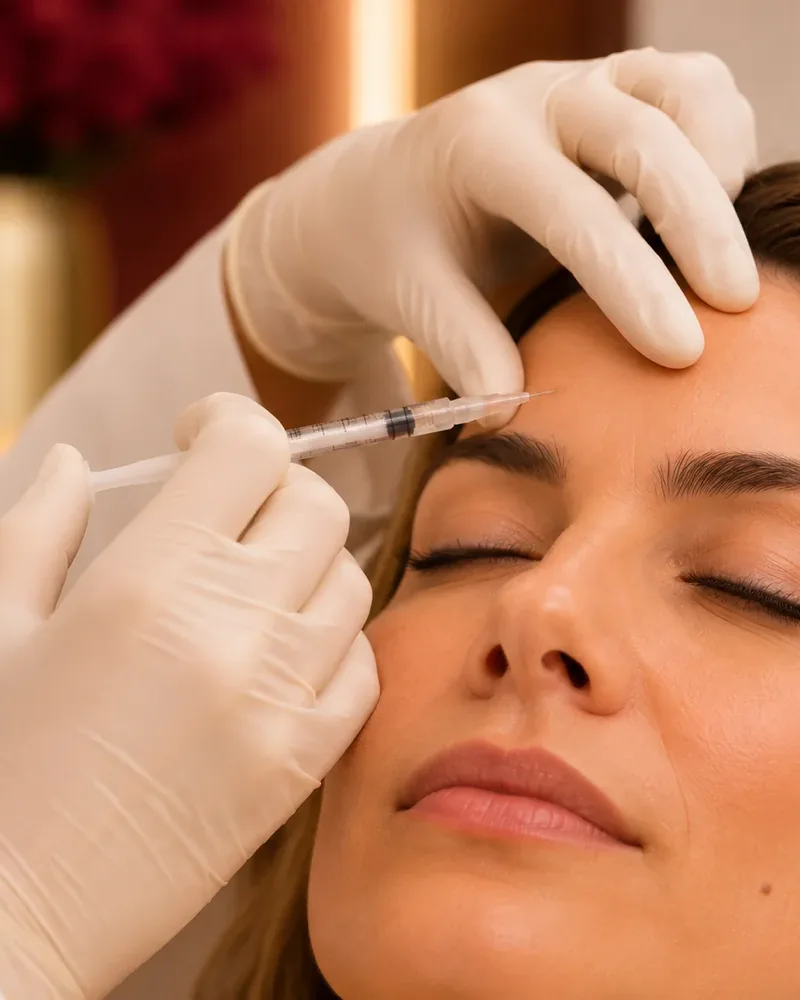
What is botulinum toxin?
It is a medicine made from a purified protein produced by a bacterium and used in very small doses. When injected into a muscle, it blocks the signal sent by the nerve, leaving the muscle more relaxed for several months. In aesthetics, it is used to soften expression wrinkles, particularly on the forehead, between the eyebrows and around the eyes, but also in other areas depending on the assessment. The effect is temporary.
Are ‘Botox’ and botulinum toxin the same thing?
The substance is the same: botulinum toxin type A. ‘Botox’ is a brand name, as are Dysport and Xeomin, and has become the best-known search term. The different brands vary in their preparation, and their dose units are not equivalent. We therefore do not claim that the clinic uses a particular brand: the product and brand are chosen with the doctor at the assessment.
Can all wrinkles be treated with toxin?
No. Toxin works on movement wrinkles, which form when the muscle contracts. When a wrinkle is already visible at rest because the skin has lost thickness and elasticity, toxin alone usually gives a more limited result, and the doctor may recommend combining it with other treatments. The assessment therefore distinguishes movement lines from set lines.
Do anti-wrinkle creams do the same thing?
They do not work in the same way. Toxin relaxes the muscle that forms the wrinkle. Creams generally treat the surface of the skin: they moisturise, protect it from the sun or improve its texture, and help prevent skin ageing. They do not replace toxin for expression lines, but they are a useful addition, and daily sun protection always comes first.
What about a surgical brow lift?
These are different types of option. A surgical brow lift repositions the eyebrow and tissues, with an effect that is generally longer-lasting, but it involves surgery, anaesthesia and several weeks of recovery. Toxin is an injection with almost no recovery, but the effect is temporary and only slight at the eyebrow. Clínica Luxmed does not perform surgery: if the doctor believes at the assessment that surgery would be the best option for you, she will tell you.
Does it hurt? How long does the session take?
Most people describe a brief needle prick because the needle is very fine and the doses at each point are small. The session is usually short. Sensitivity varies, and at the assessment the doctor explains what to expect and whether applying an anaesthetic cream beforehand is appropriate.
When does the effect become visible, and when does movement return?
The effect begins within a few days, usually between day 3 and day 7. In one clinical trial, the median onset was 3 days, and according to the FDA-approved information for a cosmetic toxin, most people had no or mild lines by day 7. The full effect takes about two weeks. Movement then gradually returns, and after 3 to 4 months the lines become visible as before. There is no single before and after result for everyone.
How long does it last, and how often is it repeated?
Usually 3 to 4 months, but it varies from person to person and from area to area. The doctor will tell you what repeat interval is appropriate. Repeating too soon and using high doses increases the risk of the body producing antibodies against the toxin, which may make the treatment less effective, so you should not shorten the intervals on your own.
What aftercare is needed?
Briefly applying a little ice may help reduce swelling and bruising. The 2016 international consensus found no evidence that avoiding pressure on the area, strenuous exercise or air travel changes the result. Even so, follow the doctor's instructions, which may be more cautious. You can usually return to work and your routine the same day.
Can I combine it with other treatments?
It can, when appropriate. Toxin is often combined with hyaluronic acid because they treat different concerns: toxin relaxes the muscle, while hyaluronic acid restores volume or treats folds. The doctor sets the order and interval, and the treatments are sometimes carried out in separate sessions.
Will my face look ‘frozen’?
It does not have to. The 2016 international consensus recommends lower doses in the upper face and an approach that modulates the muscle rather than paralysing it. The aim is to soften lines and preserve expression. A well-chosen dose leaves the expression looking natural, and this is the discussion the assessment is designed for.
What are the risks and adverse effects?
The most common effects are mild and temporary: small marks, redness, bruising and headache in the first few days. Less common and dependent on technique are drooping of the eyelid or eyebrow, which is temporary and may take weeks to settle, and asymmetry of expression. A review of 31 studies cited in the 2016 consensus reported upper eyelid drooping in about 2.5 per cent and eyebrow drooping in about 3.1 per cent. Serious effects are very rare.
Which signs require urgent help?
Difficulty swallowing, breathing or speaking, a very hoarse voice, generalised weakness or double vision at any time after the injection. These can occur from hours to weeks afterwards and result from the toxin spreading to other muscles. If this happens, call 112. Outside opening hours, you can call SNS 24 (808 24 24 24). For mild eyelid drooping or any other concern, contact the clinic.
Who should not have it?
Anyone who is pregnant or breastfeeding, has an allergy to a botulinum toxin or its ingredients, an infection in the treatment area, or a neuromuscular disorder such as myasthenia gravis. Some medicines, such as certain antibiotics, may also increase the effect. The doctor assesses each case.
Is an assessment needed first? Is there a charge?
Yes. All treatments at Clínica Luxmed begin with an assessment consultation with the doctor, where we work out whether the treatment makes sense for you. The cost of the assessment is deducted if you decide to go ahead with the treatment.
Your first time: what happens at the consultation, and what should you ask?
The doctor asks what concerns you, observes your face at rest and in motion, reviews your health history and medication, and explains what the toxin can and cannot do in your case. You can ask: what is realistic to expect, which areas are treated and why, how long it lasts, what risks there are, how treatment is repeated and when to return. If you have an important event, mention it so that we can plan the right time, allowing about two weeks for the effect to settle.