What is Treatment of complications?
It is the medical assessment of a complication or reaction that arose after an aesthetic treatment, followed by a decision on what to do next. The doctor first looks for warning signs, then the cause, and suggests observation, treatment or referral to another speciality. Reversal cannot be promised, and the recommendation depends on what is observed in each case.
What is normal after treatment and what is a complication?
Some redness, swelling and minor bruising at the injection sites are common and will pass: for example, immediate swelling after a filler treatment usually resolves within about a week (Snozzi and van Loghem, 2018). It is a concern if it increases rather than decreases, if the area becomes hard, hot or very painful, or if the skin colour changes. If in doubt, ask the doctor who treated you or book an assessment.
When is it an emergency? When should I call 112?
Call 112 if, after a filler treatment, you experience visual changes, severe pain, a severe headache, or white, purplish or dark skin; if you have difficulty breathing or swallowing, generalised weakness or double vision after Botulinum toxin; if your face or tongue swells rapidly; or if you have a high temperature, spreading redness or pus. The 2018 expert consensus states that loss of circulation to the retina can cause irreversible loss of vision in around 60 to 90 minutes, so time matters. For other concerns outside clinic hours, you can call SNS 24 (808 24 24 24).
What happens at the appointment?
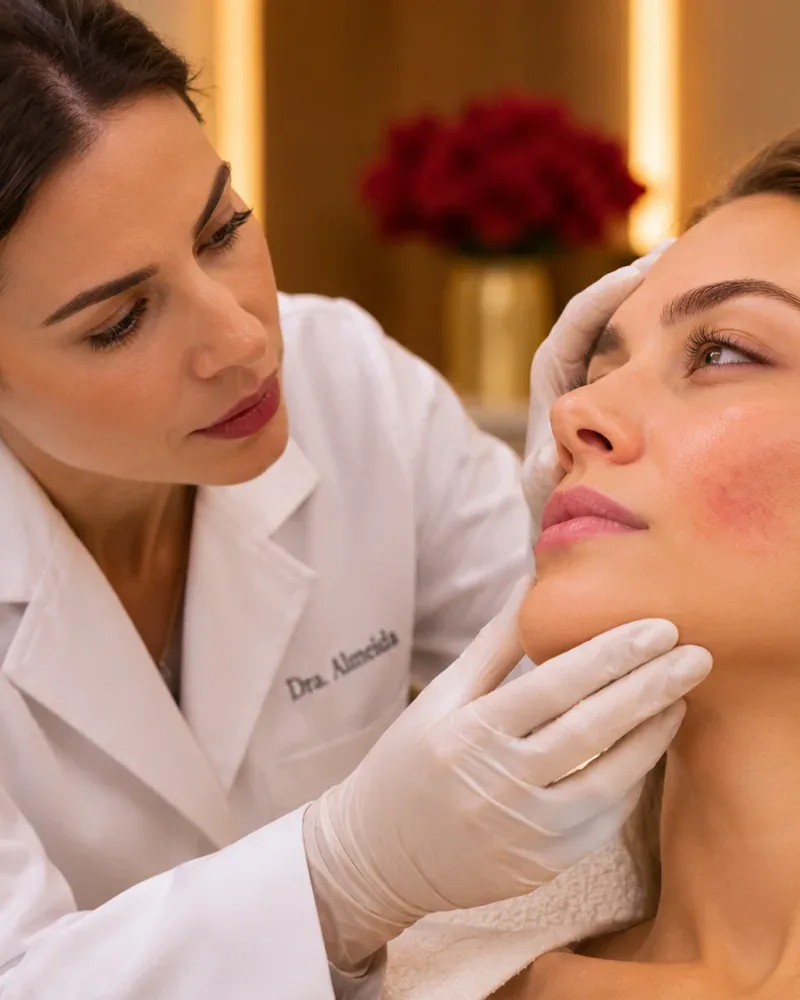
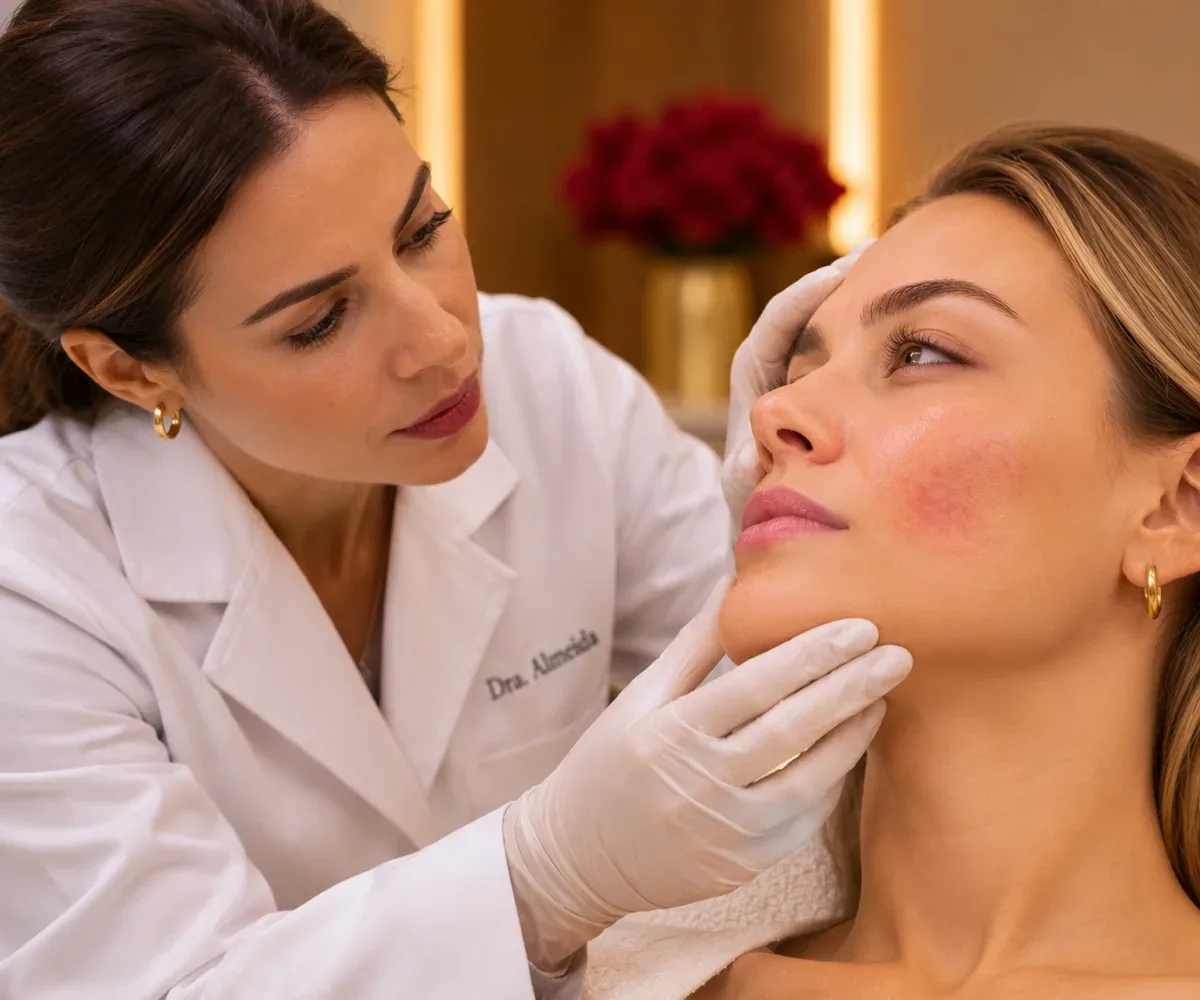
The doctor asks what treatment was carried out, when and where, which product was used, when the problem began and what has changed. She asks about your health, allergies and medication, examines the area and looks for warning signs first. If it is not an emergency, she explains what is happening, what can be done and what to expect, and agrees the next step with you. If there are warning signs, she refers you to the emergency department.
I had a complication at another clinic. Can I book an assessment? What should I bring?
Yes. The doctor assesses what can be seen today and what to do next, without judging who performed the treatment. Bring the name and date of the treatment, where it was carried out, the product card or proof of product if you have it, emergency department reports, a list of your medication and allergies, and photographs of the area from the outset. If there are serious warning signs, do not wait: call 112.
How are burns and discolouration after laser treatment or a peel assessed?
Complications after laser treatment are generally mild and temporary. In a series of 961 fractional laser treatments, around 7.6 per cent involved a complication; the most common were acne-like eruptions and herpes, both in fewer than 2 per cent of cases (Graber et al., 2008). Darkening of the skin after inflammation was more common in darker skin. Discolouration is usually treated with prescribed creams, strict sun protection and, in some cases, intense pulsed light or laser treatment. Blisters, severe pain, pus-filled scabs or signs of infection should be assessed by a doctor; avoid squeezing the area or applying home remedies.
What about herpes after a facial treatment?
Treatments that irritate the skin or the area around the mouth can reactivate cold sores. In a trial involving 99 people who had facial laser treatment and took an antiviral, around 90 per cent had no reactivation, and reactivation was more common in those who had previously had cold sores (Alster and Nanni, 1999). A 2018 consensus recommends postponing injections until the lesions have healed and considering antiviral prevention for people with frequent herpes outbreaks. You should therefore mention at the assessment if you have had herpes before. If you already have lesions, the doctor will assess them and decide on medication.
Infection, delayed-onset nodules and granulomas: what are they and how are they treated?
Infection can arise early or several weeks later. Delayed inflammatory nodules, which appear from 4 weeks to more than a year after treatment, are often linked to a reaction by the body or a low-grade infection involving a film of bacteria (biofilm). Foreign-body granulomas are rare: the 2018 consensus reports a rate of 0.01 to 1.0 per cent. Distinguishing between them requires medical assessment, sometimes including tests, and treatment varies (antibiotics, anti-inflammatory medication, or Hyaluronidase if the product is Hyaluronic acid). The evidence comes mainly from case series and expert opinion. Do not attempt to treat it yourself.
After toxin treatment: headache, asymmetry and an arched eyebrow. Is this normal?
Headache in the days following Botulinum toxin treatment has been reported, and in an analysis of 10,577 reports of reactions to aesthetic toxin treatment (2026 review), it accounted for 4.3 per cent of reactions and was generally treated with standard painkillers. An excessively arched eyebrow, known as a ‘Mephisto brow’, and asymmetry occur when the effect is distributed unevenly across the muscle. Mild cases usually ease as the toxin wears off, and the doctor may consider a small correction. If the pain is severe or unusual, it should be assessed.
My eyelid drooped after toxin treatment. What should I do?
Ptosis, or a drooping eyelid, usually appears within the first week to 10 days and generally resolves within 2 to 4 weeks, although some cases last longer (6 to 12 weeks, according to the 2026 review). Prescribed eye drops, such as apraclonidine or oxymetazoline, raise the eyelid slightly for a few hours but do not shorten recovery time. They should only be used on medical advice. If you have difficulty breathing or swallowing, double vision or eye pain, call 112. Do not massage the area or apply heat yourself.
What is Hyaluronidase and when is it used for complications?
It is an enzyme that dissolves Hyaluronic acid, the product most commonly used in fillers, and it acts only on this substance. Consensus documents describe it as one of the first-line options when a complication, such as loss of circulation to the skin or a nodule, is caused by this type of product, and the earlier it is used, the better. It is administered only by a doctor, carries risks (such as an allergic reaction) and does not guarantee recovery of the skin or vision. When there are serious warning signs, the hospital emergency department is the priority. There is a separate page about Hyaluronidase.
Can the complication be reversed? How long does it take to resolve?
It depends on the cause. Some effects settle on their own within days (mild swelling) or weeks (the effect of the toxin), others take months (some delayed nodules or pigmentation), and some may leave a mark. Reversal is not promised and no timescale is given before examination: the doctor will tell you what is realistic in your case, and the evidence for many treatments of complications is limited.
Should I go to the clinic or the emergency department?
If there are warning signs (visual changes, severe pain, white, purplish or dark skin, difficulty breathing or swallowing, a high temperature, spreading redness or pus), go to the emergency department or call 112. Without these signs, you can book an assessment; outside clinic hours, you can call SNS 24 (808 24 24 24) for advice. Clínica Luxmed is not an emergency service. The emergency department is best for severe cases and has the necessary facilities, while the clinic is an option for non-urgent cases and follow-up.
Is an assessment needed first? Is there a charge?
Yes. All treatments at Clínica Luxmed begin with an assessment consultation with the doctor, to understand what is happening and what course of action makes sense. The cost of the assessment is deducted if you decide to proceed with treatment. If there are serious warning signs, do not wait for this consultation: call 112.
Can I wait to see whether it settles on its own?
In some cases, yes: mild swelling and redness that decrease from day to day usually pass. However, you should not wait if the area is getting worse rather than better, if it is very hard, hot or painful, or if its colour has changed. If in doubt, contact the clinic that treated you or book an assessment; if there are serious warning signs, call 112.
Can I have other treatments while I am recovering?
Generally, no: it is prudent to let the area recover and only decide on further treatments after the assessment. The doctor will tell you when it makes sense to resume treatment, how long to wait and whether a different approach is needed. You should also avoid using irritating products on the area without medical advice.