Algés, Oeiras Mon to Fri · 09:00 to 13:00 and 14:00 to 19:00 · Sat · 09:00 to 14:00
WhatsApp Book a consultation

Body aesthetics

Belly after childbirthWhen the belly has not yet gone back to what it was: stretched skin, separated muscles, fat, or all at the same time

It is normal to leave the maternity ward with the belly still large, and for many women recovery takes a year or more. Part of the change is skin that has stretched, part may be the separation of the rectus abdominis muscles, which is called diastasis, and part is fat. Knowing which of these three weighs most is what guides what to do, and also the right moment to do it. Here we explain how to tell them apart, what is expected at each stage, after a vaginal birth or a caesarean, what helps at home and, only then, what Clínica Luxmed, in Algés, can assess and propose, with the evidence stated frankly.

Reviewed by Dr Michelle Campagnoli, clinical director

  • 60 %had some diastasis at 6 weeks after birth, in one study
  • 1 in 3still had it at 12 months, in that same study
  • Nocommitment
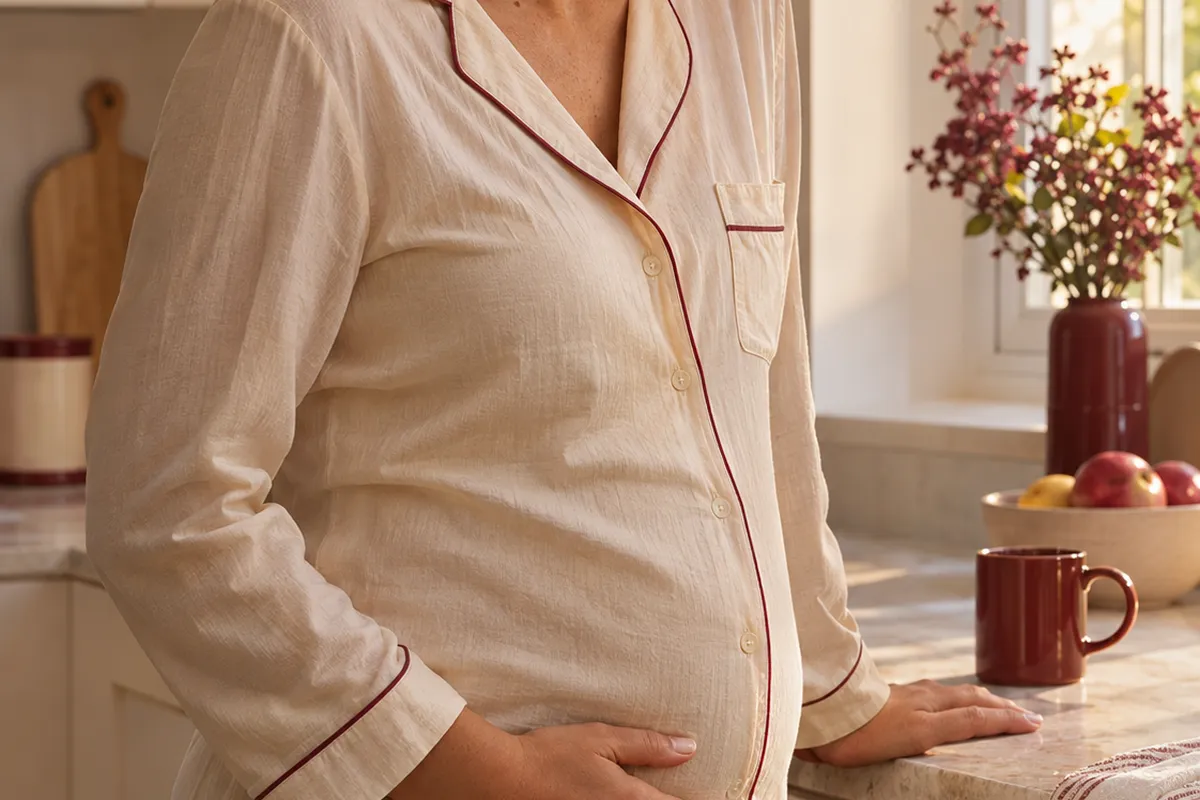
Woman in pyjamas in a kitchen, with one hand on her belly after giving birth

How to recognise it

Is it skin, muscle or fat?

After a birth, the belly rarely changes for a single reason. These signs help you to see what weighs most, before the assessment, and which deserve medical attention.

Tick what you recognise0/7

Tick the signs you recognise in your case. This is not a diagnosis, it is only meant to give you an idea.

Do you have a bulge on the midline or at the navel that grows when you cough or strain, or that hurts? Do you have fever, severe abdominal pain, or is the caesarean scar redder, swollen, painful, discharging pus or opening? Do you have sudden or very heavy bleeding, or a swollen, sore leg? You need medical assessment before any treatment. Out of hours, call SNS 24: 808 24 24 24. If you have sudden shortness of breath, chest pain or fainting, call 112.

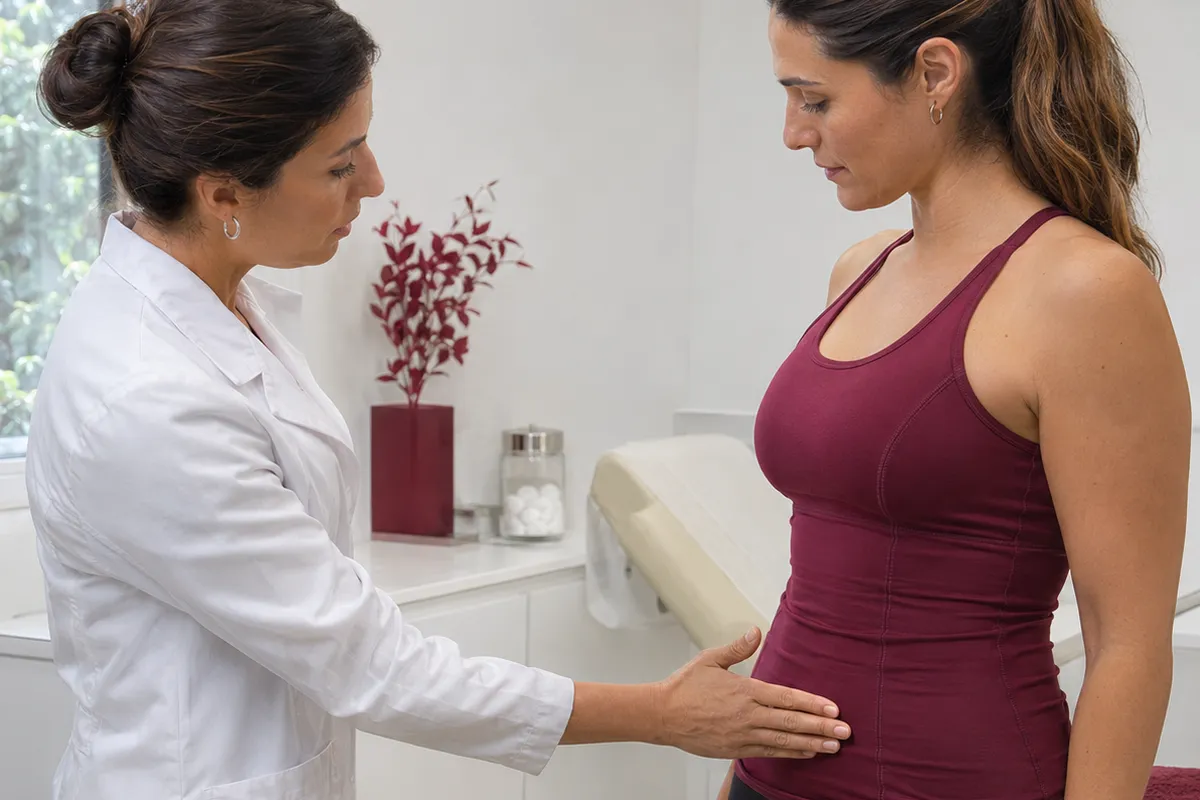
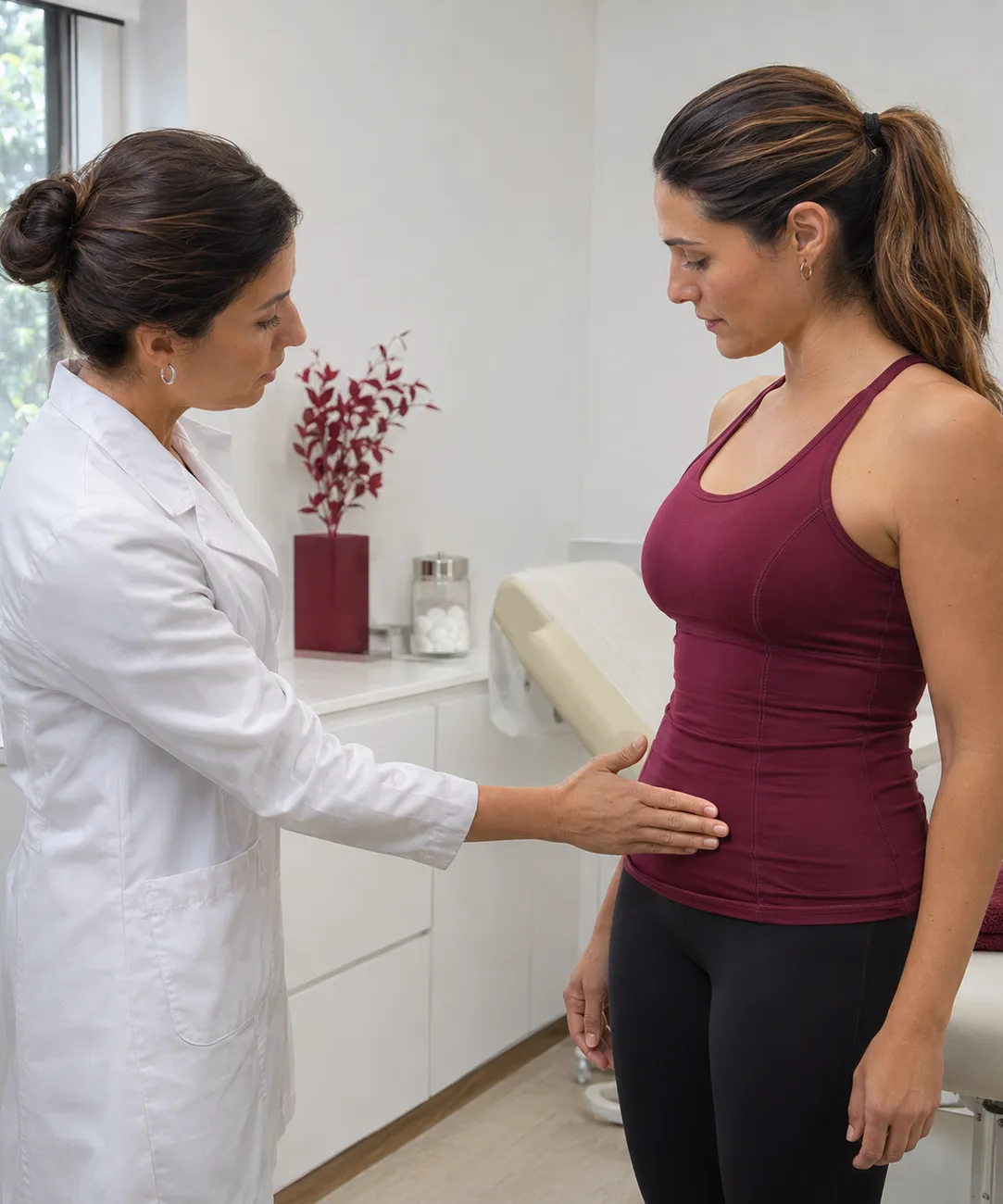
Female doctor in a white coat assessing the abdomen of a woman in gym clothes, in a consulting room
Photograph of a consultation. The dots mark what the doctor is assessing.

Why it happens

What changes in the belly after a pregnancy

The postpartum belly is almost always a sum of factors. Choose one to see how it enters the story and what usually helps.

The skin that stretched

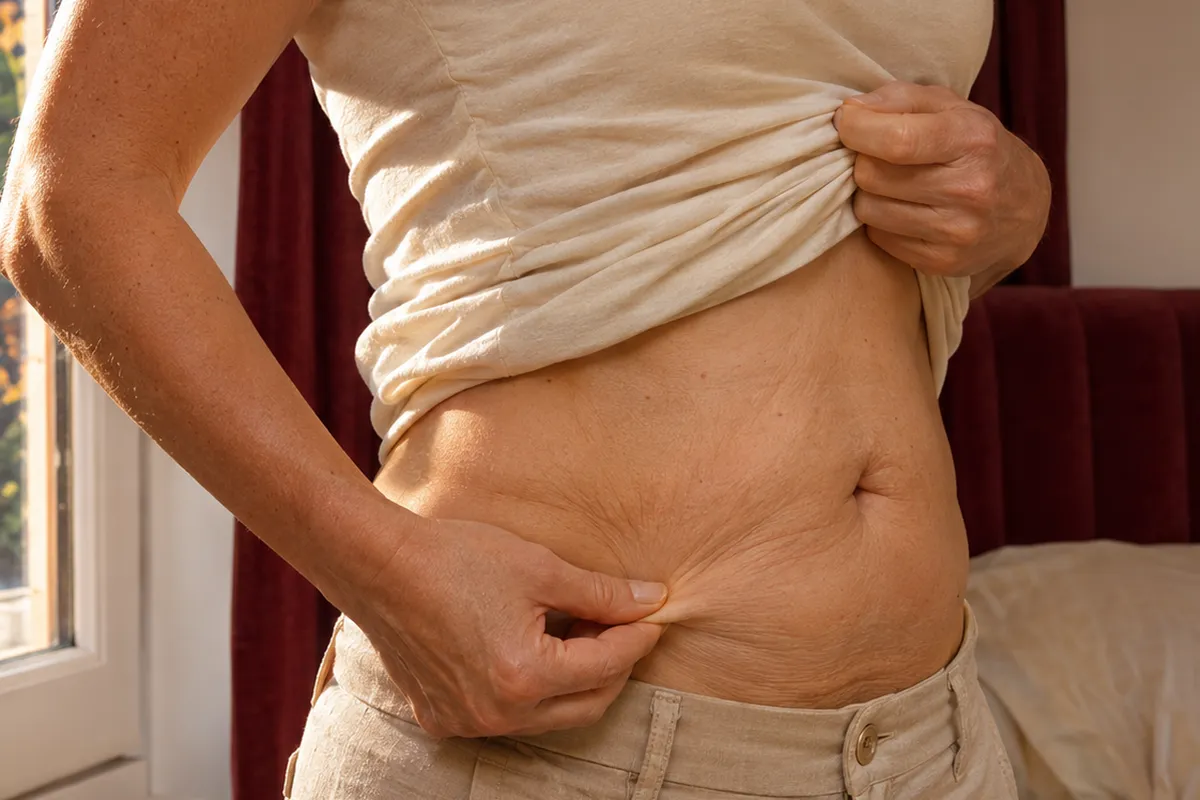
For nine months the skin of the belly stretches to accommodate the womb and the baby. After birth, it recovers in part, over months, but not always completely: it may be thinner, wrinkled and with stretch marks, especially if the pregnancy was with twins, if weight rose a great deal or if the skin has less elasticity through genetics.

What weighs on it

Expecting the skin to go back by itself to what it was within a few weeks, or losing heart when after a month the belly has not yet changed.

What helps

Giving it time (skin recovery is counted in months), moisturising, protecting from the sun and keeping a stable weight, which helps the skin settle.

Normal or to be assessed

Normal recovery or something to assess

In most cases, the postpartum belly is within what is expected. But some situations call for an assessment before any aesthetic treatment.

  • How it looks. The belly is bigger than before, but is getting smaller from week to week and month to month, with the skin a little loose and, perhaps, a slight furrow on the midline.

  • When it is noticed. At the end of the day, after eating, when lifting the head lying down, or in clothes that do not yet fit.

  • What the clinic does. The doctor examines the skin, muscle and scar, confirms that recovery is following what is expected and says when it makes sense to see the case again.

  • At home. Time, guided exercise, a balanced diet, rest and patience: in the first 6 to 12 months, this is what counts most.

Do you have chest pain, sudden shortness of breath, fainting or very heavy bleeding? Call 112. If you have fever, severe pain, a scar with signs of infection, a bulge that is growing or doubts, out of hours you can call SNS 24: 808 24 24 24.

Book an assessment

What the clinic may consider

Options for laxity of the belly after childbirth

The first line is time and what is done outside the clinic: physiotherapy and guided exercise for the trunk and pelvic floor, a balanced diet, stable weight and not smoking. The clinic’s treatments act on the skin and do not close diastasis: marked diastasis or a large excess of skin respond better to physiotherapy and, if necessary, to surgery, which is generally postponed if you want more children. After the assessment, in general after 6 to 12 months, with a stable weight and without pregnancy or breastfeeding, the clinic may consider, for mild to moderate laxity, Sectum radiofrequency or collagen biostimulators, alone or combined. The decision on timing is always the doctor’s. The data are limited: the small trial carried out in women after childbirth used another device, results are gradual, vary from person to person and are not permanent. Nothing is promised before the doctor has examined your case.

Book an assessment
Dr Michelle Campagnoli, clinical director of Clínica Luxmed

First step

Assessment consultation

The doctor listens to what you are experiencing, examines your case and explains the suitable options. No treatment begins without this consultation.

May be considered when

you want to understand the cause and decide on the best path, with time and without commitment.

Book an assessment
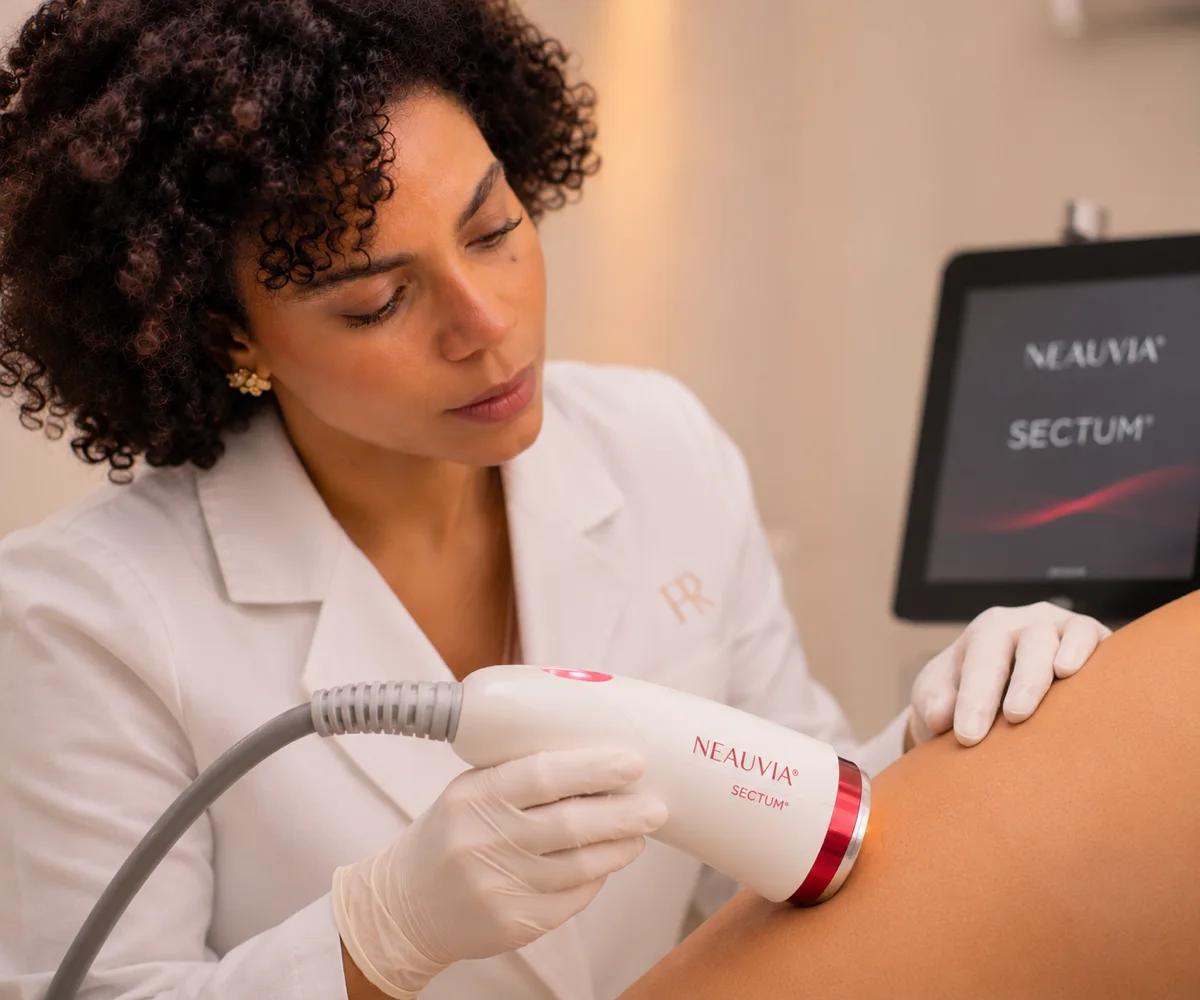
The doctor passing a radiofrequency handpiece over a patient’s thigh or arm, with the device screen in the background

Technology

Sectum radiofrequency Neauvia

Needle-free radiofrequency that heats the skin in depth, with the aim of stimulating collagen and improving the firmness and texture of the skin of the belly. Several sessions are needed and the effect is gradual and moderate. It does not treat diastasis or remove excess skin.

May be considered when

the laxity is mild to moderate, the breastfeeding period has passed, the weight is stable, the scar has healed well and the diastasis has been assessed, and the doctor has explained what is known and what is not known.

Find out more
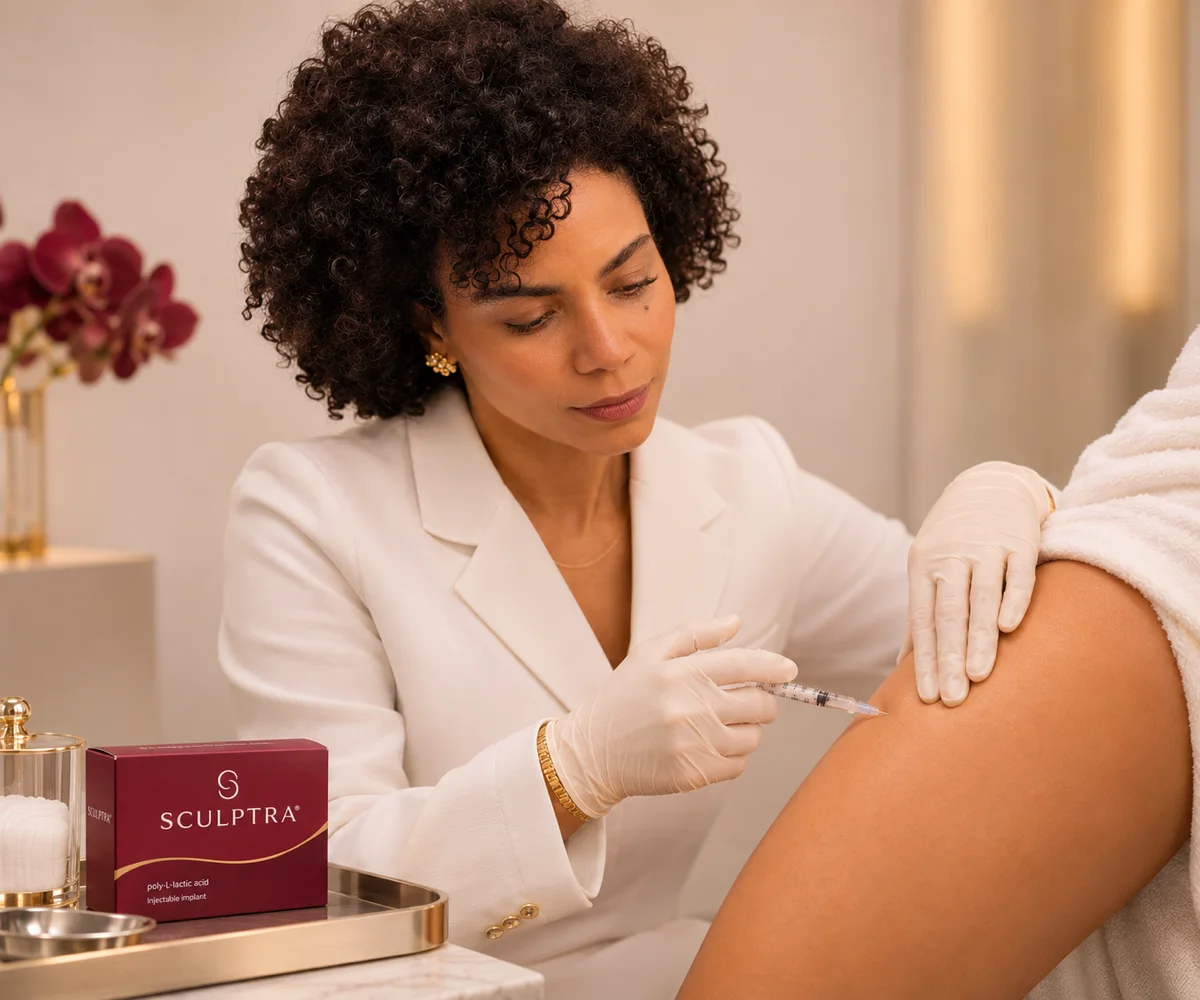
The doctor applying an injection to a patient’s thigh or arm, with a white towel over the shoulder

Injectable

Collagen biostimulators

Injectable substances that lead the skin to produce collagen progressively, over months, to improve firmness and texture. In general a few spaced sessions are carried out. Bruising, swelling and lumps may appear, and data on the belly are still limited.

May be considered when

the laxity is mild to moderate, without large excess skin, you are not pregnant or breastfeeding, the weight is stable, and the doctor has explained the risks and what is realistic to expect.

Find out more

What the journey looks like

From postpartum to a plan tailored to you

No treatment begins without an assessment consultation with the doctor. Most women start with what is simplest, at the right time.

  1. 01At the clinic

    Telling your story

    The doctor asks how long ago the birth was, whether it was vaginal or a caesarean, how many pregnancies you have had, whether you are breastfeeding, whether you plan to have more children, and whether there is pain, urine leakage or problems with the scar.

  2. 02At the clinic

    Examine the belly

    She examines the belly standing and lying down, looks for a furrow or a bulge on the midline when lifting the head, pinches the skin and assesses the scar, to tell skin, muscle and fat apart and rule out a hernia.

  3. 03At home

    Give it time and look after the body

    Activity is resumed gradually, with guidance from a physiotherapist if there is diastasis or urine leakage, and attention is paid to diet and rest. In many cases, time and exercise improve the look considerably.

  4. 04Over time

    Decide the timing

    If the laxity of the skin persists, the doctor explains whether a treatment makes sense, when to do it (in general after the end of breastfeeding and with a stable weight), what can be expected and when the case is for surgery, without promising results.

Day to day

What helps at home

At this stage, what you do every day weighs more than any product, and prepares the body for what comes after.

The golden rule

First time, then the decision

The body needs months to recover from a pregnancy and a birth, and the skin, muscle and weight continue to change during the first year. Deciding quickly on an aesthetic treatment, before the body has stabilised, rarely pays off. First, recovery, physiotherapy and habits; then, with assessment, whatever still bothers you.

Attending the follow-up appointment

Postpartum is a period of continuous care, and the 6 to 8 week appointment also serves to see how recovery is going.

In practice: bring your questions about the belly, the scar, urine leakage and the return to exercise.

Returning to exercise slowly and with guidance

A programme geared to the trunk and pelvic floor is safer than doing sit-ups on your own, especially if there is diastasis.

In practice: start with walks and simple exercises, and ask a physiotherapist to adapt the programme to you.

Eating regularly

The body needs energy and protein to recover, and even more if you are breastfeeding.

In practice: regular meals, protein at each one, and hydration throughout the day.

Looking after the skin and the scar

Moisturising and protecting from the sun helps the skin settle, and the scar calls for watching.

In practice: moisturiser every day, sun protection on the scar, and attention to redness, warmth, swelling or pus.

Dr Michelle Campagnoli, clinical director of Clínica Luxmed

Who will look after you

An assessment carried out by the doctor

At Luxmed, in Algés, the first step is always an assessment with Dr Michelle Campagnoli. She will examine your skin, muscles and scar, determine whether your recovery is progressing as expected, and discuss with you which options may be appropriate and when, before any procedure is carried out.

  • Physical examination and medical historyA discussion about the birth, breastfeeding and plans for the future, followed by an examination of your abdomen while you are standing and lying down.
  • A plan tailored to youA clear plan, without promises, in which time and physiotherapy come first and any treatment is carried out at the right stage.
  • No obligationThe cost of any treatment is confirmed only after the assessment.
Book an assessment

Book a consultation

Book your consultation

Choose how you prefer to get in touch. We will arrange the assessment consultation with Dr Michelle Campagnoli.

Booking through the websiteAssessment consultationTalk to our assistant on WhatsApp and ask for the current price of the assessment.

New Life Miraflores, Algés · Office Center, R. Santa Teresa do Menino Jesus n.º 6, 9.º C, 1495-048

Your details are used only for this contact. Any treatment depends on a prior medical assessment.

Request an appointmentIt takes less than a minute.
Speciality
You do not need to go into detail. The doctor will talk to you during the consultation.
Request received. Our team will contact you as soon as possible.
The belly after childbirth: what is it, and why does it not go back to what it was?

After birth, the belly is almost always a sum of three things: skin that stretched during pregnancy, rectus abdominis muscles that moved apart (diastasis) and fat. The skin and muscle recover in part, over months, and fat depends on weight and habits. In many women recovery takes a year or more, and some things, such as looser skin, may not return completely. Understanding which of these weighs most is the first step.

What is abdominal diastasis and how do I know if I have it?

It is the separation of the two rectus muscles of the belly along the midline. To look for it, lie on your back with your knees bent and lift your head: you may feel a furrow between the muscles, or see a long bulge. It is very frequent: in a study of 300 women in their first pregnancy, 60% had some diastasis at 6 weeks and 32.6% still had it at 12 months. It does not have to hurt, and low back pain was similar in women with and without diastasis. Only an assessment confirms yours.

Big belly after childbirth: how long does it take to recover?

There is no single timescale. In the first weeks the womb shrinks and swelling goes down, and at 6 weeks the womb is near its normal size. Between 3 and 6 months, guided exercise is usually resumed, and between 6 and 12 months the skin, muscles and weight continue to change. The distance between the muscles decreases mainly in the first 2 months, but, on average, does not return to the values of a woman who has not been pregnant at 12 months. After a caesarean, recovery of the abdominal wall is slower.

Is the belly after a caesarean different from that after a vaginal birth?

It can be. A caesarean is surgery on the wall of the belly: recovery is slower, with about 6 weeks until you return to exertion and exercise, and a scar is left that starts red and fades. Some women notice a fold of skin over the scar, or an area that is numb or sensitive. Diastasis and stretched skin happen with both types of birth. If the scar becomes redder, swollen, painful, with pus or opening, or if you have a fever, contact your doctor or SNS 24 (808 24 24 24).

Can I do sit-ups after childbirth?

With diastasis, conventional sit-ups may not be the best choice at first. Guided exercise for the trunk and pelvic floor is more likely to help, but the evidence for diastasis is limited, because studies are small and of low quality. Ask a physiotherapist to adapt a programme, return to activity gradually, and stop if you see a bulge on the midline or feel pain. After a caesarean, only start when the doctor authorises it.

When can I start aesthetic treatments?

There is no date that is the same for everyone. In general it is advised to wait 6 to 12 months and for breastfeeding to end, with a stable weight and a well-healed scar, and to have the diastasis assessed first. Radiofrequency and biostimulators may make sense in mild to moderate laxity. If you want more children, non-surgical treatments are possible, but surgery is usually postponed. The decision on timing is the doctor’s, after the assessment.

Do aesthetic treatments close diastasis or remove excess skin?

No. Radiofrequency and collagen biostimulators target the skin to improve firmness and texture; they do not bring the muscles back together or remove excess skin. For mild diastasis, a supervised exercise programme can improve function; in severe cases, or where there is substantial excess skin, surgery (abdominoplasty) may be discussed. This also repairs the abdominal muscles and is generally postponed until no further pregnancies are planned.

Can Sectum radiofrequency help with abdominal skin laxity after childbirth?

It may help to firm the skin in mild to moderate cases, and radiofrequency is used to treat skin laxity. However, evidence in the postnatal period is limited: a small trial involving 46 women, 6 to 36 months after childbirth, found an average reduction of about 1.4 cm in abdominal circumference at the level of the navel after 3 months. The study used a different device combining radiofrequency and pressure therapy and had a short follow-up period. Several sessions are required, the effect is gradual and modest, and no outcome can be guaranteed. Treatment is generally postponed until breastfeeding has ended.

Can collagen biostimulators be used on the abdomen after childbirth?

They are an option the doctor may consider for mild to moderate skin laxity, following an assessment and once breastfeeding has ended. Reviews show that collagen stimulators are used on the body, including the abdomen, but the published evidence remains limited. A few sessions are carried out at intervals. Discomfort, bruising and swelling may occur, as may palpable nodules at a later stage, particularly if the injection technique is suboptimal. The effect is gradual and not permanent.

When should I see a doctor first?

See your doctor or contact SNS 24 (808 24 24 24) if you have a bulge in your abdomen or at your navel that becomes larger when you strain or is painful, persistent lower back or abdominal pain, urinary leakage, or a caesarean scar that is red, swollen, painful, discharging pus or opening up. Seek medical advice without delay if you have a fever, severe abdominal pain, sudden or very heavy bleeding, or a swollen, painful leg. If you have chest pain, sudden shortness of breath or faint, call 112.

We could not find that question. Ask us on WhatsApp

Scientific references

This page is based on the sources below and was reviewed by Dr. Michelle Campagnoli. Last updated on .

  1. Sperstad JB, Tennfjord MK, Hilde G, Ellström-Engh M, Bø K. Diastasis recti abdominis during pregnancy and 12 months after childbirth: prevalence, risk factors and report of lumbopelvic pain. Br J Sports Med, 2016.
  2. Coldron Y, Stokes MJ, Newham DJ, Cook K. Postpartum characteristics of rectus abdominis on ultrasound imaging. Man Ther, 2008.
  3. Benjamin DR, van de Water AT, Peiris CL. Effects of exercise on diastasis of the rectus abdominis muscle in the antenatal and postnatal periods: a systematic review. Physiotherapy, 2014.
  4. Du Y, Huang M, Wang S, Yang L, Lin Y, Yu W, Pan Z, Ye Z. Diastasis recti abdominis: a comprehensive review. Hernia, 2025.
  5. Victor Baldin A, Bautista Perez IJ, Padilla Sierra MG, Briceño-Suárez M. Superficial Abdominal Skin Laxity Versus Rectus Diastasis: Distinct Pathophysiological Entities With Different Functional and Reconstructive Implications in Modern Abdominoplasty. Cureus, 2026.
  6. American College of Obstetricians and Gynecologists. Committee Opinion No. 736: Optimizing Postpartum Care. Obstet Gynecol (acog.org), 2018.
  7. National Institute for Health and Care Excellence. Postnatal care (NICE guideline NG194). NICE, 2021.
  8. NHS. Caesarean section: recovery. (nhs.uk, acedido 2026-11-11)
  9. NHS. Hernia. (nhs.uk, acedido 2026-11-11)
  10. Neville CE, McKinley MC, Holmes VA, Spence D, Woodside JV. The relationship between breastfeeding and postpartum weight change: a systematic review and critical evaluation. Int J Obes (Lond), 2014.
  11. Beasley KL, Weiss RA. Radiofrequency in cosmetic dermatology. Dermatol Clin, 2014.
  12. Fritz K, Salavastru C, Gyurova M. Reduction of abdominal skin laxity in women postvaginal delivery using the synergistic emission of radiofrequency and targeted pressure energy. J Cosmet Dermatol, 2018.
  13. Christen MO. Collagen Stimulators in Body Applications: A Review Focused on Poly-L-Lactic Acid (PLLA). Clin Cosmet Investig Dermatol, 2022.
  14. Vleggaar D, Fitzgerald R, Lorenc ZP. Understanding, avoiding, and treating potential adverse events following the use of injectable poly-L-lactic acid for facial and nonfacial volumization. J Drugs Dermatol, 2014.
  15. American Society of Plastic Surgeons. Tummy tuck (abdominoplasty). plasticsurgery.org, 2026.
CallAssistantAvailableBook