
Algés, Oeiras Mon to Fri · 09:00 to 13:00 and 14:00 to 19:00 · Sat · 09:00 to 14:00
WhatsApp Book a consultation

Body aesthetics

Abdominal laxityWhen the belly is no longer as firm: loose skin, weakened muscle, fat, or all at the same time

“Flabby belly” is an expression that encompasses different problems: skin that has lost firmness, weakened or separated abdominal muscles and fat, often in combination. It can occur after pregnancy or weight loss, with age and the menopause, and is not a sign of either self-care or neglect. Here we explain how to distinguish the three layers, what causes these changes, what can help at home, what Clínica Luxmed, in Algés, may offer after a medical assessment, how this is supported by the evidence, and when referral to another specialty is appropriate.

Reviewed by Dr Michelle Campagnoli, clinical director

  • 3layers to tell apart: skin, muscle and fat
  • 1assessment, always first
  • Nocommitment
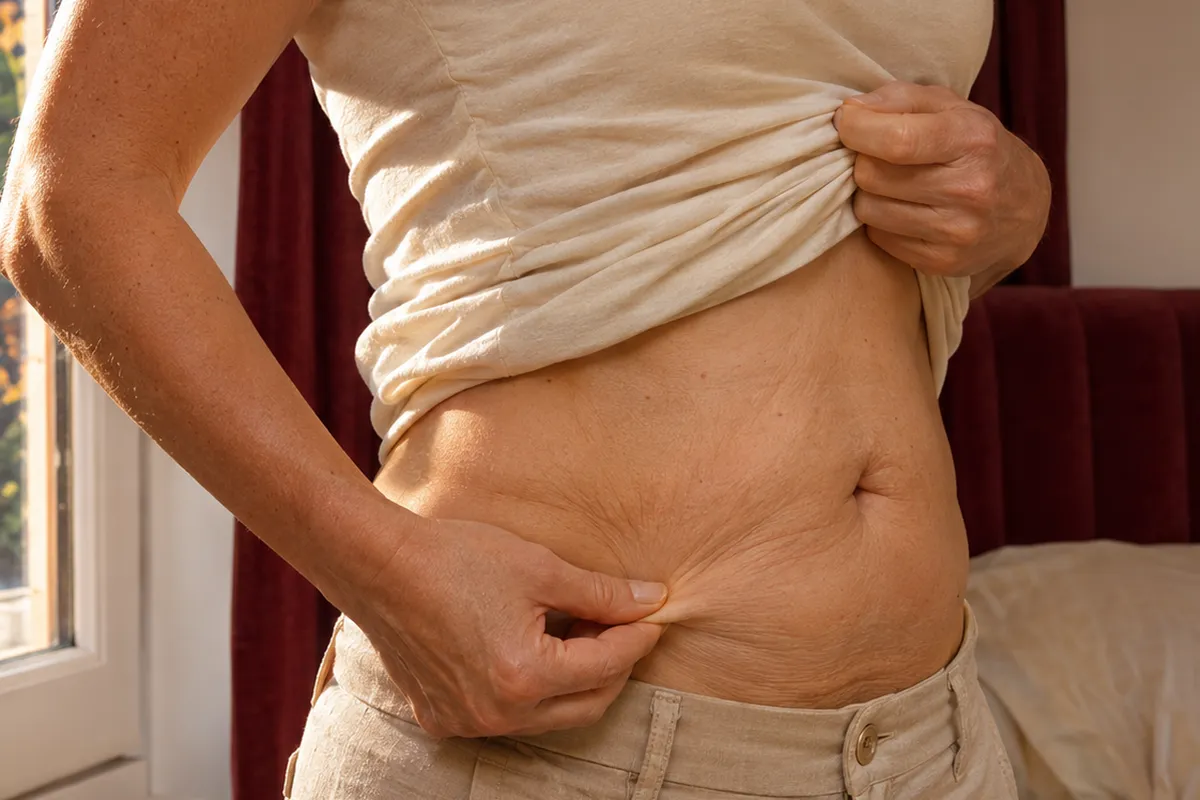
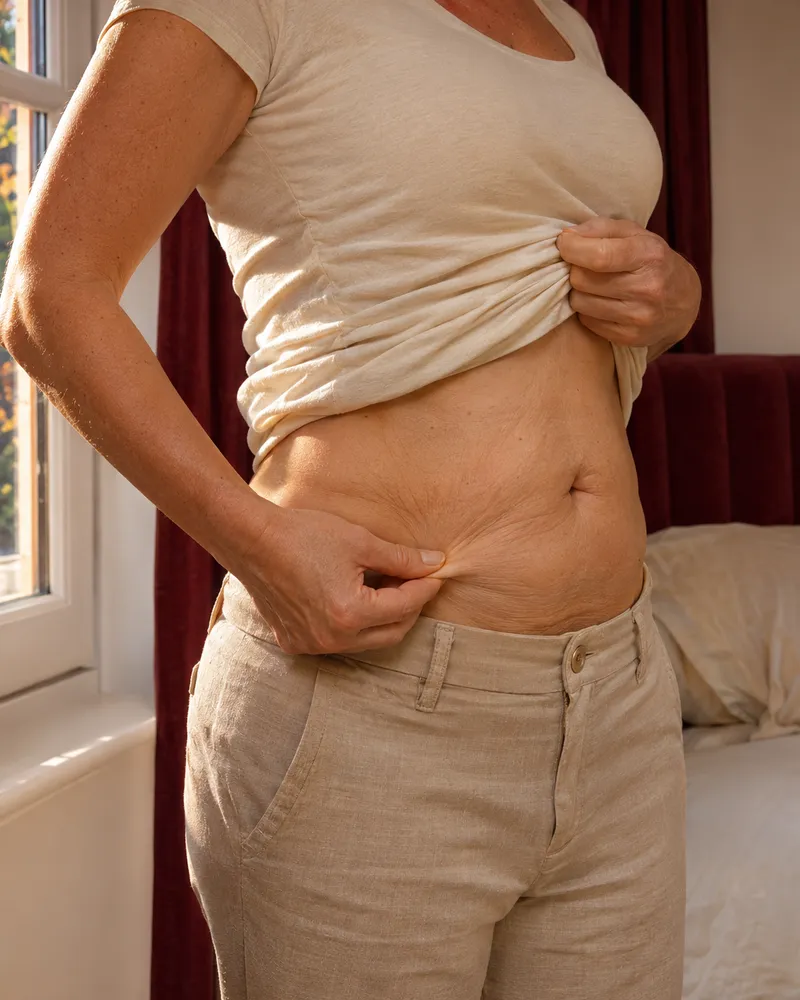
Woman holding the loose skin of her abdomen between her fingers, beside a window

How to recognise it

Is it skin, muscle or fat?

All three may be present at the same time. These signs can help you understand which factor contributes most to the appearance of your abdomen before speaking to the doctor. They are not a diagnosis.

Tick what you recognise0/7

Tick the signs you recognise in your case. This is not a diagnosis, it is only meant to give you an idea.

A bulge at the navel or on the midline, abdominal pain, or a belly that “changes” when you strain, should be seen by a doctor before any treatment, because it may be a hernia. A belly that has grown quickly and without explanation is not laxity either. If in doubt, call the SNS 24 line (808 24 24 24). Severe, sudden pain in a bulge that does not go back in, with vomiting or a hard belly, is an emergency: call 112.

Female doctor in a white coat assessing the abdomen of a woman in gym clothes, in a consulting room
Photograph of a consultation. The dots mark what the doctor is assessing.

Why it happens

What weighs on abdominal laxity

It is rarely just one thing. Choose a cause to see how it acts, what makes it worse and what usually helps.

Pregnancy and childbirth

During pregnancy, the skin of the abdomen stretches and the two rectus muscles, which run on either side of the midline, move apart. This is diastasis recti, which is common during and after pregnancy and is associated with reduced stability of the core and pelvic floor. A systematic review concluded that exercise during pregnancy reduced the presence of diastasis by about a third and suggested that exercise after childbirth may reduce the separation, although only a few studies were available.

What makes it worse

Doing repeated traditional sit-ups without knowing whether you have diastasis, or assuming that your abdomen has “gone back” without having the midline assessed.

What helps

Guided exercise for the trunk and pelvic floor, preferably with a physiotherapist, and an assessment of the midline.

Normal or to be assessed

Ordinary laxity or something to assess?

Most cases of abdominal laxity are benign and relate to the skin and fat. However, some signs indicate that a different approach is needed, and these should be distinguished before considering any treatment.

  • How it looks. Thin skin with folds that hangs down when you bend forwards, or a thick, soft fold that you can grasp with your hand.

  • How to test. Pinch the skin: if it is thin and takes a while to return, there is skin laxity; if the fold is thick and soft, there is fat.

  • What usually helps. Strength training, stable weight, not smoking, sun protection and, if the doctor thinks it appropriate, a treatment that stimulates collagen.

  • What is realistic. A gradual, moderate improvement in appearance and firmness. Severely stretched skin rarely returns to normal with home measures alone.

  • Tell us at the consultation. When the change began, whether you have been pregnant or lost weight, whether you smoke and what medication you take.

Not sure whether it is skin, muscle or fat? It is the most common question. Book an assessment and the doctor examines the three layers, explains what weighs most and where it makes sense to start.

Book an assessment

What the clinic can do

Options for laxity of the belly

First-line measures take place outside the clinic: strength and core training, maintaining a stable weight, getting enough protein, not smoking and protecting the skin from the sun. Severely stretched skin rarely returns to normal with home measures alone, and significant excess skin or marked diastasis recti respond better to surgery and physiotherapy than to any in-clinic treatment. For mild to moderate laxity, without significant excess skin and with a stable weight, the clinic may suggest collagen biostimulators or radiofrequency, alone or in combination, following a medical assessment. Results are gradual, vary from person to person and are generally moderate and not permanent. Evidence for the abdomen is more limited than for the face, and no outcome can be promised before the doctor has assessed your individual case.

Book an assessment
Dr Michelle Campagnoli, clinical director of Clínica Luxmed

First step

Assessment consultation

The doctor listens to what you are experiencing, examines your case and explains the suitable options. No treatment begins without this consultation.

May be considered when

you want to understand the cause and decide on the best path, with time and without commitment.

Book an assessment
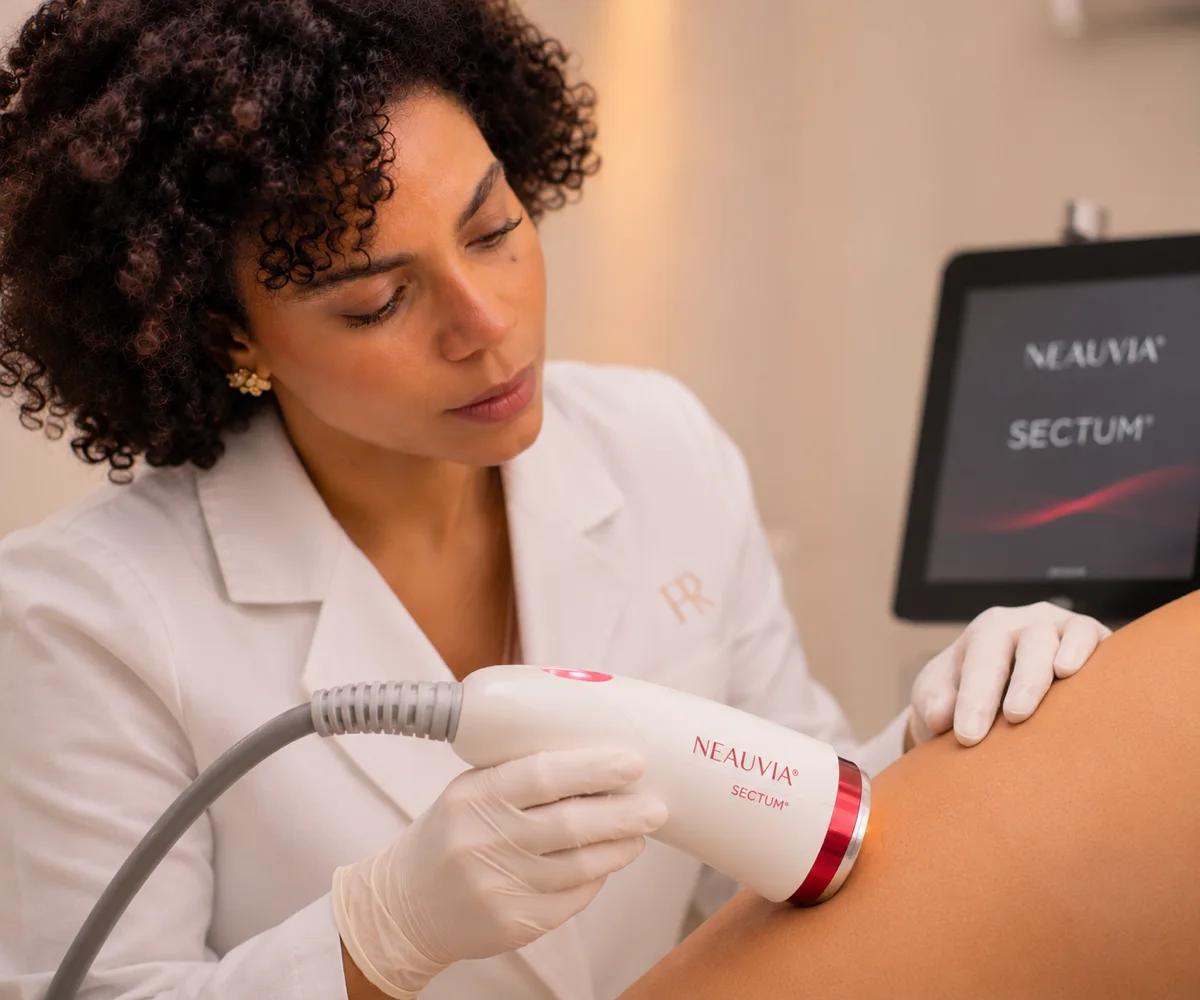
The doctor passing the radiofrequency handpiece over an area of a patient’s body, with the device screen in the background

Technology

Sectum radiofrequency Neauvia

Needle-free radiofrequency heats the deeper layers of the skin with the aim of stimulating collagen and improving firmness. Several sessions are needed, and the effect is gradual and moderate. Studies on the abdomen are small and use different devices, so no particular result can be promised.

May be considered when

the laxity is mild to moderate, the weight is stable, there is no large excess skin or contraindications, the doctor has explained what is known and what is not known, and expectations are realistic.

Find out more
The doctor administering an injectable biostimulator into a patient’s arm, with a white towel over the shoulder

Injectable

Collagen biostimulators

Injectable substances, such as poly-L-lactic acid or calcium hydroxylapatite, which stimulate the skin to produce collagen over a period of months. In general, 2 to 3 sessions are performed at intervals. Some products are used off-label on the body, and bruising, swelling and nodules may occur.

May be considered when

the laxity is mild to moderate, with no significant excess skin, the weight is stable, the assessment has ruled out contraindications and the doctor has explained the risks and limitations, including off-label use on the body.

Find out more

What the journey looks like

From the first assessment to follow-up

No treatment starts without an assessment consultation with the doctor. This is how it works.

  1. 01At the clinic

    Assessment consultation

    The doctor listens to your concerns, asks about pregnancies and births, weight loss, surgery, smoking, exercise, lower back pain, urine leakage and medication, and records when the changes to your abdomen began.

  2. 02At the clinic

    Examine the three layers

    She examines your abdomen while you are standing and lying down, pinches the skin, checks for a groove or bulge along the midline and measures your waist to distinguish between skin, muscle and fat and rule out a hernia or another cause.

  3. 03At the clinic

    Explain what is realistic

    She explains frankly which factor contributes most, what can be addressed through exercise and lifestyle changes, what the clinic can offer and when physiotherapy or plastic surgery is more appropriate, without promising results.

  4. 04Over time

    Plan and follow-up

    If it makes sense, she proposes the treatment, the number of sessions and the interval, explains risks and contraindications and examines the skin again to adjust the plan. Skin changes slowly, and the plan follows that pace.

Day to day

What helps at home

What you do every day matters more than any cream and lays the groundwork for any treatment.

The golden rule

First muscle and habits

The skin on the abdomen will not return to its previous state with creams alone. The underlying muscle and factors that damage the skin, such as smoking and weight fluctuations, are the things you can do most about at home. A stronger core and a stable weight improve the overall appearance and create better conditions for any treatment.

Guided strength and trunk training

Exercise strengthens the muscles and improves abdominal support. If you have been pregnant or diastasis recti is suspected, it is advisable to choose exercises under professional guidance.

In practice: start with what your condition allows and ask a physiotherapist or an exercise professional for guidance, especially after a pregnancy.

Adequate protein and stable weight

Adequate protein helps to maintain muscle when losing weight, and a stable weight gives the skin time to adapt.

In practice: if you are losing weight, agree the pace and amount of protein with your doctor or dietitian, without radical diets.

Not smoking and protecting from the sun

Smoking breaks down collagen in the skin, and cumulative sun exposure weakens its supporting structure.

In practice: ask for help to stop smoking and use sun protection on exposed areas. Moisturising improves the look and comfort, but not deep firmness.

The three-layer test

Knowing whether it is skin, muscle or fat helps to choose what to do.

In practice: pinch the skin and, lying down, lift your head slightly to see the midline. Always photograph in the same light and in the same position, and bring the images to the consultation.

Dr Michelle Campagnoli, clinical director of Clínica Luxmed

Who will look after you

An assessment carried out by the doctor

At Luxmed, the first step is always an assessment with Dr Michelle Campagnoli at the clinic in Algés. She examines the skin, muscle and fat of the abdomen, rules out other causes and develops a plan with you before any treatment.

  • Physical examination and medical historyAssessment of the three layers, the midline, waist circumference and medication, as well as any signs that indicate the need for a different approach, such as a hernia.
  • A plan tailored to youA tailored plan that starts with what you can do at home. Only then, if appropriate, will the doctor suggest a treatment and explain its risks and the supporting evidence.
  • No obligationThe cost of any treatment is confirmed only after the assessment.
Book an assessment

Book a consultation

Book your consultation

Choose how you prefer to get in touch. We will arrange the assessment consultation with Dr Michelle Campagnoli.

Booking through the websiteAssessment consultationTalk to our assistant on WhatsApp and ask for the current price of the assessment.

New Life Miraflores, Algés · Office Center, R. Santa Teresa do Menino Jesus n.º 6, 9.º C, 1495-048

Your details are used only for this contact. Any treatment depends on a prior medical assessment.

Request an appointmentIt takes less than a minute.
Speciality
You do not need to go into detail. The doctor will talk to you during the consultation.
Request received. Our team will contact you as soon as possible.
What is abdominal laxity?

It is a loss of firmness in the abdomen. In practice, it involves three factors, which may occur separately or together: skin that has lost firmness, weakened or separated abdominal muscles, and fat. It occurs with age and the menopause, after pregnancy or weight loss, and as a result of factors such as smoking. It is very common and usually not serious, but it is important to determine which layer is the main contributor because each requires a different approach.

How do I know whether it is skin, muscle or fat?

There are simple tests, although they are no substitute for an assessment. Skin: pinch it; if it is thin, forms folds and takes a while to spring back, there is skin laxity. Fat: a thick, soft fold that you can grasp with your hand. Muscle: while lying down, lift your head slightly; a groove or bulge along the midline suggests diastasis recti. Many people have a combination. The doctor examines all three layers and tells you which is the main contributor.

What is diastasis recti, and can conventional sit-ups correct it?

It is the separation of the two rectus abdominis muscles along the midline. It is more common after pregnancy, but also occurs around the menopause and in men, particularly with obesity and increasing age. In mild cases, supervised core exercises improve function, while severe cases may require surgery. Conventional sit-ups are not always suitable for people with diastasis recti, so seek guidance from a physiotherapist or doctor before doing repeated sets.

Abdominal laxity: what helps at home?

The measures with the strongest supporting evidence are supervised strength and core training, a balanced diet with enough protein, maintaining a stable weight, not smoking and protecting the skin from the sun. Moisturising improves the skin’s appearance and comfort, but not its firmness at a deeper level. Severely stretched skin rarely returns to normal with home measures alone, so an assessment can help establish what improvement can realistically be expected.

Do firming creams, girdles and collagen supplements work?

Girdles and plastic wraps intended to make you “sweat” do not help. Firming creams have a slight, temporary effect, and massage temporarily improves circulation and appearance. For oral collagen, a meta-analysis of trials found improvements in skin hydration, elasticity and wrinkles, but evidence for body laxity is limited, and none of these measures is a substitute for exercise and healthy habits.

How do collagen biostimulators work on the belly?

They are injectable substances, such as poly-L-lactic acid or calcium hydroxylapatite, that trigger a controlled response and stimulate the body to produce new collagen over a period of months. In general, 2 to 3 sessions are performed at intervals of 4 to 8 weeks, and results develop gradually over 2 to 6 months and are moderate. They are intended for mild to moderate laxity, without significant excess skin and with a stable weight. Evidence for the body is more limited than for the face and some products are used off-label on the body, which the doctor will explain beforehand.

And radiofrequency? How many sessions and how long does the effect last?

Radiofrequency heats the skin without needles, with the aim of contracting collagen fibres and stimulating new collagen. Several sessions are carried out and the result is gradual and moderate. Studies on the abdomen are small, for example in women with mild laxity after childbirth, and devices differ from one another, so a result cannot be promised. For biostimulators, many studies report 1 to 2 years, with a lot of individual variation, and for radiofrequency the duration varies and is not guaranteed. The assessment defines the number of sessions and the interval.

What risks do they have and who should not have them?

With biostimulators, the most common effects are discomfort, bruising and swelling, and nodules may develop, sometimes weeks later; these resolve in most cases, while granulomas are rare. Radiofrequency is generally well tolerated and involves little downtime, but it can cause redness and discomfort. Contraindications include pregnancy, breastfeeding, local infection and active autoimmune disease, so a medical assessment must always come first. Tell the doctor what medication you take and what procedures you have previously undergone.

When can excess skin no longer be addressed with in-clinic treatments?

When there is a significant amount of excess skin that forms heavy folds, causes discomfort or chafing, or limits activity, as is common after major weight loss. In these cases, the issue is the amount of excess skin rather than its firmness, and assessment by a plastic surgeon is appropriate. Marked diastasis recti may also require physiotherapy or surgery. In-clinic treatments are intended for mild to moderate laxity, and the doctor will give you an honest assessment of where you stand.

When should I see a doctor first, and what do I bring to the assessment?

Before any treatment, seek medical advice if you have a bulge at the navel or along the midline, pain, an abdomen that “changes” when you strain, urine leakage after childbirth, or if your abdomen has enlarged rapidly without explanation. If in doubt, call SNS 24 (808 24 24 24); severe, sudden pain in a bulge that cannot be pushed back in, accompanied by vomiting or a rigid abdomen, is an emergency and warrants calling 112. At the assessment, provide your history of pregnancies and births, weight changes over time, surgery, medication and previous treatments, and say whether you are pregnant, may be pregnant or are breastfeeding.

We could not find that question. Ask us on WhatsApp

Scientific references

This page is based on the sources below and was reviewed by Dr. Michelle Campagnoli. Last updated on .

  1. Farage MA, Miller KW, Elsner P, Maibach HI. Characteristics of the Aging Skin. Advances in wound care, 2013.
  2. Benjamin DR, van de Water AT, Peiris CL. Effects of exercise on diastasis of the rectus abdominis muscle in the antenatal and postnatal periods: a systematic review. Physiotherapy, 2014.
  3. Du Y, Huang M, Wang S, Yang L, Lin Y, Yu W, Pan Z, Ye Z. Diastasis recti abdominis: A comprehensive review. Hernia : the journal of hernias and abdominal wall surgery, 2025.
  4. Victor Baldin A, Bautista Perez IJ, Padilla Sierra MG, Briceño-Suárez M. Superficial Abdominal Skin Laxity Versus Rectus Diastasis: Distinct Pathophysiological Entities With Different Functional and Reconstructive Implications in Modern Abdominoplasty. Cureus, 2026.
  5. Elander A, Biörserud C, Fagevik Olsén M. Excess skin after weight loss following bariatric surgery: focus on the abdomen. Surgery for obesity and related diseases : official journal of the American Society for Bariatric Surgery, 2021.
  6. Cava E, Yeat NC, Mittendorfer B. Preserving Healthy Muscle during Weight Loss. Advances in nutrition (Bethesda, Md.), 2017.
  7. Caturano A, Amaro A, Berra CC, Conte C. Sarcopenic obesity and weight loss-induced muscle mass loss. Current opinion in clinical nutrition and metabolic care, 2025.
  8. Morita A. Tobacco smoke causes premature skin aging. Journal of dermatological science, 2007.
  9. Ross R, Neeland IJ, Yamashita S, Shai I, Seidell J, Magni P, Santos RD, Arsenault B, Cuevas A, Hu FB, Griffin BA, Zambon A, Barter P, Fruchart JC, Eckel RH, Matsuzawa Y, Després JP. Waist circumference as a vital sign in clinical practice: a Consensus Statement from the IAS and ICCR Working Group on Visceral Obesity. Nature reviews. Endocrinology, 2020.
  10. de Miranda RB, Weimer P, Rossi RC. Effects of hydrolyzed collagen supplementation on skin aging: a systematic review and meta-analysis. International journal of dermatology, 2021.
  11. Beasley KL, Weiss RA. Radiofrequency in cosmetic dermatology. Dermatologic clinics, 2014.
  12. Fritz K, Salavastru C, Gyurova M. Reduction of abdominal skin laxity in women postvaginal delivery using the synergistic emission of radiofrequency and targeted pressure energies. Journal of cosmetic dermatology, 2018.
  13. Christen MO. Collagen Stimulators in Body Applications: A Review Focused on Poly-L-Lactic Acid (PLLA). Clinical, cosmetic and investigational dermatology, 2022.
  14. Fitzgerald R, Bass LM, Goldberg DJ, Graivier MH, Lorenc ZP. Physiochemical Characteristics of Poly-L-Lactic Acid (PLLA). Aesthetic surgery journal, 2018.
  15. Vleggaar D, Fitzgerald R, Lorenc ZP. Understanding, avoiding, and treating potential adverse events following the use of injectable poly-L-lactic acid for facial and nonfacial volumization. Journal of drugs in dermatology : JDD, 2014.
  16. NHS. Hernia. (NHS, acedido 2026-11-11)
CallAssistantAvailableBook