Algés, Oeiras Mon to Fri · 09:00 to 13:00 and 14:00 to 19:00 · Sat · 09:00 to 14:00
WhatsApp Book a consultation

Body aesthetics

Laxity on the legs and thighsWhen the skin on the legs and thighs has lost firmness and you want to understand what can change

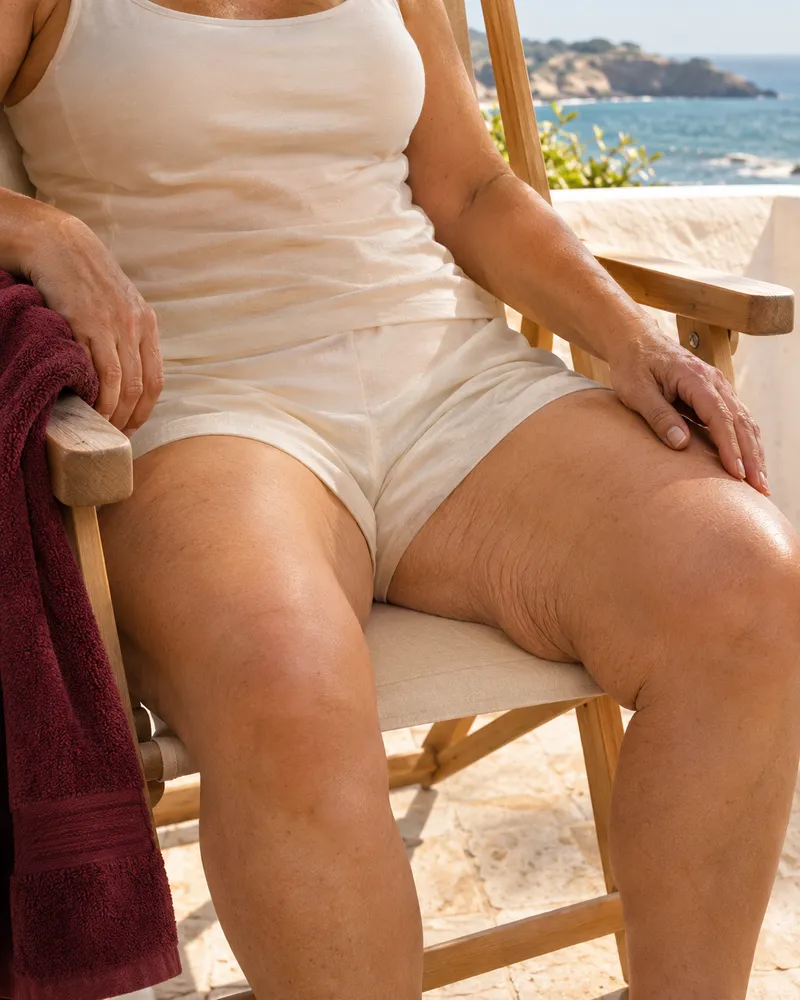
Leg laxity is most noticeable on the inner thighs and above the knees, where the skin is thinner and has less support. It becomes more wrinkled, with a crepey appearance, and may seem to hang when you walk or bend your leg. There is rarely a single cause: age, the menopause, weight fluctuations, muscle loss, sun exposure and genetics all contribute. Here, we explain the usual causes, what you can do first, what radiofrequency and collagen biostimulators can and cannot achieve, and when swelling or another symptom in the legs requires medical assessment before any treatment at Clínica Luxmed in Algés.

Reviewed by Dr Michelle Campagnoli, clinical director

  • 2procedures for this topic
  • 1assessment, always first
  • Nocommitment
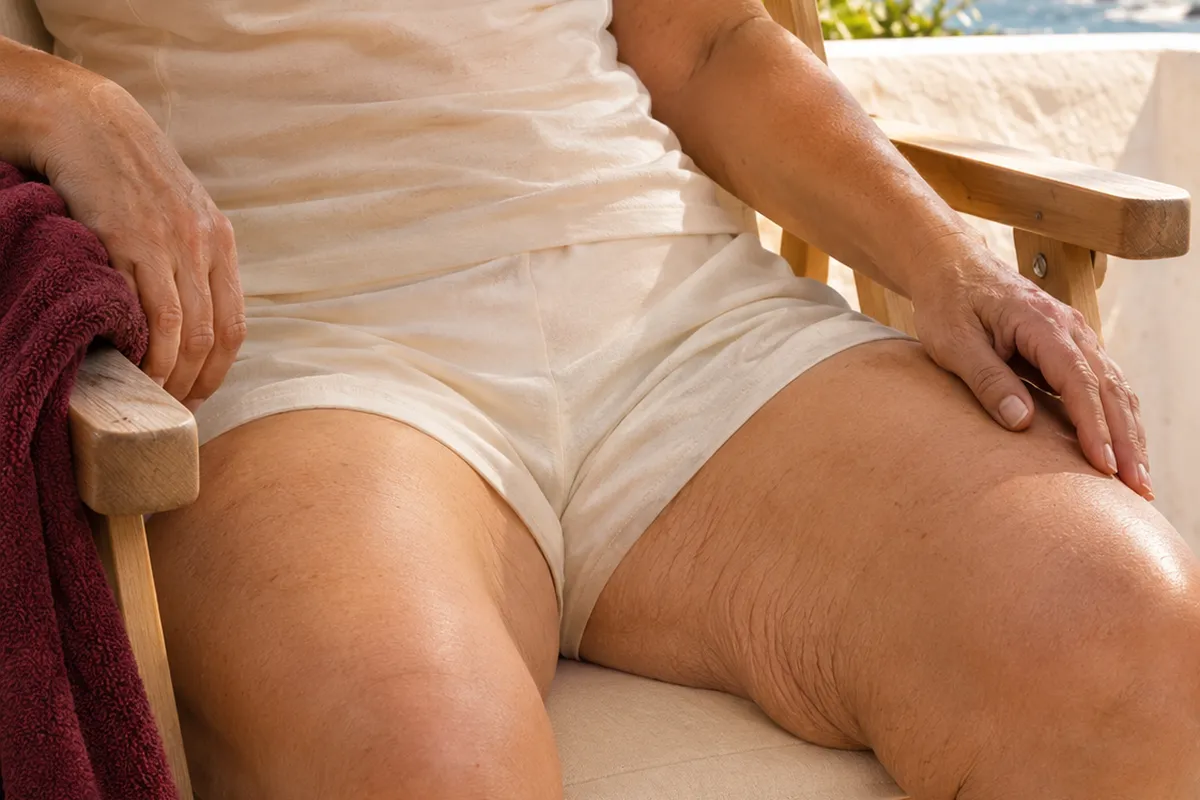
Woman sitting on a beach chair, with the skin of her inner thighs visible

How to recognise it

Is it laxity of the skin of the legs?

The skin on the legs can lose firmness in different ways: some people notice only fine creases, while others feel that the skin is loose, and the cause determines the appropriate approach. These signs can help you understand what is happening before your assessment.

Tick what you recognise0/7

Tick the signs you recognise in your case. This is not a diagnosis, it is only meant to give you an idea.

Is only one leg swollen, sore, warm or red, or is there swelling that does not go down from one day to the next? Are there sores, dark patches, varicose veins with altered skin, a lump or a mole that has changed? Does friction in the thigh crease injure the skin or are there repeated infections? You need medical assessment before any treatment. Out of hours, call SNS 24: 808 24 24 24. With shortness of breath or chest pain, call 112.

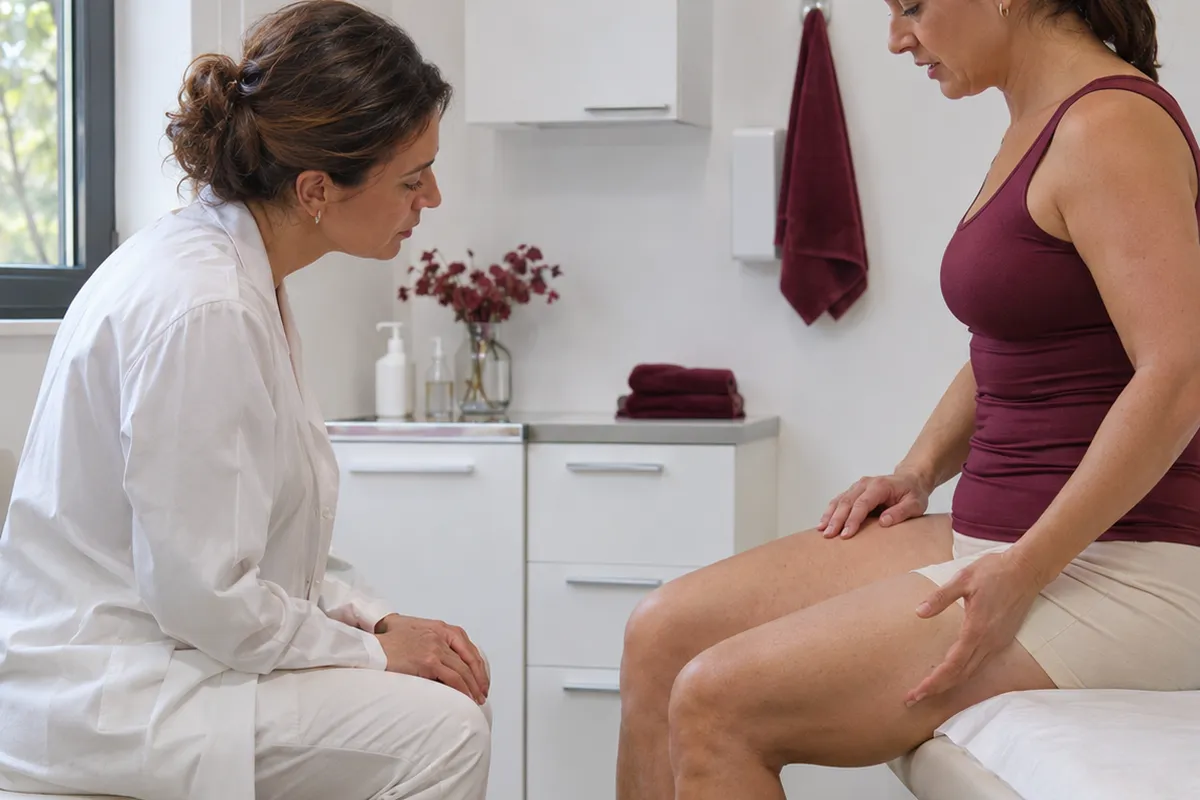
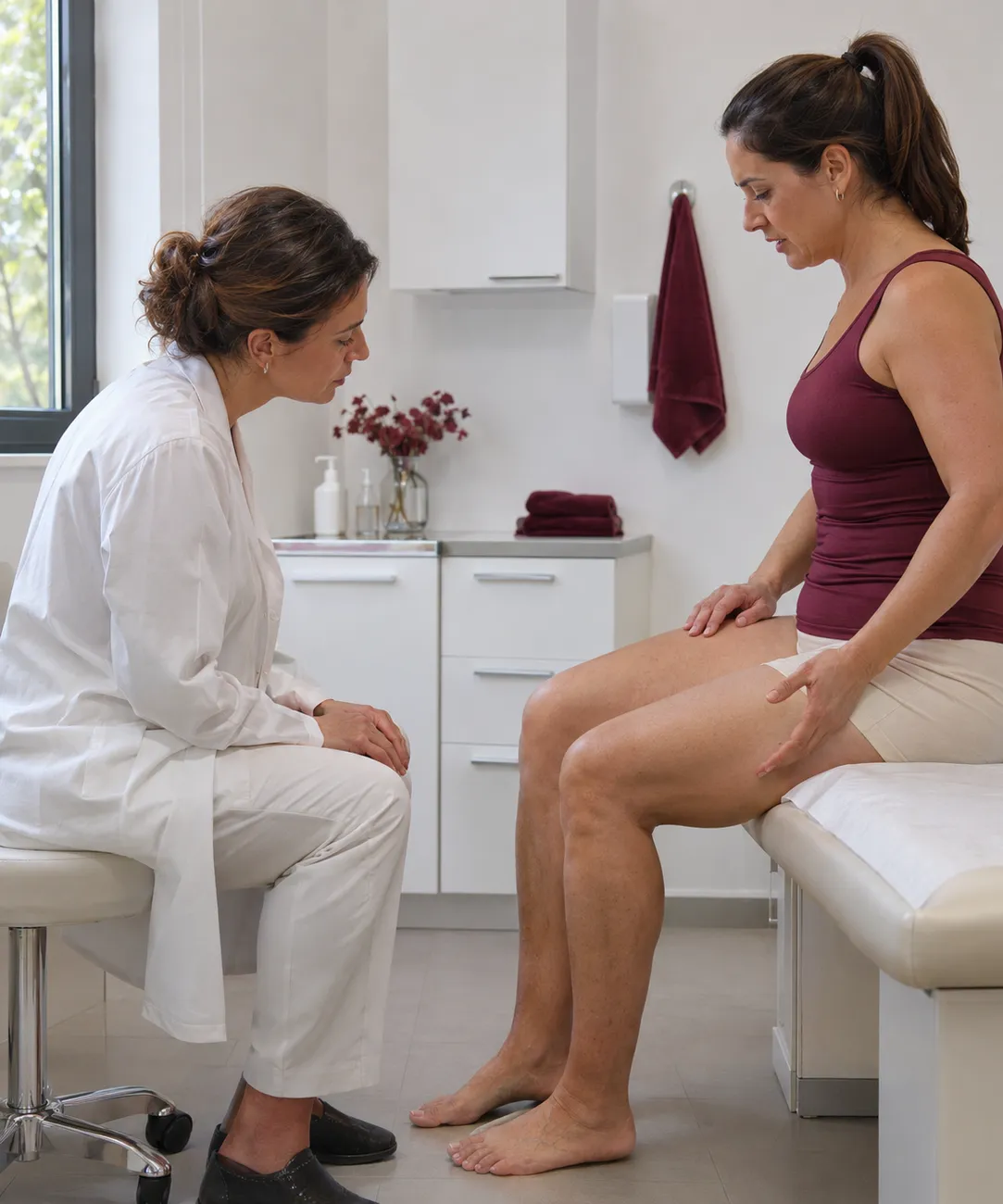
Female doctor sitting beside a woman on the examination couch, examining her legs
Photograph of a consultation. The dots mark what the doctor is assessing.

Why it happens

What may be behind laxity in the legs

There is almost always more than one cause at the same time. Choose a situation to see how it may contribute and what usually helps.

Age and the menopause

Over the years, the skin loses collagen and elasticity, becoming thinner and more easily stretched. In women, the fall in oestrogen levels during the menopause accelerates this loss, so many notice looser skin on their legs and thighs around this time. It is a natural process that can be slowed but not stopped completely.

What weighs on it

Expecting the skin to “go back by itself” to what it was and stopping looking after it and the muscles that support it.

What helps

Strength training, moisturising and sun protection; any hormonal treatment is a medical decision to be made with your doctor or GP.

Normal or to be assessed

Looser skin or something to assess

Most cases of leg laxity have common causes related to ageing and weight. However, some situations require assessment before any treatment because the problem may involve more than skin firmness alone.

  • How it looks. Thin, wrinkled skin on the inner thighs and above the knees, on both legs, which has worsened with age, weight or lack of exercise, without pain or sores.

  • When it is noticeable. When you bend your leg, walk, wear shorts or spend time in summer clothing. It may be loose skin alone, without excess fat.

  • What the clinic does. The doctor listens to the history, examines the legs and confirms that it is laxity, before proposing what makes sense.

  • At home. Strength training, stable weight, sunscreen, moisturising and giving up smoking, which are the first line.

Do you have a swollen and painful leg, shortness of breath or chest pain? Call 112. If you have persistent swelling, a sore or any concerns, you can call SNS 24 out of hours: 808 24 24 24.

Book an assessment

What the clinic may consider

Options to firm the skin of the legs

First-line measures are within your control: strengthening the leg muscles, maintaining a stable weight, protecting the skin from the sun and giving up smoking. Only then, and following an assessment, should a procedure be considered. For thigh laxity, the clinic offers radiofrequency and collagen biostimulators, which may improve skin firmness and texture in mild to moderate cases. The evidence is limited: evidence relating to the legs comes mainly from small studies, results take months to develop and vary from person to person, and maintenance treatment is required. Neither treatment removes substantial amounts of excess loose skin, which may require surgery (a thigh lift) by a plastic surgeon, nor are they a substitute for strength training.

Book an assessment
Dr Michelle Campagnoli, clinical director of Clínica Luxmed

First step

Assessment consultation

The doctor listens to what you are experiencing, examines your case and explains the suitable options. No treatment begins without this consultation.

May be considered when

you want to understand the cause and decide on the best path, with time and without commitment.

Book an assessment
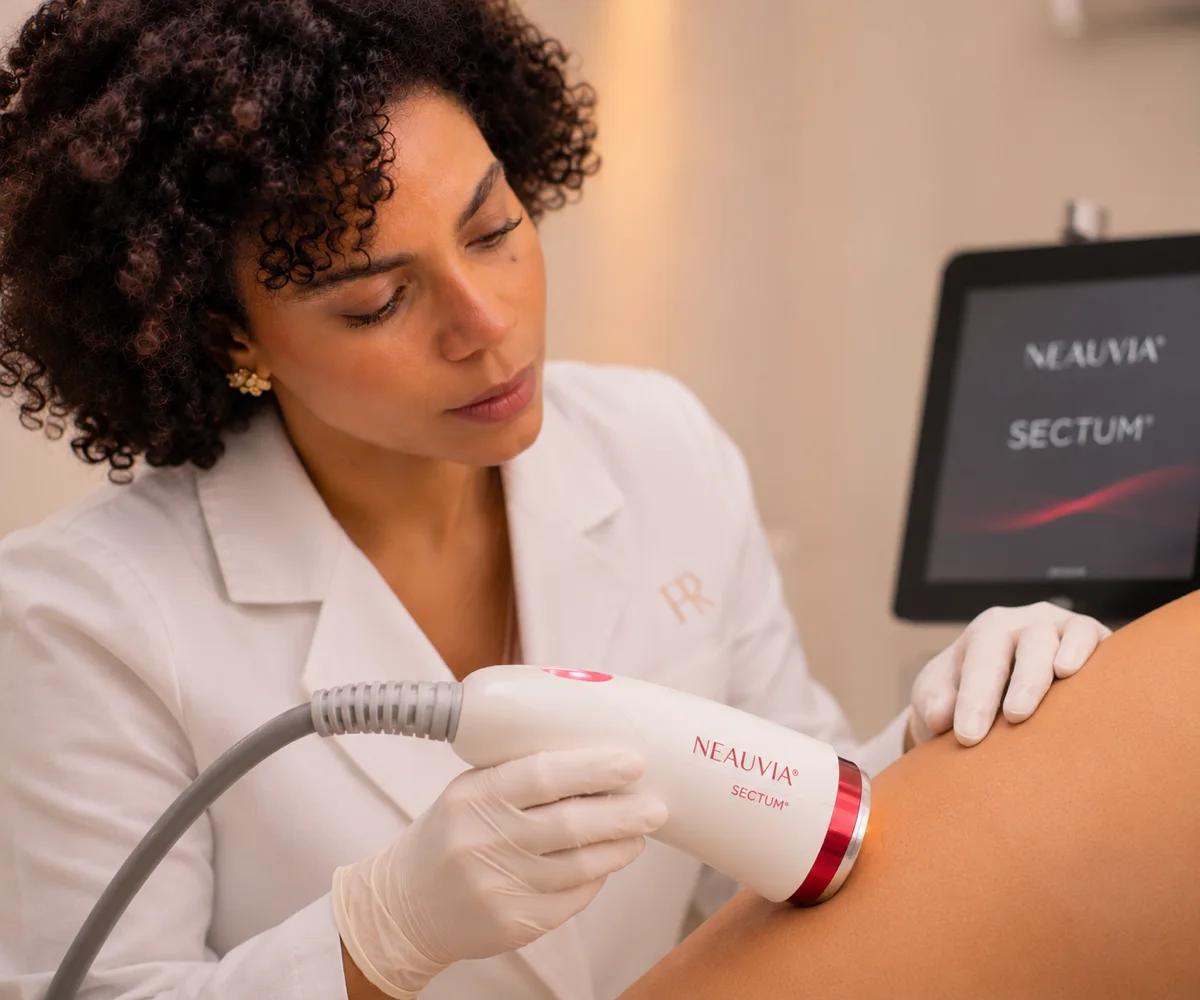
Doctor in a white coat moving a radiofrequency handpiece over a patient’s skin, with the equipment screen in the background

Firmness of the skin

Sectum radiofrequency Neauvia

Radiofrequency energy is applied to the surface of the skin, heating the deeper layers to stimulate collagen and improve firmness and texture on the inner thighs and above the knees. It is a non-invasive treatment performed over several sessions, with improvement developing gradually over a period of months.

May be considered when

the laxity is mild to moderate, the skin is intact, with no sores or infection, venous or lymphatic causes of swelling have been ruled out, and the doctor has explained that the treatment does not remove excess skin and that results vary.

Find out more
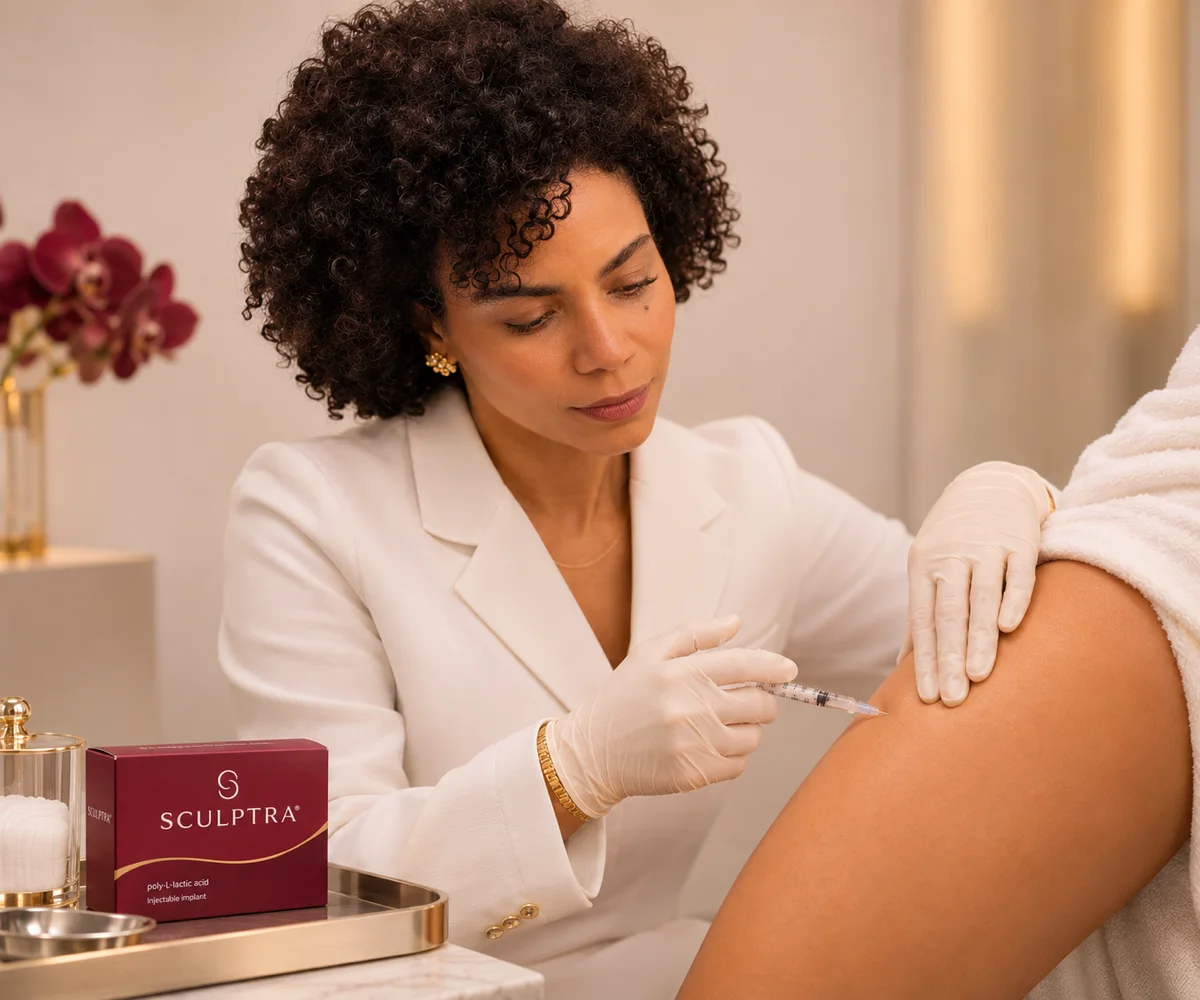
Doctor wearing gloves and administering an injection into a patient’s skin, with her other hand supporting the limb, in a bright room

Collagen stimulation

Collagen biostimulators

Injections administered by the doctor contain a substance that stimulates the body to produce collagen gradually, improving skin firmness and texture. Several sessions at intervals are usually required, and bruising, swelling and, less commonly, small nodules may occur.

May be considered when

the laxity is mild to moderate, the area has been assessed, you are willing to undergo several sessions and understand that the effect takes months to develop, that evidence relating to the legs is still limited and that there is a risk of nodules.

Find out more

What the journey looks like

From the first conversation to a plan tailored to you

No procedure begins without an assessment by the doctor. Most people start with the simplest approach, and only then is anything further considered.

  1. 01At the clinic

    Telling your story

    The doctor asks when the skin began to lose firmness, whether this followed weight loss, pregnancy or the menopause, what exercise you do, whether you smoke, and whether you have swelling, varicose veins or sores on your legs.

  2. 02At the clinic

    Examine the legs

    The doctor examines the thickness and elasticity of the skin, the inner thighs and the area above the knees, and checks for swelling or abnormal veins. If any signs are inconsistent with laxity, she arranges tests or refers you to the appropriate speciality.

  3. 03At home

    Strengthen the support and protect the skin

    We begin with measures within your control: strength training for the legs and glutes, maintaining a stable weight, using sunscreen and giving up smoking. In many cases, these improve the appearance before any procedure is considered.

  4. 04Over time

    Decide and follow up

    If the skin continues to bother you, the doctor will explain whether radiofrequency, biostimulators or another approach is appropriate, what you can expect, how many sessions are needed and when results should become visible, without making promises. The area is reassessed and the plan, including maintenance treatment, is adjusted as necessary.

Day to day

What helps at home

What you do at home matters more than you might think. These are sensible measures to take while you wait for your consultation and alongside the clinic’s plan.

The golden rule

First muscle and weight, then technology

No firming treatment can compensate for poor muscle tone, repeated weight fluctuations or a summer without sun protection. Strengthening the structures that support the skin and limiting further damage matter more than any device. Swelling in one leg, or swelling that does not subside, should be assessed by a doctor rather than “treated” as laxity.

Strengthening the legs

Muscle supports the skin and can be strengthened through training, whereas exercise cannot restore firmness to loose skin.

In practice: squats, lunges, hip raises and exercises for the inner thighs, at least 2 days a week. If you have gone a long time without exercise, talk to your doctor first.

Keeping a stable weight

Repeated ups and downs stretch the skin and leave it loose.

In practice: if you need to lose weight, do so slowly, with follow-up, and keep up strength training to protect muscle.

Protecting the legs from the sun

The sun damages collagen and adds to the effect of age.

In practice: sunscreen on the legs whenever they are exposed, and reapplied through the day at the beach or the pool.

Moisturising the skin and giving up smoking

Moisturising improves the look and comfort of the skin, and smoking accelerates its ageing.

In practice: a moisturiser every day after the shower, and ask your family doctor for support if you want to stop smoking.

Dr Michelle Campagnoli, clinical director of Clínica Luxmed

Who will look after you

An assessment carried out by the doctor

At Luxmed, in Algés, the first step is always an assessment with Dr Michelle Campagnoli. She examines your legs, determines whether the problem is laxity or whether another cause needs to be investigated, and works with you to decide on the appropriate approach before any procedure.

  • Physical examination and medical historyA conversation about weight, pregnancy, the menopause and exercise, and examination of the skin of the thighs and knees.
  • A plan tailored to youA clear plan, without promises, beginning with measures to improve the skin’s underlying support and followed by ongoing monitoring.
  • No obligationThe cost of any treatment is confirmed only after the assessment.
Book an assessment

Book a consultation

Book your consultation

Choose how you prefer to get in touch. We will arrange the assessment consultation with Dr Michelle Campagnoli.

Booking through the websiteAssessment consultationTalk to our assistant on WhatsApp and ask for the current price of the assessment.

New Life Miraflores, Algés · Office Center, R. Santa Teresa do Menino Jesus n.º 6, 9.º C, 1495-048

Your details are used only for this contact. Any treatment depends on a prior medical assessment.

Request an appointmentIt takes less than a minute.
Speciality
You do not need to go into detail. The doctor will talk to you during the consultation.
Request received. Our team will contact you as soon as possible.
Why does the skin on the legs and thighs lose firmness?

It is almost always due to a combination of factors: natural skin ageing and the associated loss of collagen and elasticity, the menopause, weight fluctuations, muscle loss caused by a sedentary lifestyle, sun exposure, smoking and genetics. The inner thighs and the area above the knees are usually the first to show these changes because the skin is thinner and has less support. The first step is therefore to identify the main contributing factors in your case.

Is crepey skin on the legs normal?

It is common with age and sun exposure and is not a sign of disease. The skin becomes thinner and more wrinkled, especially above the knees and on the inner thighs. If it is accompanied by swelling, sores, dark patches or pain, the problem is not simply laxity and a medical assessment is advisable.

Can I prevent or delay laxity in the legs?

You can delay it, but genetics and age also play a part and cannot be stopped completely. Helpful measures include strength training for the legs, maintaining a stable weight, applying sunscreen to exposed skin on the legs, moisturising and not smoking. The earlier you start looking after your skin, the better, but it is never too late to strengthen your muscles.

Why are the inner thighs among the first areas to lose firmness?

Because the skin there is thin, the thighs rub against each other and there is little muscular support. After weight loss or around the menopause, this is often where loose skin first becomes noticeable. This is common and does not mean that anything is wrong; it simply means that the area needs additional care.

What works for laxity in the legs and inner thighs?

It depends on the severity. For mild laxity, strength training and radiofrequency may improve the appearance. For moderate laxity, collagen biostimulators and radiofrequency may help. When there is a substantial amount of loose skin, only surgery (a thigh lift) can remove it. Training improves the underlying support but does not tighten the skin, and these treatments do not remove excess skin. At the assessment, the doctor will explain which options are appropriate for you.

Does radiofrequency work for the legs?

It may improve skin firmness and texture in mild to moderate cases, and reviews of non-invasive devices describe it as safe and involving little downtime. However, the effects are modest, do not match those of surgery, and evidence specifically relating to the legs is limited. Results develop gradually, vary from person to person and require maintenance. The clinic offers the treatment only after assessing the legs and ruling out causes such as venous swelling.

Can biostimulators cause nodules? What are the risks?

The most common effects are discomfort, bruising and swelling, which are usually temporary. Small nodules may develop, almost always in relation to the technique and product, and granulomas occur less commonly and are very rare. Appropriate technique and massage after treatment reduce the risk. Evidence relating to the legs remains limited, and the doctor will explain the risks before any decision is made.

When is surgery needed? Does it leave a scar?

When there is a substantial amount of loose skin, especially after major weight loss, and in-clinic treatments are insufficient. A thigh lift removes excess skin and leaves a scar in the groin or along the thigh, depending on the technique. It carries a risk of complications, most of which are minor, although studies following major weight loss report them frequently. The decision should be made with a plastic surgeon once your weight is stable. The clinic will assess your case and refer you appropriately, without promising results that a treatment cannot achieve.

When do I start to see results? Can I have it done in summer?

In general, results appear between 2 and 6 months after starting, and are gradual. Maintenance is necessary, because ageing continues. In summer, many treatments may be done with sun protection, but check at the consultation, because it depends on the procedure and the condition of the skin. Results are not guaranteed.

When should I see a doctor first?

Book a consultation if only one leg is swollen, sore, warm or red, if swelling does not go down from one day to the next, or if there are sores, dark patches, varicose veins with altered skin, a lump or a mole that has changed. Also if friction in the thigh crease injures the skin or there are frequent infections. If in doubt, out of hours call SNS 24 (808 24 24 24). With shortness of breath or chest pain, call 112.

We could not find that question. Ask us on WhatsApp

Scientific references

This page is based on the sources below and was reviewed by Dr. Michelle Campagnoli. Last updated on .

  1. Farage MA, Miller KW, Elsner P, Maibach HI. Characteristics of the aging skin. Adv Wound Care, 2013.
  2. Calleja-Agius J, Brincat M, Borg M. Skin connective tissue and ageing. Best Pract Res Clin Obstet Gynaecol, 2013.
  3. Fisher GJ, Kang S, Varani J, Bata-Csorgo Z, Wan Y, Datta S, Voorhees JJ. Mechanisms of photoaging and chronological skin aging. Arch Dermatol, 2002.
  4. Morita A. Tobacco smoke causes premature skin aging. J Dermatol Sci, 2007.
  5. Cruz-Jentoft AJ, Bahat G, Bauer J, Boirie Y, Bruyère O, Cederholm T, et al. Sarcopenia: revised European consensus on definition and diagnosis. Age Ageing, 2019.
  6. NHS. Physical activity guidelines for adults aged 19 to 64. (NHS, acedido 2026-11-11)
  7. Beasley KL, Weiss RA. Radiofrequency in cosmetic dermatology. Dermatol Clin, 2014.
  8. Mazzoni D, Lin MJ, Dubin DP, Khorasani H. Review of non-invasive body contouring devices for fat reduction, skin tightening and muscle definition. Australas J Dermatol, 2019.
  9. Christen MO. Collagen stimulators in body applications: a review focused on poly-L-lactic acid (PLLA). Clin Cosmet Investig Dermatol, 2022.
  10. Kollipara R, Hoss E, Boen M, Alhaddad M, Fabi SG. A randomized, split-body, placebo-controlled trial to evaluate the efficacy and safety of poly-L-lactic acid for the treatment of upper knee skin laxity. Dermatol Surg, 2020.
  11. Vleggaar D, Fitzgerald R, Lorenc ZP. Understanding, avoiding, and treating potential adverse events following the use of injectable poly-L-lactic acid for facial and nonfacial volumization. J Drugs Dermatol, 2014.
  12. American Society of Plastic Surgeons. Thigh lift (thighplasty). ASPS, 2026.
  13. Bonaventura B, Weber J, Kalash Z, Stark GB, Simunovic F. The Edmonton Obesity Staging System as a predictor for postoperative complications after medial thigh lift in massive weight loss patients. J Plast Reconstr Aesthet Surg, 2021.
  14. NHS. DVT (deep vein thrombosis). (NHS, acedido 2026-11-11)
  15. NHS. Lymphoedema. (NHS, acedido 2026-11-11)
  16. NHS. Varicose veins. (NHS, acedido 2026-11-11)
CallAssistantAvailableBook