Algés, Oeiras Mon to Fri · 09:00 to 13:00 and 14:00 to 19:00 · Sat · 09:00 to 14:00
WhatsApp Book a consultation

Body aesthetics

Cellulite on the legs and thighsWhen dimples on the back and sides of the thighs make you ask why and what can really be changed

The thighs, particularly the backs and outer sides, are where cellulite is most noticeable. It is not a disease or a sign of neglect, and it does not have a single cause: hormones, genetics, the structure of the skin itself and everyday habits all contribute. Other conditions can also be mistaken for cellulite, including leg swelling caused by circulatory problems. Here, we explain what usually lies behind the dimples, what exercise, weight management and creams can realistically change, what the evidence says about in-clinic treatments, and when a medical assessment is advisable before anything else at Clínica Luxmed in Algés.

Reviewed by Dr Michelle Campagnoli, clinical director

  • 4treatment options for this concern
  • 1assessment, always first
  • Nocommitment
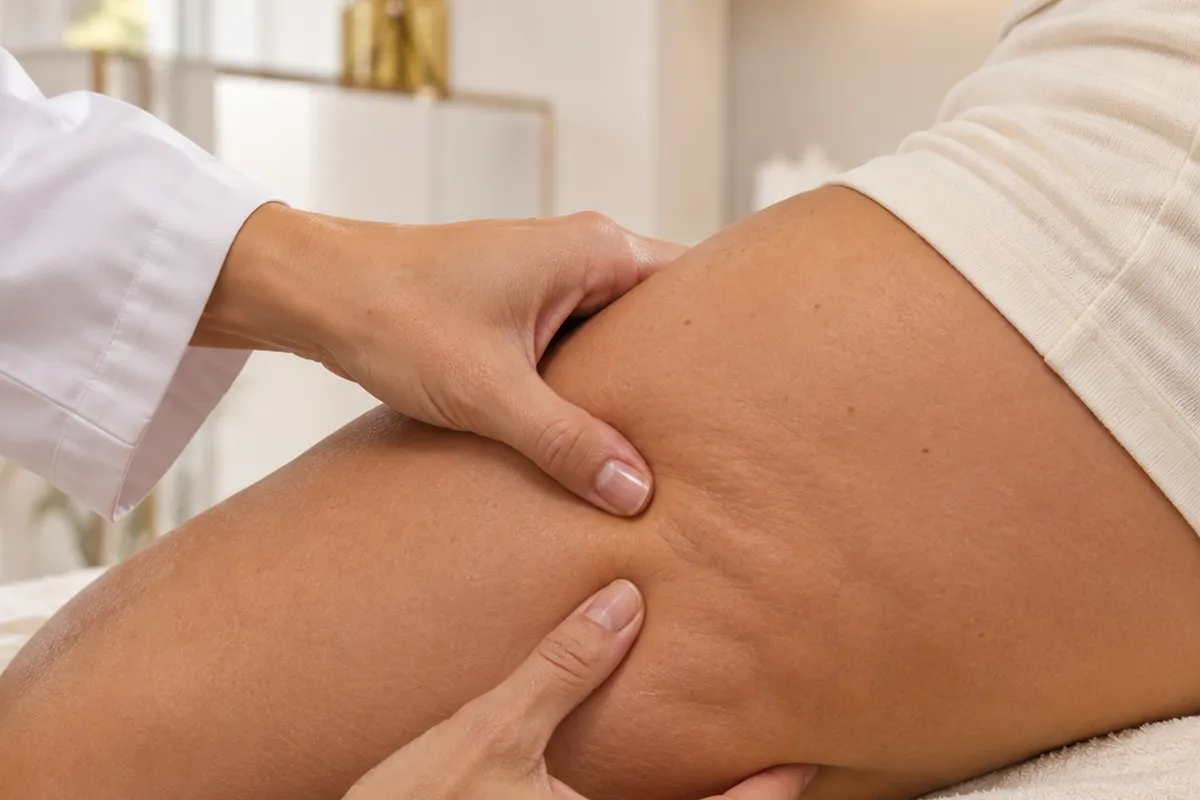
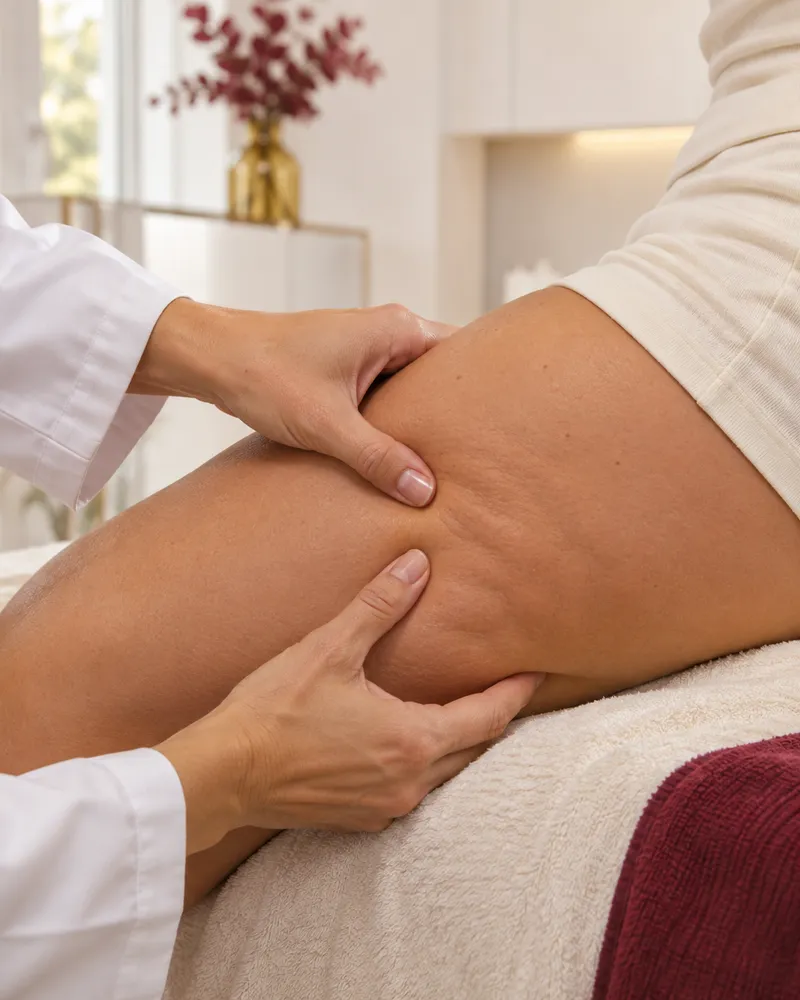
Doctor's hands gently pinching the skin of the thigh of a woman sitting on an examination couch

How to recognise it

Is it cellulite that you see on your legs?

Cellulite on the legs has a typical appearance, but heavy or swollen legs are not a feature of cellulite and require a different assessment. These signs can help you understand what may be happening before your consultation.

Tick what you recognise0/7

Tick the signs you recognise in your case. This is not a diagnosis, it is only meant to give you an idea.

Is only one leg swollen, sore, warm or red, or is there a red, warm and painful area that is spreading? Do the legs often swell, hurt, have varicose veins or have they changed colour? You need medical assessment before any treatment, because it may be infection or a circulation problem. Out of hours, call SNS 24: 808 24 24 24.

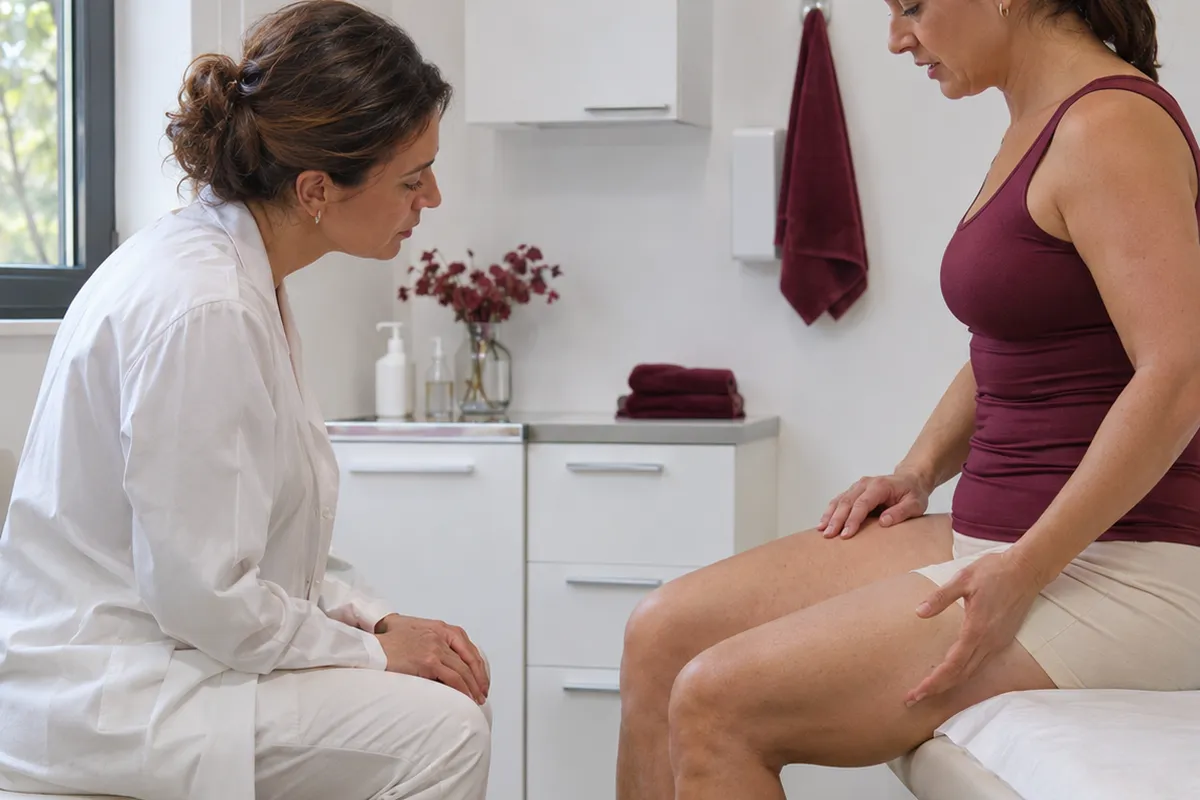
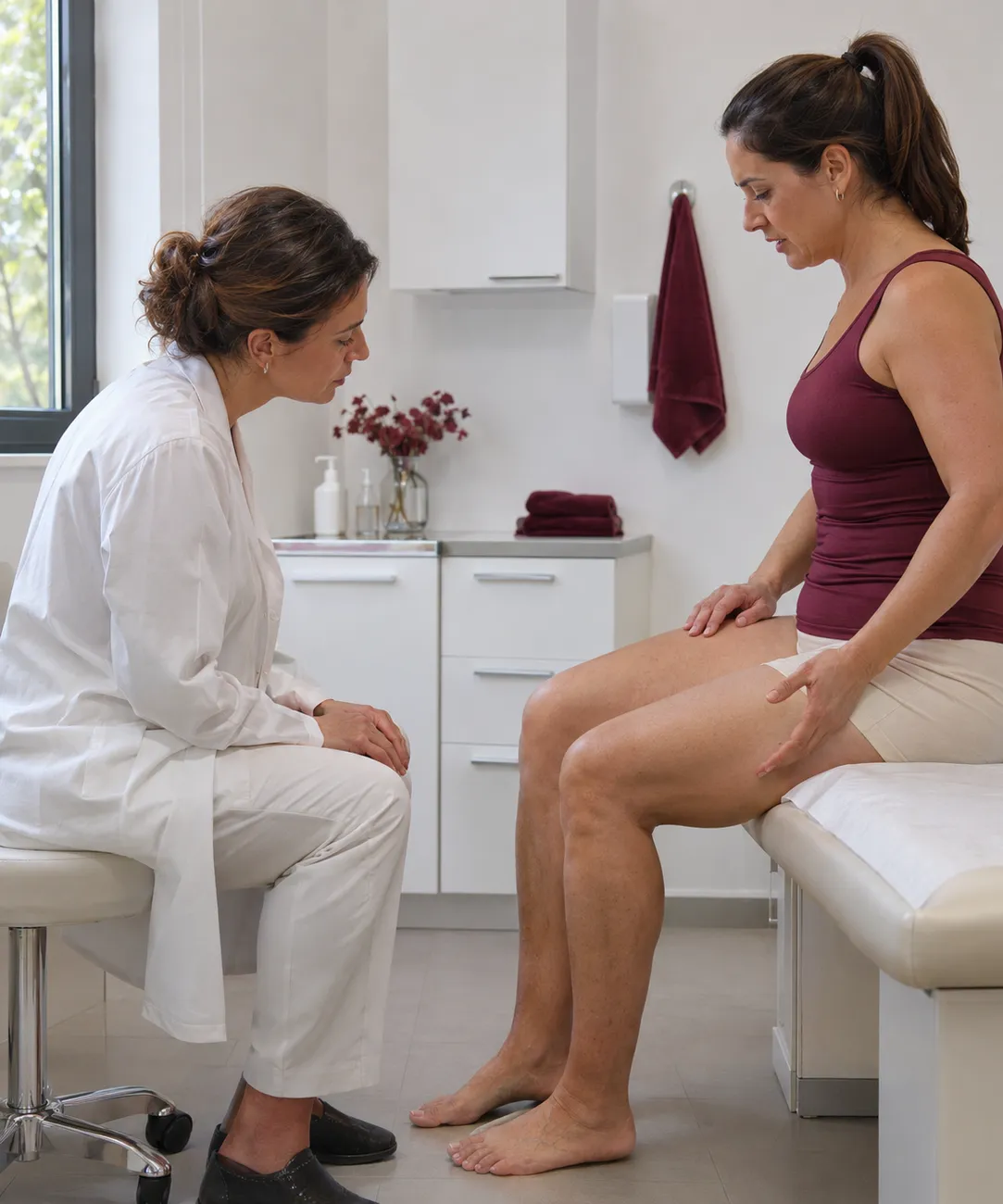
Female doctor sitting beside a woman on the examination couch, examining her legs
Photograph of a consultation. The dots mark what the doctor is assessing.

Why it happens

What may be behind cellulite in the legs

There is almost always more than one contributing factor, and not all of them can be changed. Select a situation to see how it contributes and what may help.

Hormones and thigh fat

Oestrogens favour the accumulation of fat on the thighs and hips, and that is why cellulite is so much more common in women after puberty. In scientific reviews, the hormonal factor and the difference in tissue organisation between women and men are part of the explanation. Some people notice it worsening with hormonal contraceptives, but the relationship is not well established.

What weighs on it

Blaming yourself for something to do with the normal development of the body, or stopping a contraceptive without talking to the doctor because of the dimples.

What helps

Talking to the doctor about the stage of life you are at and continuing the medication you were prescribed, until advised otherwise.

Normal or to be assessed

Simple cellulite or legs to assess

Most cellulite on the thighs is simply a feature of the skin. However, the legs sometimes need to be assessed before any treatment because their appearance may have another cause.

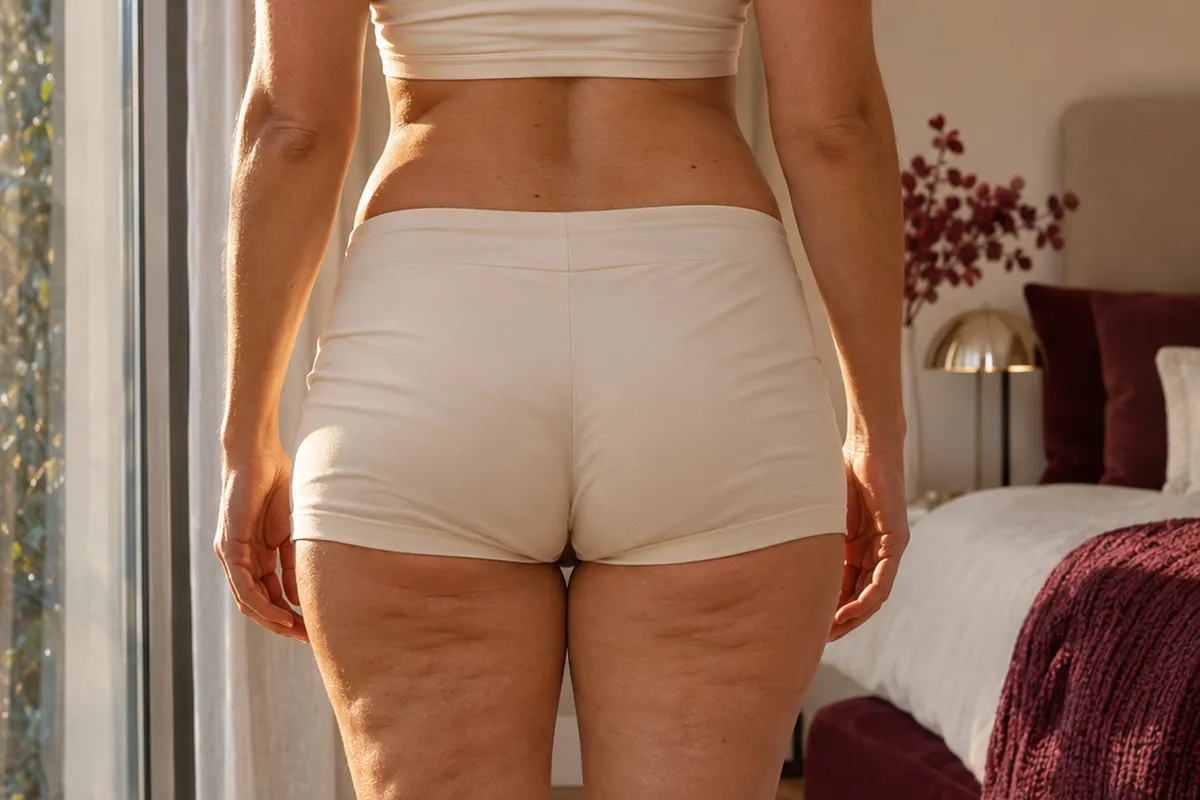
  • How it looks. Dimples on both sides, mainly at the back and sides of the thighs, without pain, warmth or change of colour, more noticeable when sitting or in side light.

  • When it is noticed. In shorts and swimwear, with the skin pinched or in certain lights. Often, the person who has it notices more than the person who sees it.

  • What the clinic does. The doctor listens to the history, examines the skin and confirms that it is cellulite, and explains what kind of improvement is realistic, before proposing what makes sense.

  • At home. Stable weight, strength training and walks, breaks at work if you sit, giving up smoking and, if you wish, a cream used with realistic expectations.

Is only one leg swollen and sore, or do you have sudden shortness of breath, chest pain or coughing up blood? Call 112. With a red, warm and painful area, or doubts about the legs, out of hours you can call SNS 24: 808 24 24 24.

Book an assessment

What the clinic may consider

Options to improve the look of the thighs

The foundation is what you can do yourself: maintain a stable weight, do strength training for the thighs and glutes, walk regularly, take breaks if you spend long periods sitting or standing, and give up smoking. These measures have the strongest evidence for improving body contours. Only then, and after an assessment has ruled out circulatory problems and infection, should in-clinic treatment be considered. Systematic reviews conclude that no treatment for cellulite has been definitively established: radiofrequency has limited to moderate evidence for improving skin firmness, while carboxytherapy, intradermotherapy and massage have limited evidence based on small studies. Subcision is a surgical procedure for pronounced depressions, and the doctor will advise whether referral is appropriate. Outcomes vary, are generally temporary and require maintenance; no treatment eliminates cellulite. The clinic offers radiofrequency and carboxytherapy for the thighs. Contouring massage may be used as an adjunct to improve circulation and body contours, while intradermotherapy, which is more commonly used to improve skin quality in areas such as the neck and hands, is offered only if the doctor considers it appropriate in your case.

Book an assessment
Dr Michelle Campagnoli, clinical director of Clínica Luxmed

First step

Assessment consultation

The doctor listens to what you are experiencing, examines your case and explains the suitable options. No treatment begins without this consultation.

May be considered when

you want to understand the cause and decide on the best path, with time and without commitment.

Book an assessment
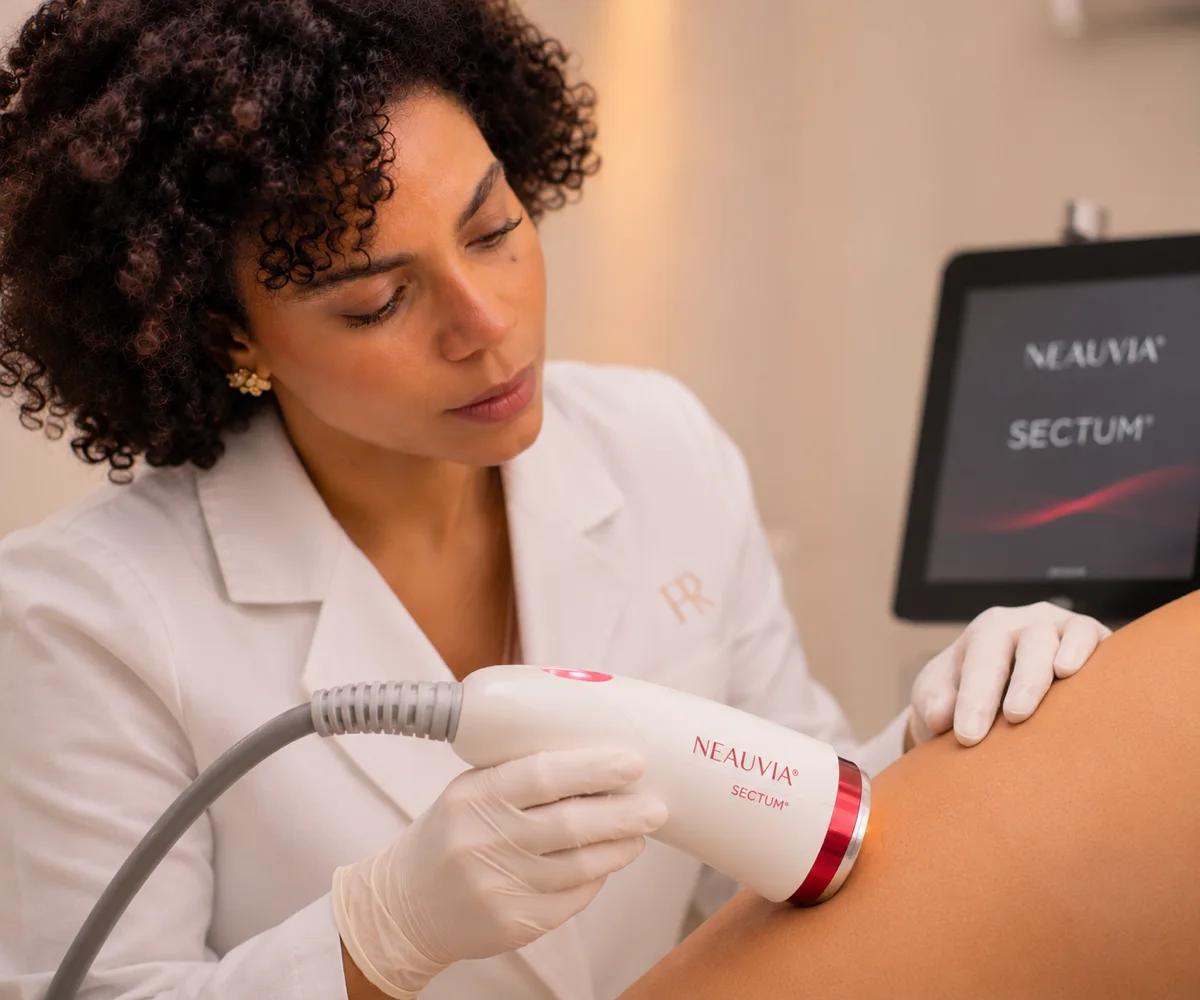
Radiofrequency handpiece being passed over the thigh in a brightly lit treatment room

Firmness of the skin

Sectum radiofrequency Neauvia

Radiofrequency firms the skin and treats laxity in areas such as the thighs, abdomen and arms by stimulating collagen production in deeper tissue. On the thighs, it may improve skin firmness and appearance, but the evidence for cellulite itself is limited to moderate, the effect is generally temporary and several studies have short follow-up periods. Treatment involves several sessions, and the doctor will explain what outcomes are realistic.

May be considered when

the legs have been assessed, the circulation and skin show no signs of infection or another cause, the basic measures have already been tried, and the doctor has explained the risks and what is realistic to expect.

Find out more
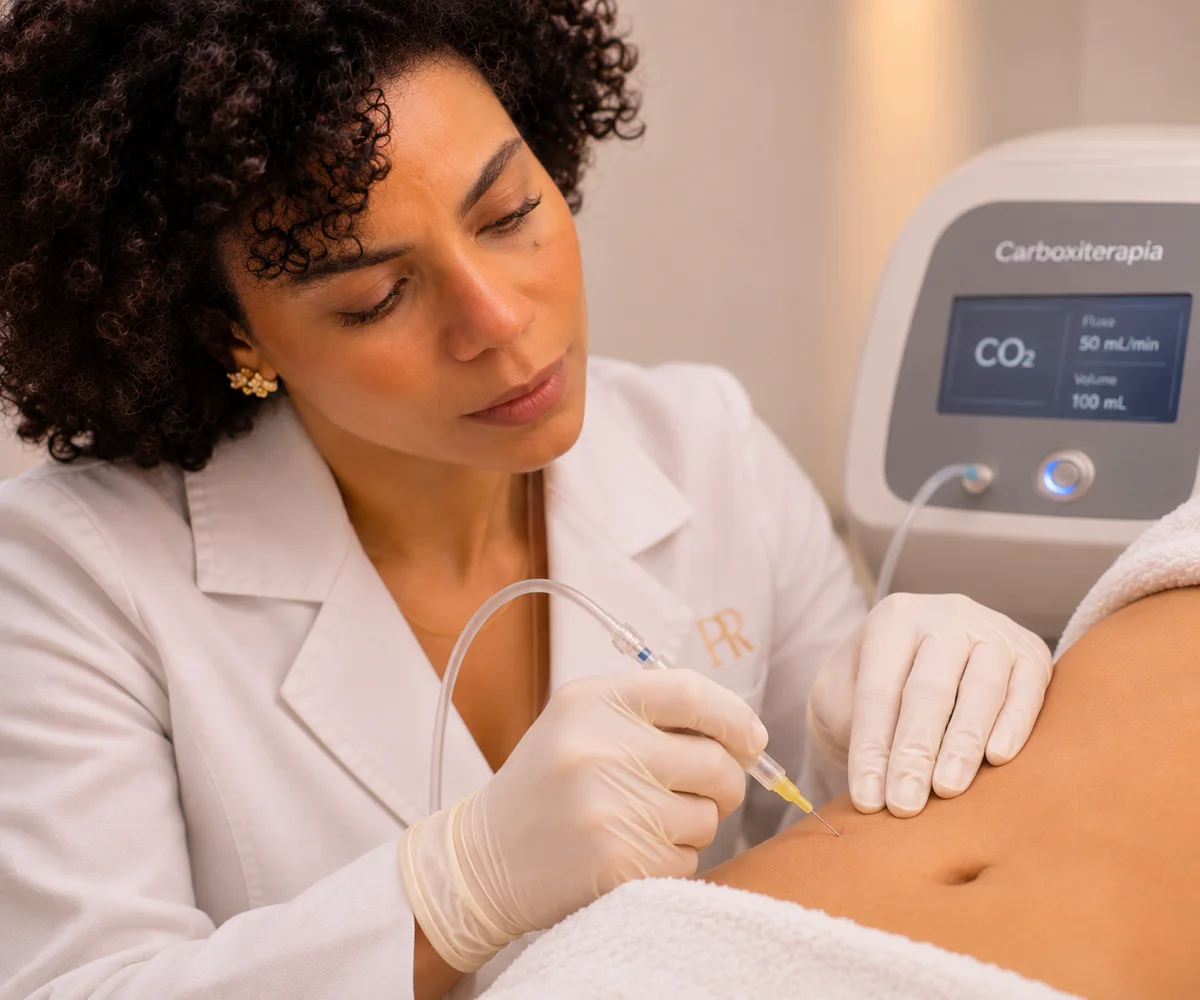
The doctor preparing to administer carboxytherapy, with the device in the background

Microcirculation

Carboxytherapy

Small injections of carbon dioxide are administered beneath the skin to improve microcirculation and elasticity and are used to treat cellulite, stretch marks and scars. Evidence for cellulite is limited and based on small studies, and sessions may cause discomfort, stinging and minor temporary bruising. Outcomes vary, and treatment involves several sessions followed by maintenance.

May be considered when

the legs have been assessed, there is no circulatory problem or infection, the person accepts that the treatment may cause discomfort, and the doctor has explained that outcomes vary and are generally temporary.

Find out more

What the journey looks like

From the first conversation to a plan tailored to you

No treatment begins without an assessment by the doctor. Most people start with the simplest measures supported by the strongest evidence and only then consider additional options.

  1. 01At the clinic

    Telling your story

    The doctor asks when you first noticed the dimples, whether they changed with weight, pregnancy or menopause, whether your legs swell or hurt, whether you smoke, which medicines you take and what you have already tried.

  2. 02At the clinic

    Examine the skin and the legs

    The skin is examined while you are standing and sitting and when it is pinched, and we check for signs of circulatory problems, swelling or infection. If there are any concerns, the doctor makes a referral before recommending treatment.

  3. 03At home

    Start with what has the most evidence

    Stable weight, strength training, walks, breaks at work and giving up smoking. It is the foundation of any plan, and in many cases improves the look of the thighs at very low cost.

  4. 04Over time

    Decide and follow up

    If the dimples persist and you wish to do more, the doctor explains whether in-clinic treatment is appropriate, how many sessions may be needed and what to expect, without promising results. The area is reassessed and the plan, including maintenance, is adjusted.

Day to day

What helps at home

What you do each day matters more than you might think and has the strongest supporting evidence. These measures are appropriate alongside the clinic’s treatment plan.

The golden rule

The legsfirst, then the cellulite

Before considering treatment for cellulite, it is important to make sure that cellulite is all that is present. Legs that swell or hurt, or have varicose veins, need to be assessed, and no cosmetic treatment can replace a proper assessment of your circulation. There are no shortcuts for cellulite itself: maintaining a stable weight and exercising have the strongest supporting evidence.

Strengthening the legs

Strength training improves the tone and contour of the thighs and glutes, and is the measure with the most evidence.

In practice: squats, lunges and step-ups, two to three times a week, increasing the load gradually.

Keeping a stable weight

Frequent weight fluctuations make cellulite more visible and leave the skin with less underlying support.

In practice: avoid very restrictive diets and opt for sustainable changes.

Moving throughout the day

Spending many hours sitting or standing without breaks impairs circulation in the legs.

In practice: get up every hour, walk for a few minutes and alternate between sitting and standing.

Using a cream with realistic expectations

Some studies suggest that caffeine and retinol slightly improve the skin’s appearance, but the effect disappears when their use is discontinued.

In practice: use it every day, with massage, for at least two to three months, and compare with photographs in the same light; avoid retinoids in pregnancy and breastfeeding.

Dr Michelle Campagnoli, clinical director of Clínica Luxmed

Who will look after you

An assessment carried out by the doctor

At Luxmed, in Algés, the first step is always an assessment with Dr Michelle Campagnoli. She will examine your skin and legs, determine whether it is simply cellulite or whether anything needs further investigation, and agree with you on the most appropriate approach before any treatment.

  • Physical examination and medical historyA conversation about weight, habits, circulation and what you have already tried, and examination of the skin of the thighs and legs.
  • A plan tailored to youA clear plan, without promises, that starts with what has the most evidence and is followed up over time.
  • No obligationThe cost of any treatment is confirmed only after the assessment.
Book an assessment

Book a consultation

Book your consultation

Choose how you prefer to get in touch. We will arrange the assessment consultation with Dr Michelle Campagnoli.

Booking through the websiteAssessment consultationTalk to our assistant on WhatsApp and ask for the current price of the assessment.

New Life Miraflores, Algés · Office Center, R. Santa Teresa do Menino Jesus n.º 6, 9.º C, 1495-048

Your details are used only for this contact. Any treatment depends on a prior medical assessment.

Request an appointmentIt takes less than a minute.
Speciality
You do not need to go into detail. The doctor will talk to you during the consultation.
Request received. Our team will contact you as soon as possible.
Why does cellulite appear on the legs and thighs?

Cellulite results from a combination of factors. Hormones, particularly oestrogens, promote fat accumulation on the thighs and hips; genetics accounts for the tendency to run in families; and the structure of the skin, with septa pulling it downwards, creates the dimples. Other factors can make it worse, including weight gain and frequent weight fluctuations, spending long periods sitting or standing, fluid retention, smoking and the loss of firmness with age. Cellulite is therefore not a sign of neglect, and understanding which factors are most relevant in your case is the first step.

Why do I have cellulite on the back of my thighs?

The backs and sides of the thighs are typical areas for cellulite, as more fat accumulates there under the influence of hormones. These areas are also under pressure when you sit for long periods, which may make the dimples more visible. No particular position causes cellulite, but getting up regularly and doing strength training can help overall.

Does the pill cause cellulite? And high-heeled shoes?

Some people notice it worsening with hormonal contraceptives, but the relationship is not well established, and you should not stop the pill on your own because of the dimples: talk to your doctor. As for high-heeled shoes, there is no clear evidence that they influence cellulite.

How do I tell cellulite from swollen legs or lipedema?

Cellulite causes dimpling and rippling of the skin, without pain, which becomes more noticeable when the skin is pinched. Legs that swell at the end of the day, are painful, have varicose veins or have changed colour may indicate a circulatory problem. Legs that are disproportionately large in relation to the trunk, with tenderness and easy bruising, may indicate lipedema, a disorder of adipose tissue that cannot be resolved through diet; swelling in just one leg may have other causes. Only a medical assessment can distinguish between them.

How do I get rid of cellulite on the legs?

There is no way to eliminate it completely, but its appearance can be improved. The measures with the strongest evidence are maintaining a stable weight, exercising—particularly strength training—and giving up smoking. In a clinical setting, some options, such as radiofrequency, have limited to moderate evidence for improving skin firmness, while others, including carboxytherapy, intradermotherapy and massage, have limited evidence. Results vary, are generally temporary and require maintenance. After assessing you, the doctor will help you decide what is appropriate, including whether to have no treatment at all.

Do cellulite creams work?

Studies of some ingredients, such as caffeine and retinol, have shown a slight improvement in the appearance of the skin. The effect is modest, takes weeks to appear and disappears when use is discontinued; some of the benefit also comes from massaging the product into the skin. No cream eliminates cellulite, and ‘thermal’ creams are not more effective simply because they produce a warming sensation. Retinoids can cause irritation and must not be used during pregnancy or while breastfeeding.

Do radiofrequency and carboxytherapy remove cellulite from the thighs?

They do not eliminate it. Radiofrequency has limited to moderate evidence for improving skin firmness, while carboxytherapy has limited evidence from small studies. Results vary from person to person, are generally temporary, and treatment usually involves several sessions followed by maintenance. After assessing you, the doctor will advise whether either option is appropriate in your case or whether it would be best to start with the basic measures.

Do the results last? How many sessions are needed?

There are no guaranteed or permanent results. Treatments usually involve several sessions, and any improvement is gradual and varies from person to person. It can only be sustained through healthy habits and, in the case of treatments, maintenance sessions. If contributing factors persist, such as a sedentary lifestyle, smoking or weight fluctuations, the cellulite is likely to become more noticeable again. During the assessment, the doctor will set out the treatment plan and realistic expectations without promising results.

Does running or swimming help with cellulite on the legs?

Any regular exercise helps with weight and circulation, and is good for health in general. Strength training for the thighs and glutes is what best improves the contour, but no exercise makes cellulite disappear. So the best activity is the one you can keep up for years.

When should I see a doctor first?

Book a consultation if the legs often swell, hurt, have varicose veins or changes in skin colour. A red, warm and painful area may be an infection: seek assessment on the same day, and out of hours call SNS 24 (808 24 24 24). A single leg that is swollen and sore, especially with sudden shortness of breath, chest pain or coughing up blood, is a reason to call 112.

We could not find that question. Ask us on WhatsApp

Scientific references

This page is based on the sources below and was reviewed by Dr. Michelle Campagnoli. Last updated on .

  1. Rossi AB, Vergnanini AL. Cellulite: a review. J Eur Acad Dermatol Venereol, 2000.
  2. Luebberding S, Krueger N, Sadick NS. Cellulite: an evidence-based review. Am J Clin Dermatol, 2015.
  3. Zerini I, Sisti A, Cuomo R, Ciappi S, Russo F, Brandi C, D'Aniello C, Nisi G. Cellulite treatment: a comprehensive literature review. J Cosmet Dermatol, 2015.
  4. Lim SK, Gultekin G, Suresan S, Jacob A, Zou Y, Liyanage DD, Parekh JN, Mavilakandy AK, Vyas K, Khajuria A. Comparative Analysis of Cellulite Treatment Modalities: A Systematic Review. Aesthetic Plast Surg, 2025.
  5. Hexsel DM, Mazzuco R. Subcision: a treatment for cellulite. Int J Dermatol, 2000.
  6. Hexsel D, Soirefmann M. Cosmeceuticals for cellulite. Semin Cutan Med Surg, 2011.
  7. Kligman AM, Pagnoni A, Stoudemayer T. Topical retinol improves cellulite. J Dermatolog Treat, 1999.
  8. Herman A, Herman AP. Caffeine's mechanisms of action and its cosmetic use. Skin Pharmacol Physiol, 2013.
  9. Eberhardt RT, Raffetto JD. Chronic venous insufficiency. Circulation, 2014.
  10. Buso G, Depairon M, Tomson D, Raffoul W, Vettor R, Mazzolai L. Lipedema: A Call to Action!. Obesity (Silver Spring), 2019.
  11. NHS. Cellulitis. (NHS (Reino Unido), acedido 2026-11-11)
  12. NHS. DVT (deep vein thrombosis). (NHS (Reino Unido), acedido 2026-11-11)
CallAssistantAvailableBook