

Algés, Oeiras Mon to Fri · 09:00 to 13:00 and 14:00 to 19:00 · Sat · 09:00 to 14:00
WhatsApp Book a consultation

Body aesthetics

Neck skin laxityIf you have noticed changes in the skin, double chin or neck bands and want to understand what is happening

The neck is one of the first areas to show the passage of time, and this is rarely due to a single cause. Three components are almost always ageing together: the skin, which loses elasticity and becomes thin and wrinkled; the fat beneath the chin, or “double chin”, which is strongly influenced by genetics and weight; and the platysma muscle, which separates in the centre and forms vertical bands. The relative contribution of each affects which approach is appropriate, so the first step is to tell them apart. Here we explain how to recognise each component, what usually causes it, which non-surgical options the clinic may consider and their limitations, when surgery is the only effective option, and when a lump or swelling in the neck requires medical assessment before any treatment at Clínica Luxmed, in Algés.

Reviewed by Dr Michelle Campagnoli, clinical director

  • 2non-surgical treatments to consider
  • 1assessment, always first
  • Nocommitment
Woman touching her jawline, with arrows showing the direction of lift for the skin of the neck and chin

How to recognise it

Could it be laxity of the neck?

Neck laxity may involve the skin, fat, muscle or a combination of all three, and each responds differently. These signs can provide an indication before your assessment.

Tick what you recognise0/7

Tick the signs you recognise in your case. This is not a diagnosis, it is only meant to give you an idea.

Have you noticed a new lump in the neck, or a swelling that grows quickly or on one side only? Do you have difficulty swallowing, hoarseness that does not pass, neck pain, fever or a hard “gland” that does not go down within a few weeks? It needs a medical assessment before any treatment. Out of hours, call SNS 24: 808 24 24 24. If you have difficulty breathing or the neck swells quickly after an allergy, call 112.

Female doctor examining the neck and décolletage of a seated patient
Photograph of a consultation. The dots mark what the doctor is assessing.

Why it happens

What may be behind laxity in the neck

There is almost always more than one cause at the same time. Choose a situation to see how it may contribute and what usually helps.

Ageing of the skin

As we age, the skin produces less collagen and elastin and becomes thinner. The skin on the neck is thin, has few glands and is in constant motion, so fine lines and loose skin tend to appear early. This is a normal process and not a sign of disease.

What weighs on it

Expecting a cream to “tighten” skin that is already loose, or ignoring the neck in facial care.

What helps

Moisturise and protect your neck from the sun, caring for it in the same way as your face; if it bothers you, consider having the options assessed.

Normal or to be assessed

Laxity with age or something to assess

Most laxity of the neck is a sign of ageing. But some situations call for an assessment before any treatment, because what you see may not be only skin.

  • What it looks like. Thin, wrinkled skin, soft volume beneath the chin and bands when tensing, symmetrical and set in slowly, over months and years.

  • When it is noticed. In profile, when looking down, in photographs and after weight loss. A phone camera held below you exaggerates everything.

  • What the clinic does. The doctor listens to the history, examines and feels the skin, fat and muscle and says what weighs most, before proposing whatever makes sense.

  • At home. Protecting the neck from the sun, keeping a stable weight, not smoking and moisturising the skin; a cream does not remove laxity, but helps the skin to be better cared for.

Do you have difficulty breathing or swallowing saliva, or does the neck swell quickly after a sting or a food? Call 112. If you have a lump, a swelling that grows or doubts, out of hours you can call SNS 24: 808 24 24 24.

Book an assessment

What the clinic may consider

Options to firm the neck

The first-line approach consists of measures taken at home and maintained over the years: daily sun protection, not smoking, maintaining a stable weight and caring for the skin. Following an assessment, non-surgical treatments may improve skin firmness and quality when laxity is mild to moderate. The clinic may consider Sectum radiofrequency, collagen biostimulators and microneedling, which it also performs on the body, to improve texture and fine lines. Results are gradual, vary from person to person and do not amount to a “lift”; the evidence is limited, as radiofrequency studies are heterogeneous and some biostimulator products are used on the neck outside their approved indications (off-label). Very loose skin, substantial fat beneath the chin or very prominent bands tend to respond poorly, and surgery (a neck lift) is generally more effective in these cases. The clinic does not perform this surgery, but can refer you to a plastic surgeon.

Book an assessment
Dr Michelle Campagnoli, clinical director of Clínica Luxmed

First step

Assessment consultation

The doctor listens to what you are experiencing, examines your case and explains the suitable options. No treatment begins without this consultation.

May be considered when

you want to understand the cause and decide on the best path, with time and without commitment.

Book an assessment
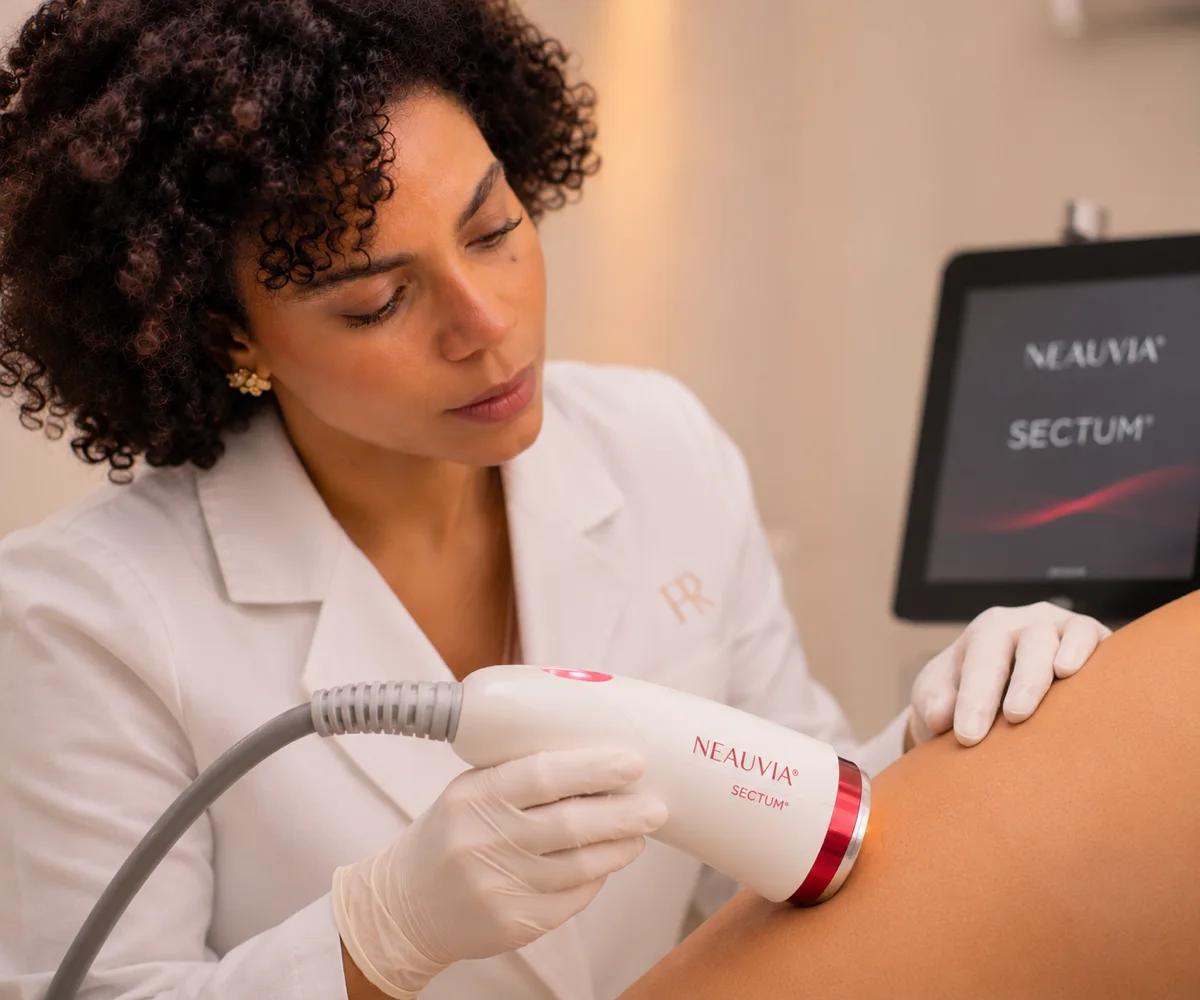
Radiofrequency applicator gliding over the neck of a seated patient in a brightly lit treatment room

Technology

Sectum radiofrequency Neauvia

Radiofrequency treatment that heats the deeper layers of the skin with the aim of stimulating its own collagen production and firming the skin on the neck and beneath the chin. It is performed over several sessions, generally with no downtime, and the expected improvement is mild to moderate. The evidence is limited, and it is not a substitute for surgery when there is substantial excess skin.

May be considered when

the laxity is mild to moderate, the skin is not irritated or infected, there is no lump or swelling awaiting assessment, and the doctor has explained what is realistic to expect and how many sessions may be needed.

Find out more
A doctor injecting the skin on a patient’s neck, wearing gloves and working under clinical lighting

Collagen stimulation

Collagen biostimulators

Injections of a substance that stimulates the skin itself to produce collagen, gradually over weeks and months. 2 to 3 sessions are usually needed. There may be discomfort and bruising, and nodules may appear, above all if the technique or dilution are not the most suitable. On the neck, the use of some products is outside approved indications (off-label).

May be considered when

the laxity is mild to moderate, the skin is of good quality and there is no significant excess skin, the doctor has explained the risks, the evidence and the use of some products outside approved indications, and the decision is yours.

Find out more

What the journey looks like

From the first conversation to a plan tailored to you

No treatment begins without an assessment by the doctor. Most people start with the simplest approach, and the main contributing component (skin, fat or muscle) determines the appropriate course.

  1. 01At the clinic

    Telling your story

    The doctor asks when you first noticed the change, what bothers you most, whether you have lost weight, whether you smoke, how much sun exposure you have had, what you have already done or tried, and whether you have experienced any lumps, swelling, pain or other symptoms.

  2. 02At the clinic

    Examining the neck

    The doctor examines the skin, the fat beneath the chin and the muscle bands by sight and touch, both at rest and in motion. If there is a lump, swelling or a change that does not appear to arise from the skin, tests or a referral will be arranged before any treatment.

  3. 03At home

    Protect and care

    Apply sunscreen to your neck every day, stop smoking, maintain a stable weight and moisturise. These measures will not correct laxity, but they help protect the skin and support any subsequent treatment.

  4. 04Over time

    Decide and follow up

    If the laxity bothers you, the doctor will explain the non-surgical options or, if there is substantial excess skin or fat, refer you for plastic surgery. She will explain what you can expect and how many sessions may be needed, without promising results, and will monitor your progress.

Day to day

What helps at home

What you do at home matters more than you might think. These are sensible measures to take while you wait for your consultation and alongside the clinic’s plan.

The golden rule

Protecting the skin of the neck every day

The neck ages as a result of sun exposure, smoking and weight fluctuations, yet it is the area most often overlooked. Protecting it, stopping smoking and maintaining a stable weight will not reverse existing laxity, but can slow further changes. A lump or swelling in the neck should be assessed by a doctor rather than “treated”.

Sunscreen on the neck

The neck is almost always exposed and the sun damages collagen and elastin.

In practice: the same sunscreen as for the face, extended to the neck and décolletage, every day and renewed outdoors.

Keep your weight stable

Large fluctuations in weight can leave the skin loose.

In practice: if you need to lose weight, do so gradually, with strength training and a suitable diet.

Stopping smoking

Tobacco smoke is associated with premature ageing of the skin.

In practice: ask your GP or a smoking cessation helpline for help if you need it.

Doing the simple test and keeping a record

It helps to tell skin, fat and muscle apart and to see whether something has changed.

In practice: pinch the skin, pinch beneath the chin, tense the neck in front of the mirror and photograph it once a month in the same light.

Dr Michelle Campagnoli, clinical director of Clínica Luxmed

Who will look after you

An assessment carried out by the doctor

At Luxmed, in Algés, the first step is always an assessment with Dr Michelle Campagnoli. She will examine your neck, determine whether the skin, fat or muscle is the main contributor, and agree an appropriate approach with you before any treatment.

  • Physical examination and medical historyA conversation about what has changed, habits and clinical history, and examination of the neck at rest and in movement.
  • A plan tailored to youA clear plan with no promises, an honest explanation of the limitations and, where appropriate, a referral for plastic surgery.
  • No obligationThe cost of any treatment is confirmed only after the assessment.
Book an assessment

Book a consultation

Book your consultation

Choose how you prefer to get in touch. We will arrange the assessment consultation with Dr Michelle Campagnoli.

Booking through the websiteAssessment consultationTalk to our assistant on WhatsApp and ask for the current price of the assessment.

New Life Miraflores, Algés · Office Center, R. Santa Teresa do Menino Jesus n.º 6, 9.º C, 1495-048

Your details are used only for this contact. Any treatment depends on a prior medical assessment.

Request an appointmentIt takes less than a minute.
Speciality
You do not need to go into detail. The doctor will talk to you during the consultation.
Request received. Our team will contact you as soon as possible.
What causes laxity in the neck and how can I tell whether it is skin, fat or muscle?

It almost always results from three components ageing together: the skin, which loses elasticity; the fat beneath the chin, which is influenced by genetics and weight; and the platysma muscle, which forms vertical bands. A simple test can help: pinching the skin shows whether it is thin and remains “tented”; pinching beneath the chin shows whether there is soft fullness; and tensing the neck shows whether bands appear. Sun exposure, smoking and substantial weight loss all contribute. The more components involved, the more likely you are to need a combination of treatments or surgery; only a medical assessment can determine which component is most significant in your case.

Is a double chin just fat? Will losing weight get rid of it?

Not always. There may be fat, but also loose skin, muscle bands and, more rarely, prominent salivary glands or an enlarged thyroid gland. Losing weight helps if the problem is mainly fat, but may worsen skin laxity by leaving excess skin. It is therefore important to identify the main contributing component before deciding what to do. If the “double chin” appeared quickly, is present on only one side or is associated with a lump, it should be assessed by a doctor.

Do neck exercises work?

There is no robust evidence that neck or facial exercises tighten loose skin or remove fat beneath the chin. General strength training and physical activity are beneficial for health and muscle, but “pulling faces” will not treat the platysma and movement will not make loose skin contract. If you enjoy doing these exercises, there is no harm in continuing, provided you do not expect guaranteed results or strain your neck.

Do neck creams help?

Moisturisers and sunscreen help keep the skin in good condition and protect its existing collagen. Some active ingredients, such as vitamin C or retinoids (the latter used on medical advice), may improve the appearance of the skin’s surface, but no cream can “lift” loose skin or treat fat or muscle bands. Retinoids should not be used during pregnancy or while breastfeeding.

What non-surgical treatments are available for neck laxity?

In mild to moderate laxity, with skin of good quality, there are radiofrequency and collagen biostimulators, which seek to improve firmness gradually, microneedling, for texture and fine wrinkles, and botulinum toxin for platysma bands, used outside approved indications in many products. The clinic may consider Sectum radiofrequency and biostimulators, and also performs microneedling on the body. None amounts to a “lift”: they may improve and postpone surgery, but do not replace it when there is a lot of excess.

How do radiofrequency and biostimulators work on the neck, and what evidence is there?

Radiofrequency heats the deeper layers of the skin to stimulate collagen production and is performed over several sessions; biostimulators are injections that stimulate the skin to produce collagen, generally over 2 to 3 sessions. Studies of radiofrequency for laxity are heterogeneous and of limited quality, and consensus statements recommend combining techniques in more severe cases. Biostimulators can cause bruising and nodules, and some products are used on the neck outside their approved indications. The doctor will explain the risks and what you can realistically expect.

Can microneedling or botulinum toxin help with neck laxity?

Microneedling creates controlled micro-injuries in the skin to stimulate renewal and is used more for texture and fine lines than for loose skin; studies have focused mainly on the face, and results vary. Botulinum toxin may soften platysma bands, and there have been trials involving a specific product, but the effect is temporary and treatment must be repeated after a few months. Risks include difficulty swallowing. Whether it is appropriate for you can be discussed during your consultation.

When will I see results and how long will they last?

With treatments that stimulate collagen, improvement is usually noticeable 2 to 3 months after completing the course and, with maintenance, may last for several months or more than a year. The improvement is mild to moderate, varies from person to person and is not guaranteed. Ageing continues, so your appearance will change again over time; protecting your skin from the sun and not smoking are just as important as the treatment itself.

When is surgery the only effective option? What is a neck lift?

When there is a large amount of hanging skin, very prominent platysma bands or substantial fat beneath the chin, non-surgical treatments have a limited effect. A neck lift may remove skin, bring the platysma together and include liposuction, with scars concealed behind the ears and beneath the chin and a recovery period of a few weeks. Risks include haematoma, infection, visible scarring, asymmetry and, rarely, nerve injury. The procedure is performed by plastic surgeons; the clinic will assess you and make a referral if it is the best option, but does not perform the surgery.

When should I see a doctor first?

Book a consultation if you have noticed a new or hard lump in your neck, swelling that is growing or is present on only one side, a “double chin” that appeared quickly, pain, fever, hoarseness lasting for weeks, difficulty swallowing or a hard lymph node that has not reduced in size within a few weeks. If in doubt, call SNS 24 out of hours on 808 24 24 24. If you have difficulty breathing or your neck swells rapidly after an insect sting or after eating a particular food, call 112.

We could not find that question. Ask us on WhatsApp

Scientific references

This page is based on the sources below and was reviewed by Dr. Michelle Campagnoli. Last updated on .

  1. Fabi SG, Burgess C, Carruthers A, et al. Consensus recommendations for combined aesthetic interventions using botulinum toxin, fillers, and microfocused ultrasound in the neck, décolletage, hands, and other areas of the body. Dermatol Surg, 2016.
  2. Farage MA, Miller KW, Elsner P, Maibach HI. Characteristics of the aging skin. Adv Wound Care (New Rochelle), 2013.
  3. de Lima Faria GE, Humphrey S. Anatomical-Functional-Aesthetic Classification of Cervical Aging: Development of the S-F-M Score and Visual Mandala Model. Aesthetic Plast Surg, 2026.
  4. Nadir U, Bao-Loc-Trung M, Jeha GM, et al. A Dermatologist's Guide to Nonsurgical Rejuvenation of the Neck and Jawline. J Clin Aesthet Dermatol, 2026.
  5. Beasley KL, Weiss RA. Radiofrequency in cosmetic dermatology. Dermatol Clin, 2014.
  6. Araújo AR, Soares VP, Silva FS, Moreira TS. Radiofrequency for the treatment of skin laxity: myth or truth. An Bras Dermatol, 2015.
  7. Vleggaar D, Fitzgerald R, Lorenc ZP. Understanding, avoiding, and treating potential adverse events following the use of injectable poly-L-lactic acid for facial and nonfacial volumization. J Drugs Dermatol, 2014.
  8. Udoma-Udofa OC, Ribeiro LFS, de Freitas LR, et al. Efficacy and safety of onabotulinumtoxin A in the treatment of platysma prominence: A systematic review and meta-analysis of randomized clinical trials. J Plast Reconstr Aesthet Surg, 2025.
  9. Foppiani JA, Fanning JE, Beltran K, et al. Microneedling for Facial Rejuvenation: A Systematic Review. Aesthetic Plast Surg, 2025.
  10. Cambiaso-Daniel J, Giordano S, Agnelli B, et al. Neck Lift to Treat Platysma Bands and Defining Cervical Angle: A Systematic Review and Pooled Analysis. Facial Plast Surg, 2025.
  11. Morita A. Tobacco smoke causes premature skin aging. J Dermatol Sci, 2007.
  12. NHS. Swollen glands. (NHS, acedido 2026-11-11)
CallAssistantAvailableBook