Algés, Oeiras Mon to Fri · 09:00 to 13:00 and 14:00 to 19:00 · Sat · 09:00 to 14:00
WhatsApp Book a consultation

Body aesthetics

Spots on the armsWhen there are brown, white or red patches on the arms and you want to understand what they are

The arms are frequently exposed to the sun and show signs of sun damage early, but not all patches have the same cause. Colour provides a useful first clue: brown patches are usually sun spots or marks left by previous irritation; white patches may be small areas of pigment loss associated with ageing, a fungal infection or, less commonly, vitiligo; and red or purple patches are often caused by dry skin, eczema or thin skin that bruises at the slightest knock. A small number need medical assessment before any treatment. Here, we explain what usually causes each colour, when a patch should be assessed by a doctor first, what a chemical peel can and cannot do, and what care is provided at home and at Clínica Luxmed in Algés.

Reviewed by Dr Michelle Campagnoli, clinical director

  • 1Procedure for this concern
  • 1assessment, always first
  • Nocommitment
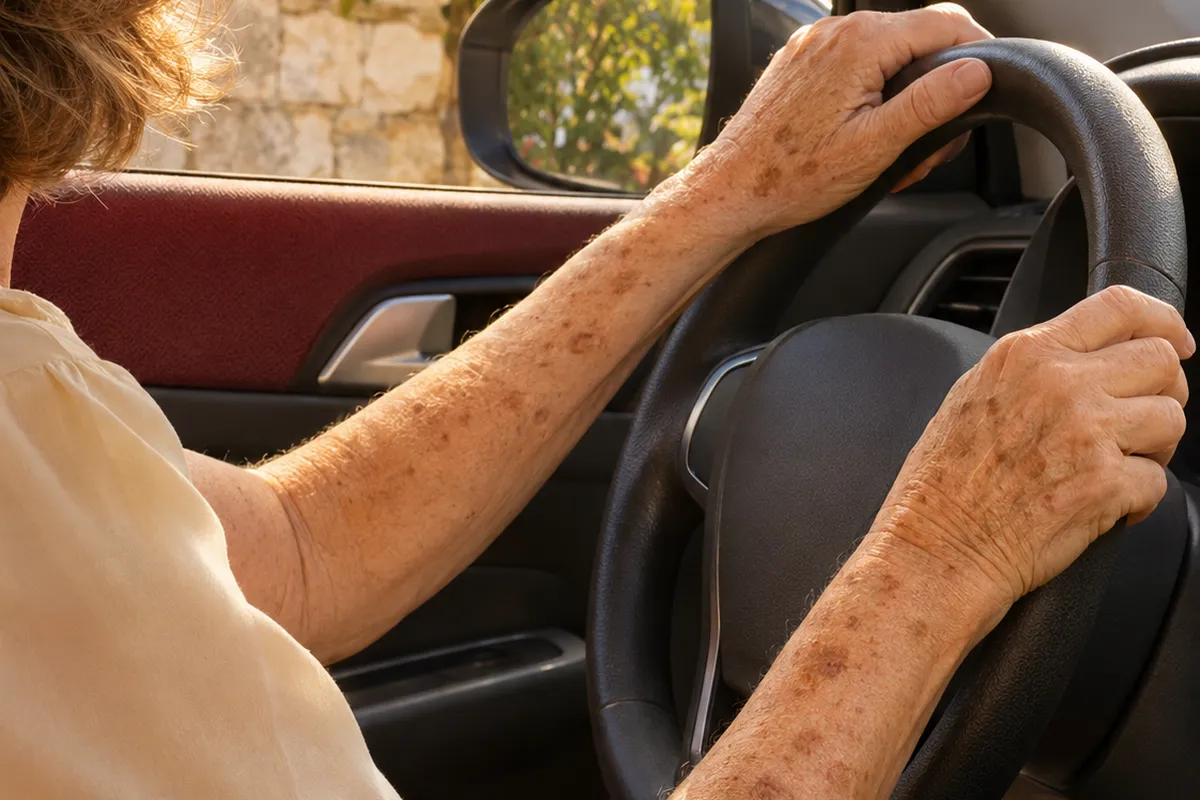
Forearms and hands of a woman at the wheel, with sun spots

How to recognise it

What colour are the patches on your arms?

The colour, location and texture of a patch help identify its cause, and the cause determines the appropriate course of action. These signs provide a starting point for assessment.

Tick what you recognise0/7

Tick the signs you recognise in your case. This is not a diagnosis, it is only meant to give you an idea.

Is there a brown or dark patch that is new, that grows, that changes colour, shape or outline, that bleeds, crusts or hurts, or that is different from all the others? Are the white patches spreading quickly? Do bruises appear for no reason, on other parts of the body, or accompanied by nose or gum bleeding? You need medical assessment before any treatment. Out of hours, call SNS 24: 808 24 24 24.

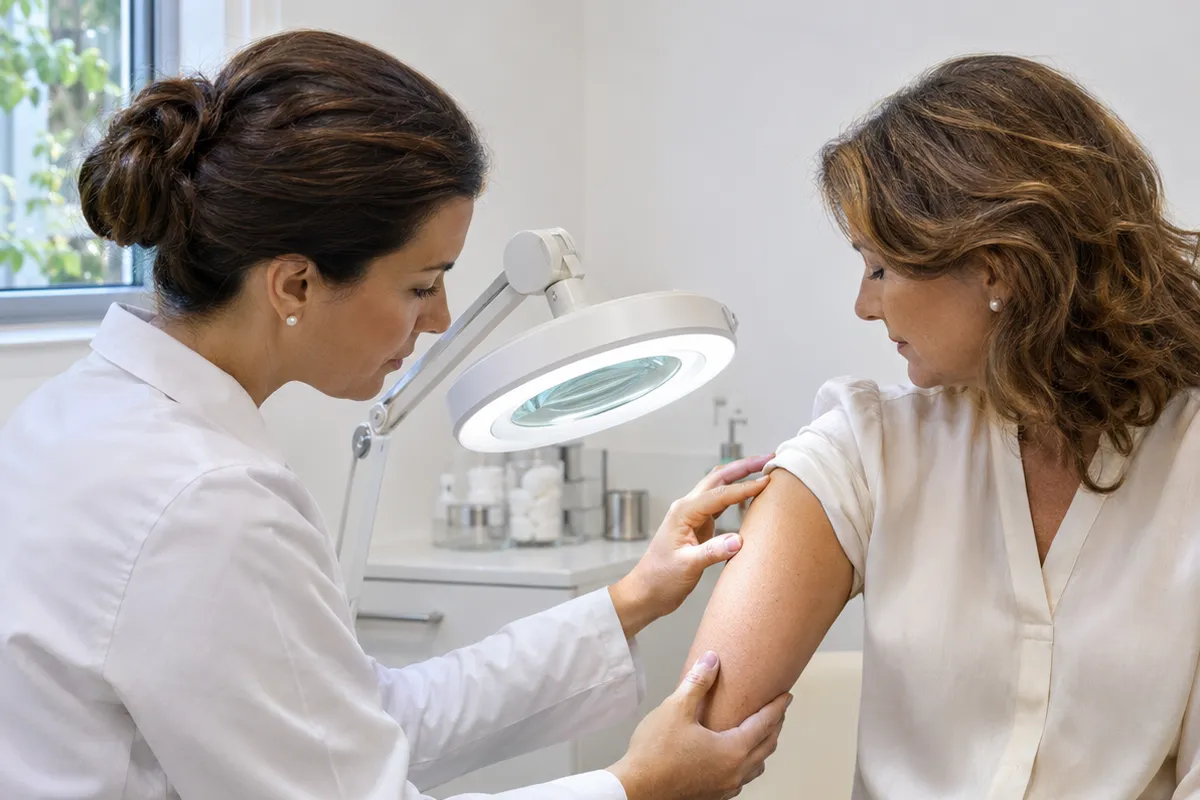
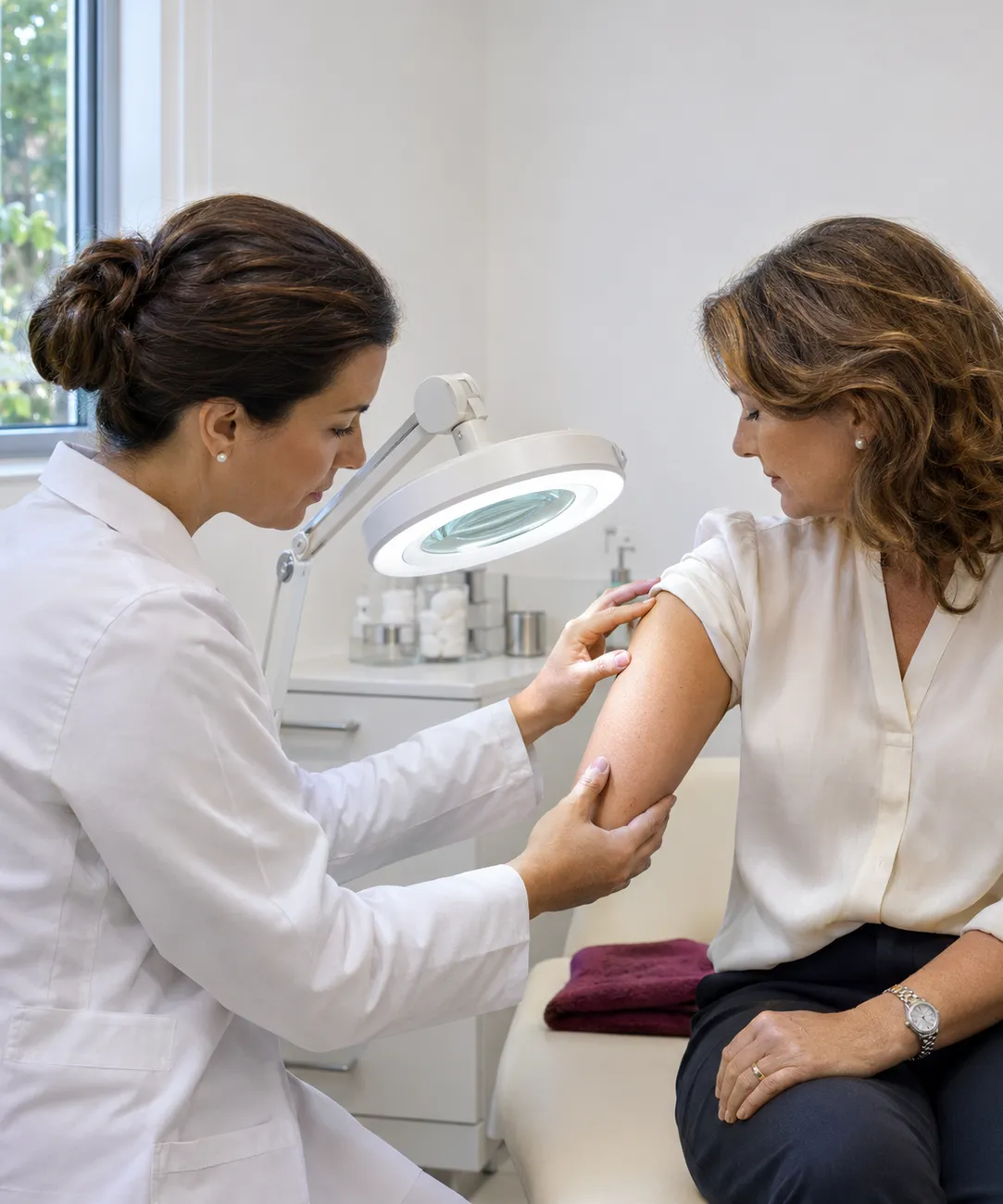
Female doctor assessing a patient's arm with an examination magnifier
Photograph of a consultation. The dots mark what the doctor is assessing.

Why it happens

What may be behind the patches

There is almost always more than one cause at the same time. Choose a situation to see how it may contribute and what usually helps.

Sun accumulated over the years

The arms are exposed to the sun over many years, and ultraviolet radiation stimulates pigment-producing cells, resulting in flat, well-defined brown patches, particularly on the forearms and the backs of the hands. These are solar lentigines, or “age spots”. They become more noticeable with age, but cumulative sun exposure is what matters, including exposure while driving or out walking.

What weighs on it

Sun exposure without protection during the hottest part of the day, sunburn, sunbeds and the belief that only time spent at the beach counts.

What helps

Use sunscreen with an SPF of 30 or higher on your forearms and the backs of your hands, wear lightweight sleeves during prolonged exposure and reapply sunscreen when outdoors.

Normal or to be assessed

Benign patches or something to assess

Most patches on the arms are benign. But some situations call for an assessment before any treatment, because colour is only the visible part and no patch should be treated “to see if it goes away”.

  • What it looks like. Flat, well-defined brown patches on the forearms, small round white patches that do not grow, rough skin with spots on the backs of the arms or purple bruises that disappear within weeks.

  • When it is noticed. After summers in the sun, with short-sleeved clothing or with thin skin that marks easily. They do not change from one month to the next.

  • What the clinic does. The doctor takes your history, examines each patch and confirms that it is a recognised benign condition before recommending an appropriate approach.

  • At home. Protect your skin from the sun, moisturise it, monitor it with monthly photographs and give it time to recover.

Do you have bleeding that does not stop, fever with very red, painful skin, or shortness of breath? Call 112. If you have a patch that is changing or have doubts, out of hours you can call SNS 24: 808 24 24 24.

Book an assessment

What the clinic may consider

Options to even out the tone of the arms

Treatment depends on the type of patch, so the first step is to identify it. Fungal patches need antifungal treatment, vitiligo has its own medical treatment, and bruises are not treated with a peel. Only sun spots and benign marks that have already been assessed may warrant an aesthetic procedure. For these, the clinic offers chemical peels after an assessment and once the skin is ready. Other medical options, such as depigmenting creams, cryotherapy and pigment-targeting laser treatment, are available and are considered case by case with the doctor or in dermatology. The evidence is limited: most studies of peels and pigmentation have involved other areas and conditions. Results are gradual, vary from person to person, may not make the treated area match the surrounding skin completely and, without sun protection, the patches can return.

Book an assessment
Dr Michelle Campagnoli, clinical director of Clínica Luxmed

First step

Assessment consultation

The doctor listens to what you are experiencing, examines your case and explains the suitable options. No treatment begins without this consultation.

May be considered when

you want to understand the cause and decide on the best path, with time and without commitment.

Book an assessment
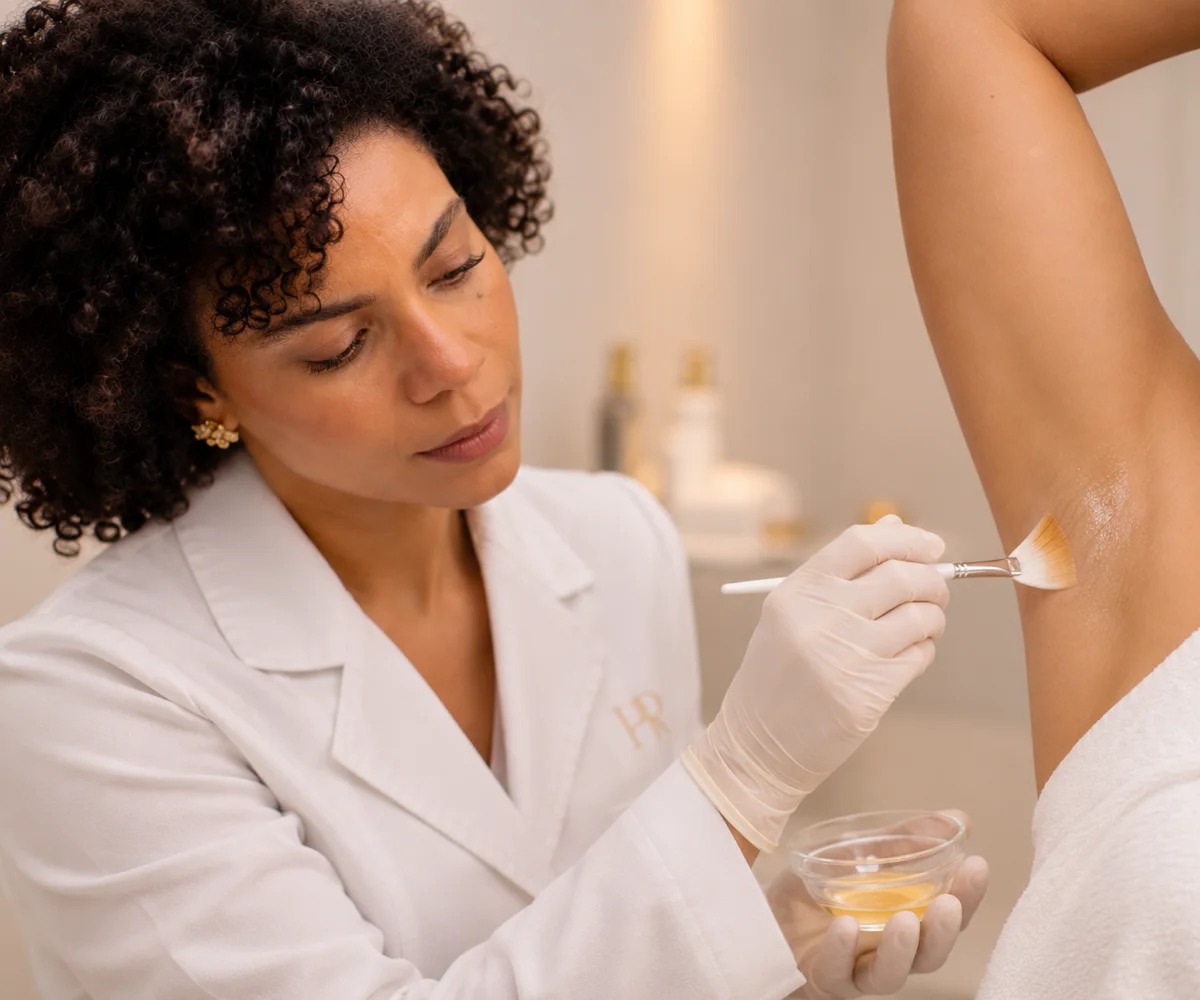
Consulting-room brush applying a peel solution to the skin, in bright consulting-room light

Skin renewal

Chemical peel

An acid is applied to the skin to renew its superficial layers, even out skin tone and smooth darkened or thickened skin. On the arms, this may be considered for sun spots and benign marks that have already been assessed. Several sessions may be needed. In darker or tanned skin, the agent is chosen carefully because irritation can leave a patch darker or lighter than it was before.

May be considered when

the patch has been assessed and confirmed as benign (for example, a sun spot), the skin is not irritated and has not recently been exposed to the sun, you are not pregnant or breastfeeding, and the doctor has explained the risks and what you can realistically expect.

Find out more

What the journey looks like

From the first conversation to a plan tailored to you

No procedure begins without an assessment by the doctor. First, each patch is identified; the simplest options are considered next, and only then is further treatment considered.

  1. 01At the clinic

    Telling your story

    The doctor asks how long the patches have been there, whether they have changed, whether they itch or flake, how much sun exposure you have, what medicines you take, whether there is a history of skin cancer, and what creams or treatments you have already tried.

  2. 02At the clinic

    Examine each patch

    The colour, outline and texture of each patch and the surrounding skin are examined. If a patch meets any warning criteria or raises concerns, you will be referred to dermatology before any treatment. Medical conditions such as fungal infection or vitiligo require their own specific treatment.

  3. 03At home

    Protect and care for the skin

    Start with simple measures you can take yourself: apply sunscreen to your forearms and the backs of your hands, moisturise your skin and wear lightweight long sleeves. In many cases, these measures are the foundation for preventing new patches and helping existing ones fade.

  4. 04Over time

    Decide and follow up

    If the benign patch persists and bothers you, the doctor explains whether a peel makes sense, what can be expected and how many sessions are needed, without promising results. The examination is repeated and the plan adjusted, including sun protection.

Day to day

What helps at home

What you do at home matters more than you might think. These are sensible measures to take while you wait for your consultation and alongside the clinic’s plan.

The golden rule

First knowing what the patch is, then the colour

Treating a patch without a diagnosis can delay what really matters, and a benign patch will return if sun exposure continues. Protecting your skin from the sun and identifying each type of patch matter more than any cream. A patch that has changed, grown or bled should be assessed by a doctor rather than “treated”.

Protecting the arms from the sun

Cumulative sun exposure is the most common cause of brown patches, and exposure while driving counts too.

In practice: sunscreen of factor 30 or higher on the forearms and the backs of the hands, reapplied outdoors, and light sleeves in prolonged exposure.

Moisturising the skin every day

Dry or irritated skin is more prone to marks and to darkening after inflammation.

In practice: a short, lukewarm bath, a moisturiser after bathing and, if there is itching or plaques, asking for medical advice.

Monitoring with photographs

It helps to see whether a patch has changed, and the doctor can compare.

In practice: one photograph a month, in the same light and with a ruler beside it, and noting what has changed.

Protecting thin skin

Knocks and scratches leave bruises and marks on the fragile skin of the forearms.

In practice: gloves and light long sleeves for gardening and tidying, and talking to the doctor about medicines before changing them.

Dr Michelle Campagnoli, clinical director of Clínica Luxmed

Who will look after you

An assessment carried out by the doctor

At Luxmed in Algés, the first step is always an assessment with Dr Michelle Campagnoli. She will examine the patches, determine whether they are benign or need to be assessed at a different consultation, and discuss the most appropriate options with you before any procedure.

  • Physical examination and medical historyA conversation about the sun, medication and changes in the patches, and examination of the skin of the arms.
  • A plan tailored to youA clear plan that puts diagnosis first, makes no promises and includes ongoing follow-up.
  • No obligationThe cost of any treatment is confirmed only after the assessment.
Book an assessment

Book a consultation

Book your consultation

Choose how you prefer to get in touch. We will arrange the assessment consultation with Dr Michelle Campagnoli.

Booking through the websiteAssessment consultationTalk to our assistant on WhatsApp and ask for the current price of the assessment.

New Life Miraflores, Algés · Office Center, R. Santa Teresa do Menino Jesus n.º 6, 9.º C, 1495-048

Your details are used only for this contact. Any treatment depends on a prior medical assessment.

Request an appointmentIt takes less than a minute.
Speciality
You do not need to go into detail. The doctor will talk to you during the consultation.
Request received. Our team will contact you as soon as possible.
Why do patches appear on the arms and what can they be?

It depends on the colour. Brown patches are usually solar lentigines (sun and age spots), freckles, moles or marks left by previous irritation. White patches may be small areas of pigment loss associated with ageing (guttate hypomelanosis), a fungal infection (pityriasis versicolor) or, less commonly, vitiligo. Red or purple patches may be due to dry skin, eczema, keratosis pilaris or thin skin that bruises easily. Because the causes vary so widely, the first step is to identify each type of patch.

Brown patches on the arms: when are they a concern?

Almost all are benign, but it is important to know the warning signs. Use the ABCDE rule: asymmetry, irregular borders, multiple colours, a diameter greater than about 6 mm and evolution, meaning a change in size, colour or shape. A new patch that grows, bleeds, crusts, hurts or is different from the others should be examined by a doctor. A brown patch should never be treated without a diagnosis, as treatment may mask a problem.

Are white patches on the arms caused by a vitamin deficiency, a fungal infection or vitiligo?

It is rarely due to a vitamin deficiency. The most common causes are sun exposure and ageing (small, round white patches on the forearms), a fungal infection (pale patches that flake when scratched and are more visible in summer) and, less commonly, vitiligo, which causes completely white, symmetrical patches that grow. A visual diagnosis alone is not reliable, so if the white patches increase in number or spread, book an assessment, as vitiligo requires specific medical treatment, which works best when started early.

Red or purple patches on the arms: is it normal to bruise easily?

With age and sun exposure, the skin on the forearms becomes thinner and the blood vessels more fragile, so bruises can appear after the slightest knock. Corticosteroids and anticoagulants increase this tendency. This is generally benign, but consult a doctor if bruises appear elsewhere on the body for no apparent reason, are accompanied by nosebleeds or bleeding gums, or are very extensive. Rough, itchy red patches are usually caused by dry skin or eczema.

How can patches on the arms be removed?

It depends on the type. Sunspots can be faded with a chemical peel, prescription skin-lightening creams, cryotherapy or laser treatment, while post-inflammatory marks fade over time with sun protection. A fungal infection is treated with an antifungal, and vitiligo requires dermatological treatment. Before anything else, the patch must be assessed, and sun protection is necessary in all cases. Results are gradual and, without sun protection, the patches return.

Is the chemical peel suitable for patches on the arms?

It may help to even out skin tone and smooth darkened skin, and it is the procedure the clinic recommends for sunspots and benign marks that have already been assessed. However, the evidence comes mainly from studies of other areas and conditions. The choice of agent is more limited for darker skin because irritation may darken rather than lighten it. Chemical peels are not used on patches caused by a fungal infection, vitiligo or bruising, or on lesions that have not been assessed, nor are they performed during pregnancy or while breastfeeding.

Can over-the-counter creams or home remedies remove brown patches?

Some creams can help lighten the patches, but only slowly and partially, and skin-lightening products should be used on medical advice. There is no evidence that lemon, bicarbonate of soda or toothpaste helps; these substances are irritants and can burn the skin, making the patch worse. If a brown patch has warning signs, no cream should be used before it has been examined by a doctor.

Do the patches come back? How many sessions are needed?

Without sun protection, yes. Results are neither guaranteed nor permanent, and improvement is usually gradual, taking weeks or months. Several peel sessions are usually required, and the skin needs time to recover between them. Maintenance and sun protection are just as important as the procedure. At the assessment, the doctor will set out the plan and realistic expectations without promising results.

Is sunscreen enough to prevent patches on the arms?

It helps greatly to prevent new patches and stop existing ones from darkening, but it rarely removes them on its own. Apply a sunscreen with SPF 30 or higher and good UVA protection to the forearms and backs of the hands, including when driving. Reapply it when outdoors and combine it with shade and lightweight sleeves, as sunscreen cannot provide complete protection on its own.

When should I see a doctor first?

Book a consultation if a brown patch is new, grows, changes colour, shape or outline, bleeds, crusts, hurts or is different from the others; if white patches spread; if bruises appear for no apparent reason or alongside other bleeding; or if you have a history of skin cancer. If in doubt, call SNS 24 (808 24 24 24) out of hours. If you have bleeding that will not stop, a fever with very red, painful skin, or shortness of breath, call 112.

We could not find that question. Ask us on WhatsApp

Scientific references

This page is based on the sources below and was reviewed by Dr. Michelle Campagnoli. Last updated on .

  1. Abbasi NR, Shaw HM, Rigel DS, Friedman RJ, McCarthy WH, Osman I, Kopf AW, Polsky D. Early diagnosis of cutaneous melanoma: revisiting the ABCD criteria. JAMA, 2004.
  2. Davis EC, Callender VD. Postinflammatory hyperpigmentation: a review of the epidemiology, clinical features, and treatment options in skin of color. J Clin Aesthet Dermatol, 2010.
  3. Ezzedine K, Eleftheriadou V, Whitton M, van Geel N. Vitiligo. Lancet, 2015.
  4. Gupta AK, Foley KA. Antifungal treatment for pityriasis versicolor. J Fungi (Basel), 2015.
  5. Sarkar R, Bansal S, Garg VK. Chemical peels for melasma in dark-skinned patients. J Cutan Aesthet Surg, 2012.
  6. Hughes MCB, Williams GM, Baker P, Green AC. Sunscreen and prevention of skin aging: a randomized trial. Ann Intern Med, 2013.
  7. DermNet NZ. Solar lentigo. (DermNet, acedido 2026-11-11)
  8. DermNet NZ. Idiopathic guttate hypomelanosis. (DermNet, acedido 2026-11-11)
  9. DermNet NZ. Pityriasis versicolor. (DermNet, acedido 2026-11-11)
  10. DermNet NZ. Senile purpura. (DermNet, acedido 2026-11-11)
  11. DermNet NZ. Keratosis pilaris. (DermNet, acedido 2026-11-11)
  12. NHS. Vitiligo. (NHS, acedido 2026-11-11)
  13. NHS. Moles. (NHS, acedido 2026-11-11)
  14. NHS. Sunscreen and sun safety. (NHS, acedido 2026-11-11)
  15. American Academy of Dermatology Association. What to look for: ABCDEs of melanoma. (AAD, acedido 2026-11-11)
CallAssistantAvailableBook