Algés, Oeiras Mon to Fri · 09:00 to 13:00 and 14:00 to 19:00 · Sat · 09:00 to 14:00
WhatsApp Book a consultation

Body aesthetics

Spots on the shouldersWhen brown patches appear on the shoulders and you want to know what they are and whether they should be monitored

The shoulders are directly exposed to the sun for years, at the beach, in the countryside, during outdoor sports and even in the car, so they develop freckles, sun spots and other marks. The patches are almost always benign and related to sun exposure, but the shoulders are also an area where moles develop and melanoma can occur, and they are difficult to examine yourself. Here we explain how to distinguish the most common patches, what can be done to prevent them, what a chemical peel can and cannot do, and when a patch requires medical assessment before any treatment at Clínica Luxmed in Algés.

Reviewed by Dr Michelle Campagnoli, clinical director

  • 1Procedure for this concern
  • 1assessment, always first
  • Nocommitment
Woman in a strappy dress on a terrace, with freckles and sun spots on her shoulders

How to recognise it

Are they sun spots or something to monitor?

Not all patches on the shoulders are the same: some are simply signs of sun exposure, while others need to be examined by a doctor. Before your assessment, these signs can help indicate which group your patch may fall into.

Tick what you recognise0/7

Tick the signs you recognise in your case. This is not a diagnosis, it is only meant to give you an idea.

Is there a patch or mole that has changed in size, shape or colour, has irregular edges, two or more colours or is different from all the others (the “ugly duckling”)? Does it grow, itch, hurt, crust or bleed? Do you have a sore on the shoulders that does not heal? You need medical assessment before any treatment, and it should not be treated as a “patch”. Out of hours, call SNS 24: 808 24 24 24.

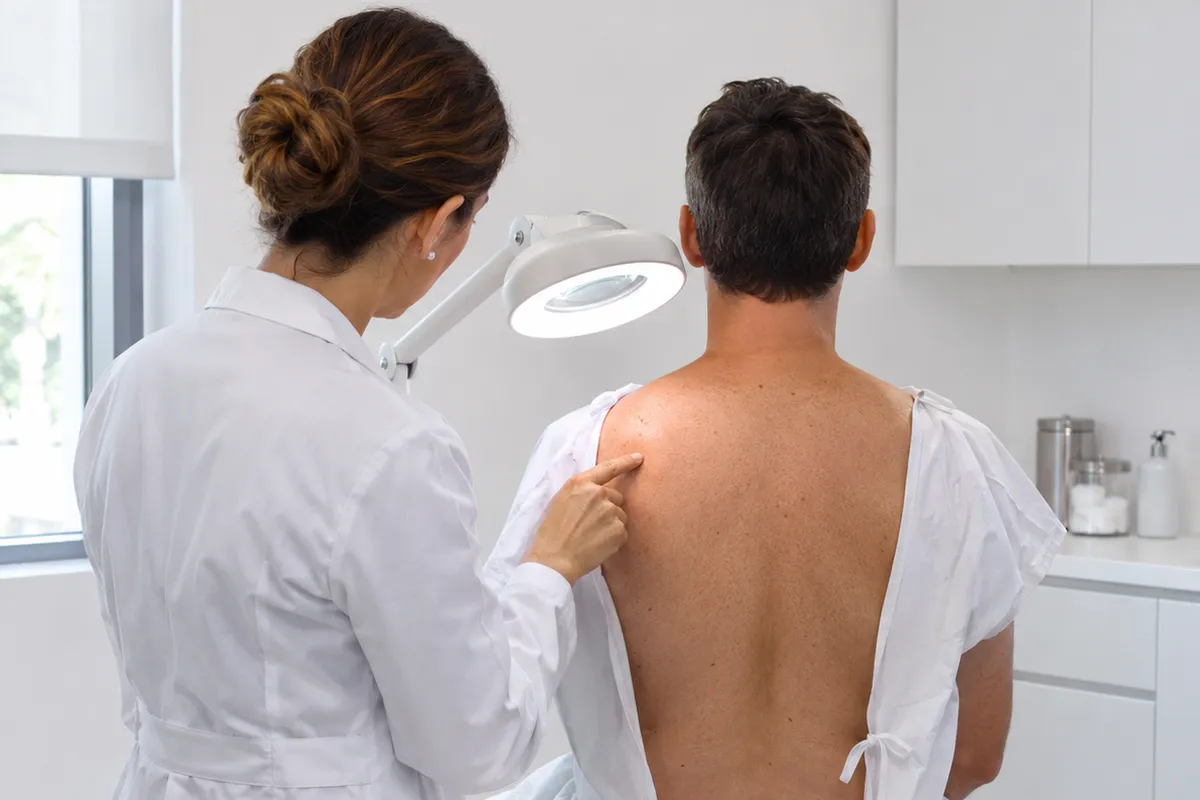
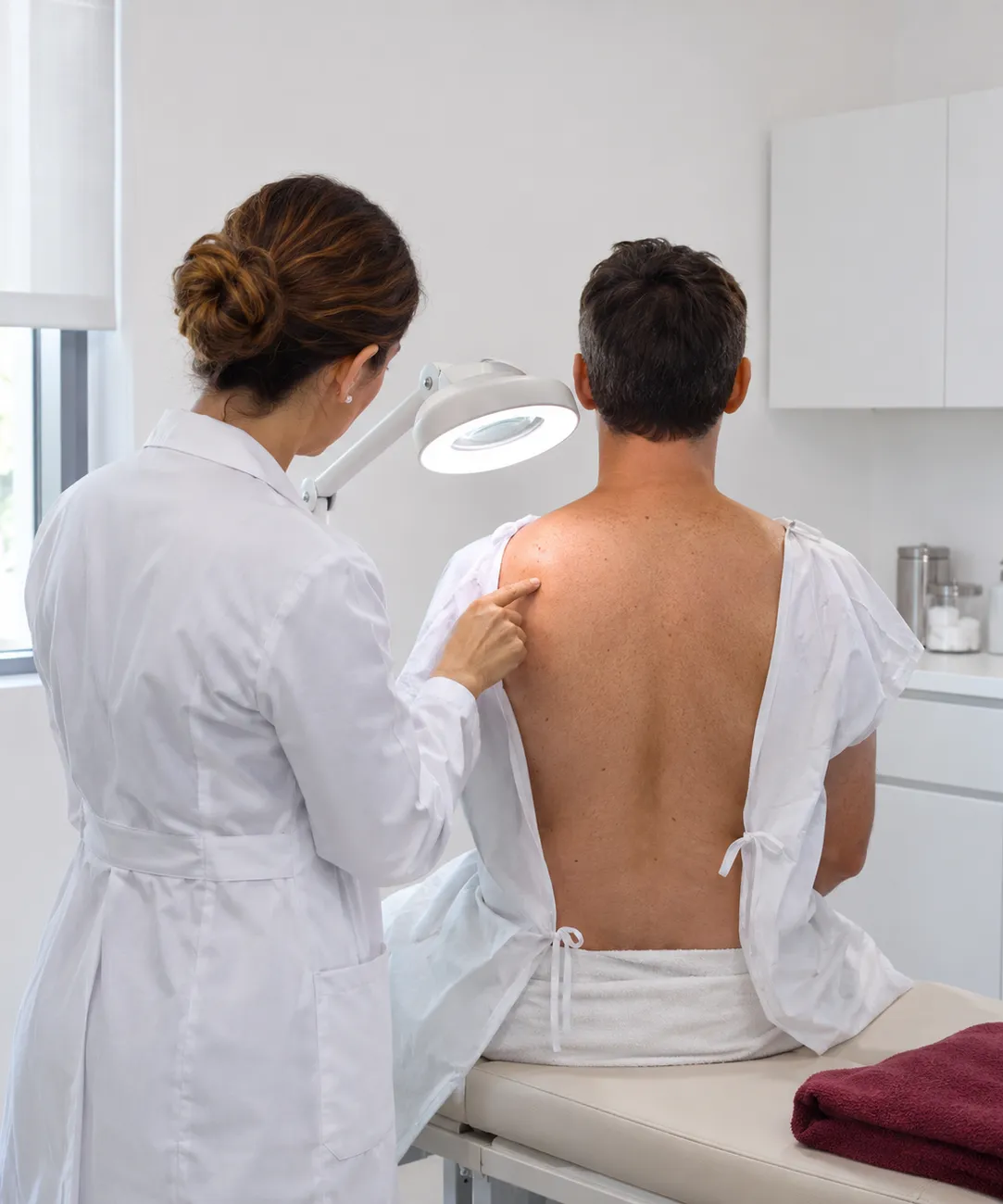
Female doctor examining the skin on the back of a patient sitting on the examination couch
Photograph of a consultation. The dots mark what the doctor is assessing.

Why it happens

What may be behind patches on the shoulders

There is often more than one cause affecting the same area of skin. Choose a situation to see how it may be relevant and what usually helps.

Sun spots (lentigines)

Solar lentigines are flat, brown patches with a well-defined outline and uniform colour that appear over the years on sun-exposed skin. They do not fade in winter and may increase in number. They indicate significant cumulative sun exposure, and people who have them are also at greater risk of skin cancer, so it is advisable to have the skin examined.

What weighs on it

Continuing to expose the shoulders to the sun without protection or to use sunbeds, and assuming that any longstanding patch is “normal” without showing it to a doctor.

What helps

Use sunscreen regularly, cover the shoulders with clothing when the sun is strongest and have the skin examined by a doctor to confirm that the patches are benign.

Normal or to be assessed

A benign sun spot or something that needs assessing

Most patches on the shoulders are benign and caused by sun exposure. However, any that change or look different need to be assessed first, because a suspicious mole should not be treated as though it were an ordinary patch.

  • How it looks. Flat patches, small or medium, of uniform colour and regular outline, which do not change from one year to the next, on skin that gets a lot of sun; freckles fade in winter and lentigines do not.

  • When they are noticeable. In summer, after tanning and when wearing wide-necked clothing. Solar lentigines remain visible all year round.

  • What the clinic does. The doctor examines the skin, confirms that the patches are benign and explains what can be treated, what to expect and how to prevent new ones from forming.

  • At home. Use sunscreen and clothing to protect your shoulders, avoid sunburn and take photographs from time to time for comparison.

Do you have a patch that bleeds, grows quickly or a sore that does not heal? Book a medical assessment without waiting. Out of hours, you can call SNS 24: 808 24 24 24. 112 is for an emergency.

Book an assessment

What the clinic may consider

Options to lighten benign patches

Before any procedure, every patch to be treated must be examined by a doctor: a suspicious mole must not be treated as an ordinary patch. Once it has been confirmed as benign, sun protection is the most important factor, as the patches will return without it. For benign sun spots on the shoulders, the clinic offers chemical peels. Other dermatological options include depigmenting creams, intense pulsed light, laser treatment and cryotherapy for isolated patches, but the choice is made during the consultation and depends on the patch and the skin type. Evidence for peels comes mainly from their use for other conditions and on other areas of the body; results are gradual, vary from person to person and are generally not permanent.

Book an assessment
Dr Michelle Campagnoli, clinical director of Clínica Luxmed

First step

Assessment consultation

The doctor listens to what you are experiencing, examines your case and explains the suitable options. No treatment begins without this consultation.

May be considered when

you want to understand the cause and decide on the best path, with time and without commitment.

Book an assessment
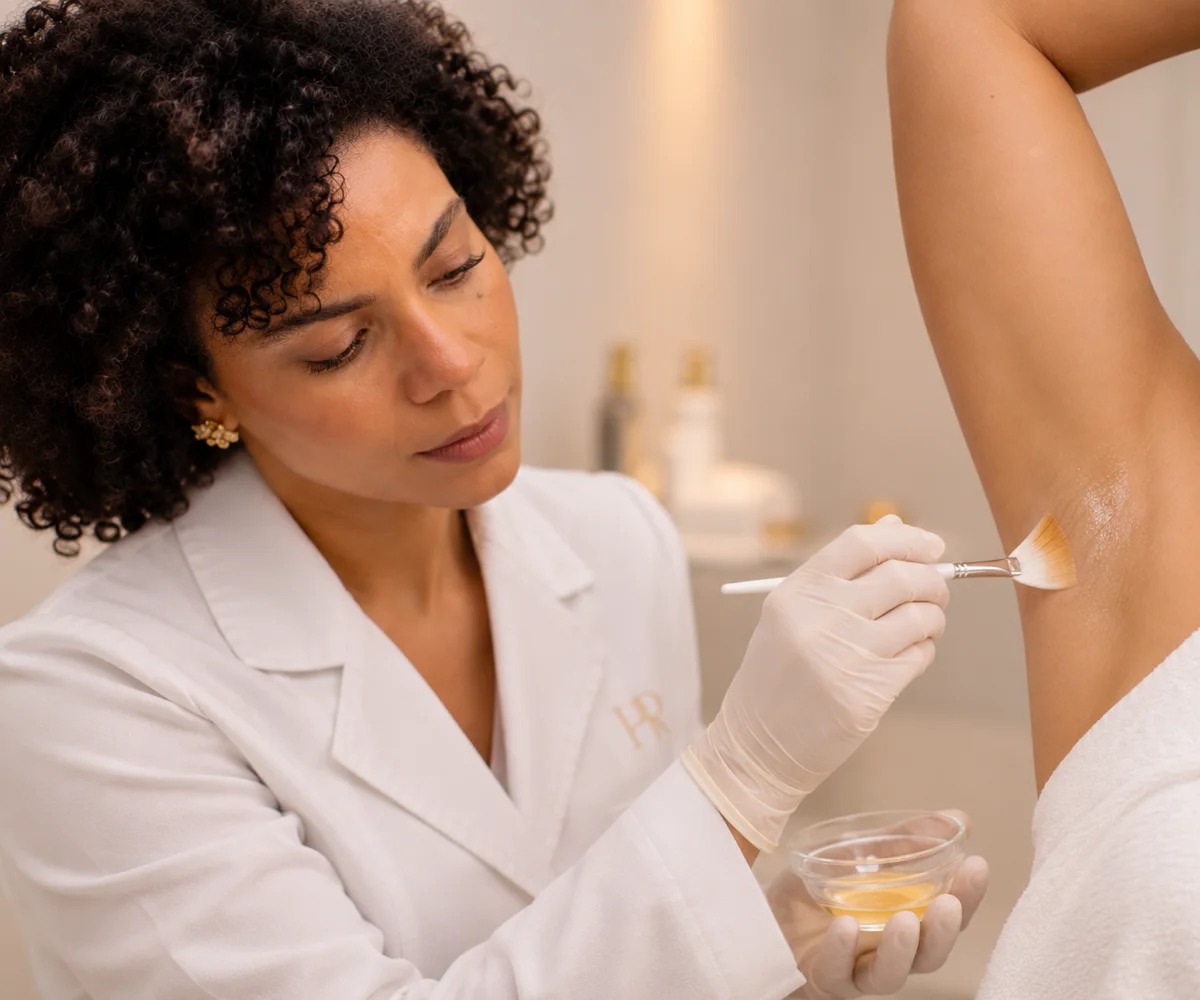
Consulting-room brush applying a peel solution to the skin, in bright consulting-room light

Skin renewal

Chemical peel

An acid is applied to the skin to renew its superficial layers, even out skin tone and smooth darkened or thickened skin. Treatment is usually given as a course of several sessions for benign sun spots and uneven skin tone. In darker skin, the agent is chosen carefully because irritation can darken the area rather than lighten it.

May be considered when

the patches have been confirmed as benign by a doctor, the skin is neither sunburnt nor irritated, you can protect it rigorously from the sun in the weeks that follow, and the doctor has explained the risks and what you can realistically expect.

Find out more

What the journey looks like

From the first conversation to a plan tailored to you

No procedure begins without an assessment by the doctor. Each patch is examined first, the appropriate approach is then selected, and treatment is only considered after that.

  1. 01At the clinic

    Telling your story

    The doctor asks how long the patches have been there, whether they have changed, whether they itch, hurt or bleed, what sunburn you have had, your tanning habits and whether there is a family history of moles or skin cancer.

  2. 02At the clinic

    Examine each patch

    The patches and moles on the shoulders, back and arms are examined, using a dermatoscope when necessary. If any show suspicious features, you will be referred to dermatology and, if necessary, a biopsy will be arranged before any treatment.

  3. 03At home

    Protect from the sun and monitor

    Use broad-spectrum sunscreen, cover your shoulders with clothing and seek shade when the sun is strongest, and take regular photographs in the same lighting. Without protection, patches return even after treatment.

  4. 04Over time

    Decide and follow up

    If the patches are benign and you want to treat them, the doctor will explain whether a peel is appropriate, how many sessions are needed and what to expect, without promising results. Your skin will be reviewed periodically.

Day to day

What helps at home

Sun protection is what makes the greatest difference to the shoulders. Follow this advice alongside the clinic’s plan and while you wait for your appointment.

The golden rule

First see, then treat, and always protect

A benign sun spot can be lightened, but a patch that changes should be assessed by a doctor rather than “treated”. Whatever the plan, without sun protection the shoulders will develop patches again and remain at risk.

Protecting the shoulders from the sun

Repeated sunburns leave marks and increase the risk of skin cancer, and the shoulders are among the first places to burn.

In practice: broad-spectrum sunscreen, reapplied every two hours and after swimming, sleeved clothing and shade in the hours of strongest sun.

Asking someone to look

It is hard to see your own shoulders and back, and changes may go unnoticed.

In practice: once a month, ask someone to look at your shoulders and back, or use a mirror and your phone.

Photographing in the same light

Comparing with photographs is the best way to see whether a patch has changed.

In practice: photographs from time to time, in the same light and at the same distance, and bring them to the consultation.

Having your skin checked

Those with many patches or moles, or fair skin, benefit from a routine examination.

In practice: book a skin assessment consultation, especially if you have many moles, a family history or many burns.

Dr Michelle Campagnoli, clinical director of Clínica Luxmed

Who will look after you

An assessment carried out by the doctor

At Luxmed in Algés, the first step is always an assessment with Dr Michelle Campagnoli. She examines your skin, distinguishes benign sun spots from those that need further assessment, refers you to dermatology if there are suspicious features and works with you to decide on the most appropriate approach before any procedure.

  • Physical examination and medical historyA discussion about sun exposure, sunburn, moles and family history, followed by an examination of the patches on your shoulders and back.
  • A plan tailored to youA clear plan, without promises, with assessment first, sun protection always and follow-up over time.
  • No obligationThe cost of any treatment is confirmed only after the assessment.
Book an assessment

Book a consultation

Book your consultation

Choose how you prefer to get in touch. We will arrange the assessment consultation with Dr Michelle Campagnoli.

Booking through the websiteAssessment consultationTalk to our assistant on WhatsApp and ask for the current price of the assessment.

New Life Miraflores, Algés · Office Center, R. Santa Teresa do Menino Jesus n.º 6, 9.º C, 1495-048

Your details are used only for this contact. Any treatment depends on a prior medical assessment.

Request an appointmentIt takes less than a minute.
Speciality
You do not need to go into detail. The doctor will talk to you during the consultation.
Request received. Our team will contact you as soon as possible.
Patches on the shoulders: what are they and why do they appear?

In most cases, these are marks caused by the sun: freckles, which appear in childhood and darken in summer, and solar lentigines, or “sun spots”, which develop over the years and do not fade in winter. The shoulders receive direct sunlight and burn easily. Other possibilities include a fungal skin infection (pityriasis versicolor), a mark left by spots or friction, a mole or a seborrhoeic keratosis. The first step is therefore to examine each patch and only then decide whether anything needs treating.

What is the difference between freckles and sun spots?

Freckles are small, measuring 1 to 3 mm, appear in childhood, darken in summer and fade in winter, and have a strong genetic component. Solar lentigines are larger, develop in adulthood, have a well-defined outline and even colour, and do not fade in winter. Both are signs of sun-sensitive skin. Neither is cancerous, but the skin still needs to be monitored for changes in moles and protected from the sun.

How do I know whether it is a sun spot or a mole to monitor?

A sun spot is flat, of uniform colour and regular outline, and stays the same. A mole or patch to monitor is asymmetrical, has irregular edges, two or more colours, or has changed (the ABCDE rule) or is different from all the others. But the ABCDE rule is not enough on its own, because some early melanomas do not meet it. So, if you have doubts or if a patch has changed, book a medical assessment.

Could patches that flake and do not tan be a fungal infection?

They could. Pityriasis versicolor is a fungal infection commonly found on the chest, back, shoulders and arms. It causes flat, round patches that may be pinkish or brownish on fair skin and lighter on dark skin, sometimes with fine scaling. It is treated with antifungals prescribed or recommended by a doctor or pharmacist, and it can recur. A lightening cream will not treat an infection.

How do I get rid of patches on the shoulders?

First, a doctor must confirm that the patches are benign. The most important step is then to stop them getting worse by protecting the shoulders from the sun. To lighten benign sun spots, the clinic offers a course of chemical peels. Other dermatological options include depigmenting agents, intense pulsed light, laser treatment and cryotherapy; the appropriate option is chosen during the consultation. Results are gradual and vary, and the patches will return without sun protection.

Does a chemical peel lighten patches on the shoulders?

It can help even out skin tone and fade benign sun spots, and is usually performed over several sessions. However, evidence for peels comes mainly from their use in other situations, and results vary. The risk of irritation and darkening is greater in darker or recently sun-exposed skin, so the agent is chosen carefully. Treatment is only performed after an assessment, and the skin must be protected from the sun in the weeks that follow.

How many sessions are needed and do the patches come back?

Several sessions are usually needed. The doctor will determine the number according to the number and intensity of the patches, and improvement will be gradual. Results cannot be guaranteed and are not permanent: the patches can return, especially with further sun exposure, so rigorous sun protection is part of the treatment, not an optional extra.

Can I go in the sun after a peel?

For the following weeks, you should avoid direct sunlight and always use sun protection thereafter. The skin becomes more sensitive, and exposing it too soon can cause new patches. Peels are therefore best performed outside the summer months, at a time when it is easier to protect the skin.

When should a patch not be treated?

When it has not been examined by a doctor; when it is new, has changed or looks different from the others; when it bleeds, hurts or crusts over; or when the skin is sunburnt, irritated or infected. In these cases, assessment comes before any treatment. A suspicious lesion is only removed after it has been assessed and, if necessary, sent for histological examination.

When should I see a doctor about a patch on the shoulders?

Book an appointment if a patch or mole has changed in size, shape or colour, has irregular edges or several colours, looks different from the others, is growing, itches, hurts, crusts over or bleeds, or if you have a sore that does not heal. You should also book if you have many patches, fair skin, a history of frequent sunburn or a family history of skin cancer. If in doubt out of hours, call SNS 24 on 808 24 24 24. Reserve 112 for emergencies.

We could not find that question. Ask us on WhatsApp

Scientific references

This page is based on the sources below and was reviewed by Dr. Michelle Campagnoli. Last updated on .

  1. Abbasi NR, Shaw HM, Rigel DS, et al. Early diagnosis of cutaneous melanoma: revisiting the ABCD criteria. JAMA, 2004.
  2. Duarte AF, Sousa-Pinto B, Azevedo LF, et al. Clinical ABCDE rule for early melanoma detection. Eur J Dermatol, 2021.
  3. Green AC, Williams GM, Logan V, Strutton GM. Reduced melanoma after regular sunscreen use: randomized trial follow-up. J Clin Oncol, 2011.
  4. Hughes MC, Williams GM, Baker P, Green AC. Sunscreen and prevention of skin aging: a randomized trial. Ann Intern Med, 2013.
  5. Praetorius C, Sturm RA, Steingrimsson E. Sun-induced freckling: ephelides and solar lentigines. Pigment Cell Melanoma Res, 2014.
  6. Ezzedine K, Mauger E, Latreille J, et al. Freckles and solar lentigines have different risk factors in Caucasian women. J Eur Acad Dermatol Venereol, 2013.
  7. Sharad J. Glycolic acid peel therapy: a current review. Clin Cosmet Investig Dermatol, 2013.
  8. Costa IMC, Damasceno PS, Costa MC. Review in peeling complications. J Cosmet Dermatol, 2017.
  9. DermNet. Solar lentigo. (DermNet, acedido 2026-11-11)
  10. NHS. Pityriasis versicolor. (NHS, acedido 2026-11-11)
  11. NHS. Symptoms of melanoma skin cancer. (NHS, acedido 2026-11-11)
  12. American Academy of Dermatology Association. What to look for: ABCDEs of melanoma. (AAD, acedido 2026-11-11)
CallAssistantAvailableBook