Algés, Oeiras Mon to Fri · 09:00 to 13:00 and 14:00 to 19:00 · Sat · 09:00 to 14:00
WhatsApp Book a consultation

Treatment · Facial aesthetics

HIFUFocused ultrasound to add firmness to the contours of the face and neck, without surgery and gradually

HIFU uses focused ultrasound that passes through the surface of the skin and concentrates heat at precise points deep beneath it, where it stimulates collagen and firms the supporting tissue. It is also called microfocused ultrasound. It may gradually improve mild to moderate laxity of the face and neck. Like all treatments at Clínica Luxmed, it begins with an assessment consultation with the doctor, whose fee is deducted if you decide to proceed.

  • 1session in many protocols
  • 1assessment, deducted if you go ahead
  • 3months until the peak, in studies
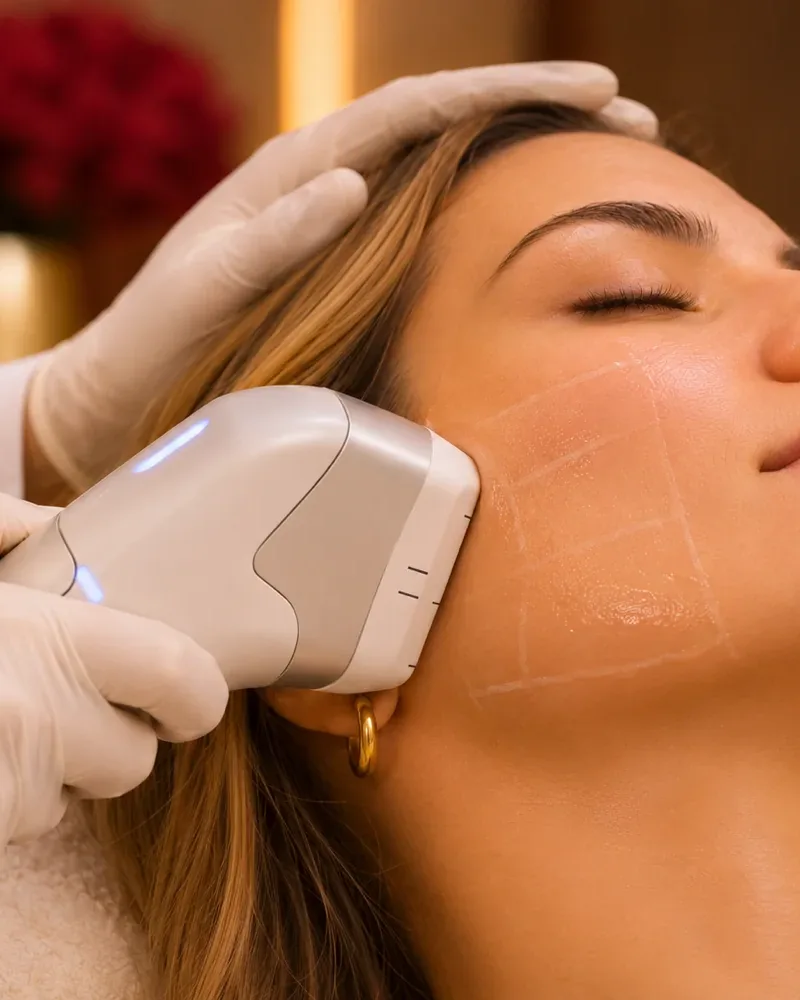
HIFU: handpiece treating the contour of the face

How it works

Concentrated heat, out of sight

HIFU heats at depth without breaking the skin. Choose one of the stages to see what happens and what it means for you.

Ultrasound

The handpiece emits ultrasound, sound waves that the ear cannot detect. Placed on the skin with gel, it allows them to pass through the upper layers without damaging them.

What happens

The handpiece has a transducer that concentrates the waves at one point, like a magnifying glass concentrating light. The surface of the skin is neither cut nor pierced.

What this means

There are no needles or open wounds. This does not mean that the treatment is painless: the heat deep beneath the skin can be felt, particularly near the bones.

What the journey looks like

It all starts with an assessment

At Clínica Luxmed, no treatment is decided over the phone or from what is seen in a photograph. The first step is always an assessment consultation with the doctor.

The assessment fee is deducted. If you decide to go ahead with the treatment, the cost of the assessment is deducted. If you prefer not to go ahead, nothing further is asked of you.

Book an assessment
  1. 01At the clinic

    Assessment with the doctor

    The doctor listens to your history, examines your skin, asks about medication and previous treatments, and explains what it is realistic to expect.

  2. 02At the clinic

    A plan tailored to you, with no commitment

    The areas, the number of sessions, the intervals and the aftercare are defined. You can think it over calmly and come back whenever you wish: nothing is started until you have fully understood what is going to be done.

  3. 03At the clinic

    Session

    In many protocols, one session per area. At the assessment, the doctor defines the areas, handpiece and energy, and whether it makes sense to repeat or combine it with other treatments.

  4. 04Over time

    Result and maintenance

    The improvement becomes noticeable over about 3 months and, in studies, is maintained for at least 6 to 12 months. Longer-term data are limited, and the doctor will tell you whether and when it makes sense to repeat the treatment.

Who it is for

When it makes sense and when it is necessary to wait

The doctor assesses each case individually. These are the situations in which HIFU is usually considered and those in which it is advisable to wait or choose another approach.

  • Mild to moderate laxity. A face that has lost firmness but still has skin and tissues capable of responding. This is where studies show moderate improvement.

  • Less defined jawline. When the lack of definition is mainly due to skin and tissues with little support, rather than a lack of volume or bone.

  • Loose skin under the chin and on the neck. This is one of the areas assessed in studies. HIFU has not been proven to eliminate fat: if the problem is mainly fat, the doctor will explain other options.

  • Slightly drooping eyebrow. Lifting the eyebrow is one of the indications described in the literature, with a small effect measured in millimetres. The eyelids and the area inside the eye socket are not treated.

  • Looser-looking face after weight loss. When the main issue is a lack of firmness. HIFU does not restore volume in a very hollow face and the result may be limited.

  • People who prefer to avoid needles and surgery. And who accept a moderate, gradual effect without the pronounced lift that only surgery can provide.

Comparing options

HIFU or thread lifts?

People seeking to lift the face without surgery often also consider thread lifts, which Clínica Luxmed does not perform. We compare the two options honestly, so that you understand what each does best. It depends on what you want to treat, and the doctor decides with you at the assessment.

At LuxmedHIFU
4of 6
criteria
Absorbable threadsThread lifts
2of 6
criteria
Ultrasound, intact skin
Threads under the skin
None
Threads, until they are absorbed
Temporary redness and swelling
Swelling, dimpling, tingling
Usually back to your routine the same day
A few days of swelling
Gradual, over several months
Immediate
Moderate firmness
Visible mechanical lift
Luxmed does not perform thread lifts

It marks the side with the advantage in each criterion. Tap a criterion to see the detail.

In summary. If you are looking for greater firmness along the facial contour, without needles or material left in the face, and accept a moderate, gradual effect, HIFU may be appropriate. If you want a visible lift from the outset, threads may be more suitable, and we will tell you so plainly at the assessment.

This compares types of treatment, not professionals, clinics or brands. The scoring is simple and does not weight the importance of each criterion: both options lack data beyond two years, and the effect varies from person to person. Results and risks vary from person to person and depend on the technique and equipment used.

Where it can help

Facial concerns for which the clinic may consider it

HIFU is not suitable for every case or the only option. These are the concerns for which the clinic may propose it, on its own or combined with other treatments. Open each page to see the causes and other options.

What a session is like

From preparation to recovery

The session has three stages. The timings and sensations are those usually described in studies, and the doctor adapts them to your case: the protocol is only finalised at the assessment.

Book an assessment

Swipe to see the three stages →

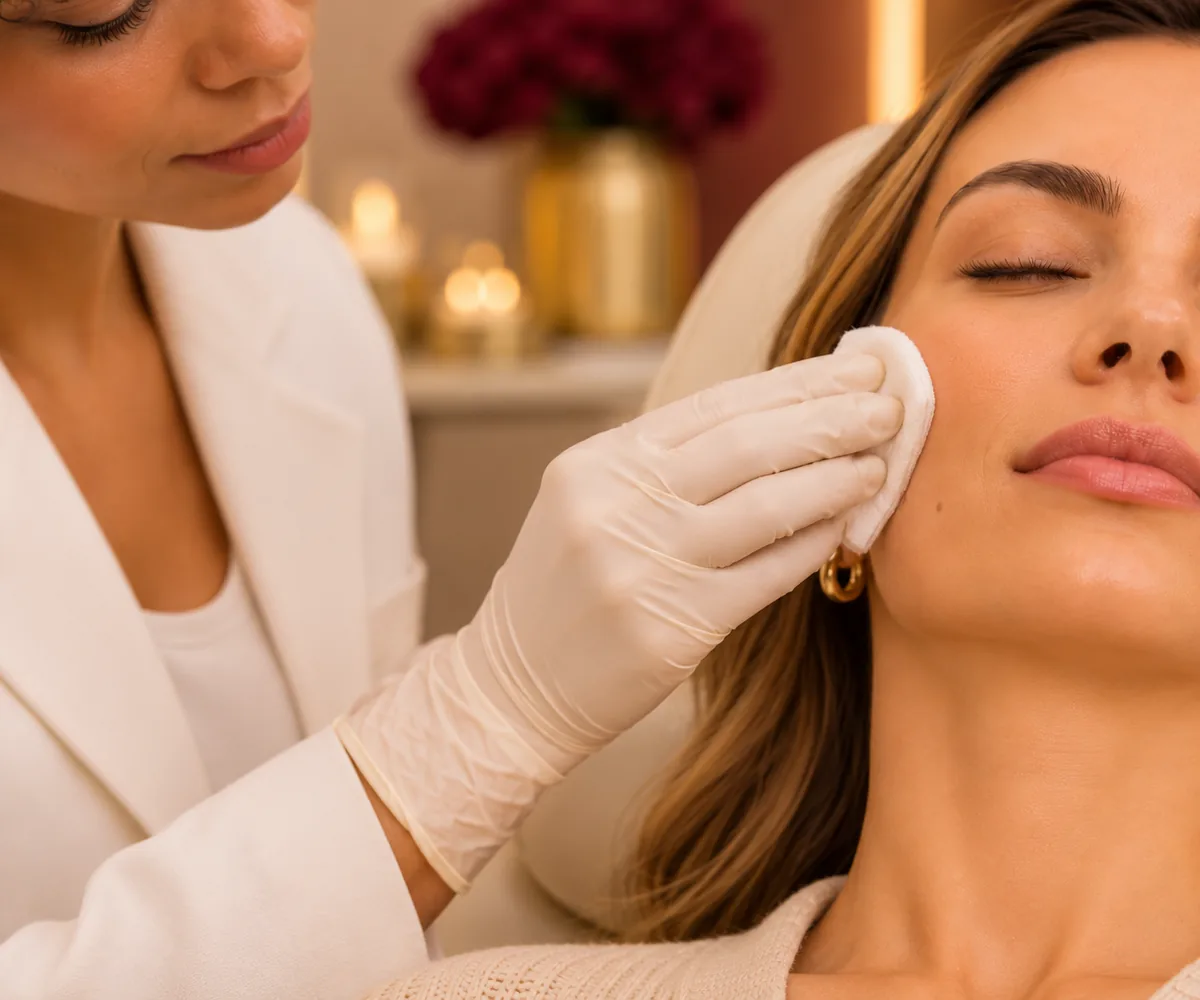
The doctor's gloved hand cleaning a woman's cheek with a gauze pad before the treatment

Before

Preparation

The skin is cleansed and the doctor confirms the areas to treat, the applicator and the energy setting again. If she considers it appropriate, she may recommend pain relief to make the session more comfortable.

Worth remembering

Arrive without make-up or with clean skin, and report any change in your health or medication since the assessment, especially pregnancy, electronic or metal implants, herpes or wounds in the area.

Book an assessment
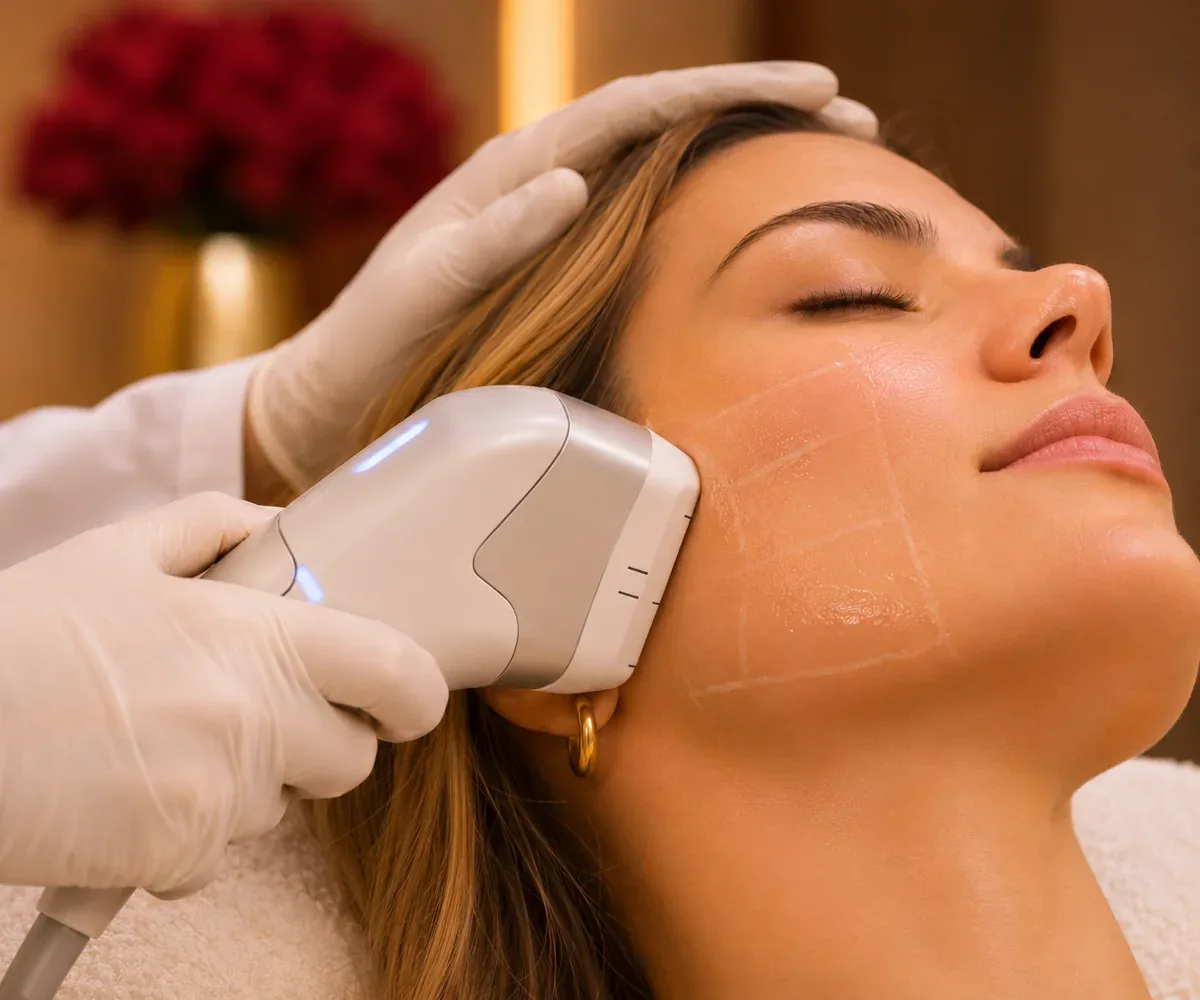
HIFU: handpiece treating the contour of the face

During

The session

The applicator is placed against the skin with gel and delivers pulses area by area, with the depth adjusted for each location. You will feel heat and pain or a pricking sensation with each pulse, which studies rate as moderate and which is more noticeable near bone. The duration depends on the areas treated.

What you feel

Deep heat and brief sharp sensations, especially near the jawline and temples. The doctor adjusts the energy to your comfort and can stop when necessary.

Book an assessment
Woman lying in the treatment chair with her eyes closed and a hand on her face after the treatment

Afterwards

Recovery

There may be redness and mild swelling, which generally pass within hours or a few days, and tenderness for a few days to two weeks. Bruising or welts occur less commonly. Use sunscreen and moisturiser and avoid rubbing the area.

When to return to your routine

As a rule, you can return to your routine the same day. If you develop blisters, severe pain, a burning sensation that does not pass, or loss of sensation or movement, contact the clinic.

Book an assessment
Dr Michelle Campagnoli, clinical director of Clínica Luxmed

Who will look after you

An assessment carried out by the doctor

At Luxmed in Algés, the first step is always an assessment with Dra. Michelle Campagnoli. She examines your skin, determines whether HIFU is the right option for you and agrees the plan with you before any procedure. The cost of the assessment is deducted if you decide to go ahead with treatment.

  • Physical examination and medical historyA conversation about your skin, medication, previous treatments and what you would like to improve, and a careful examination of the area to be treated.
  • A plan tailored to youAreas, number of sessions, intervals and aftercare, explained clearly and without promises.
  • Deducted if you go aheadIf you decide to go ahead with the treatment, the cost of the assessment is deducted. If you prefer not to go ahead, nothing further is asked of you.
Book an assessment

Book a consultation

Book your consultation

Choose how you prefer to get in touch. We will arrange the assessment consultation with Dr Michelle Campagnoli.

Booking through the websiteAssessment consultationTalk to our assistant on WhatsApp and ask for the current price of the assessment.

New Life Miraflores, Algés · Office Center, R. Santa Teresa do Menino Jesus n.º 6, 9.º C, 1495-048

Your details are used only for this contact. Any treatment depends on a prior medical assessment.

Request an appointmentIt takes less than a minute.
Speciality
You do not need to go into detail. The doctor will talk to you during the consultation.
Request received. Our team will contact you as soon as possible.
What is HIFU?

HIFU stands for high-intensity focused ultrasound, also called microfocused ultrasound. It is a non-surgical treatment in which an applicator placed on the skin concentrates ultrasound at small, deep points, where heat contracts collagen and stimulates the formation of new collagen. It may improve the firmness of the face and neck moderately and gradually. The surface of the skin is not opened.

Are all HIFU devices the same?

No. There are various devices from different brands, such as Ultherapy, and they do not all have the same characteristics. A 2022 expert panel noted differences between devices, for example in the visualisation of tissues during treatment and the uniformity of the heat points. Study results therefore do not apply equally to all devices. The device and settings are selected at the assessment, and the doctor explains what it is realistic to expect.

How does it differ from radiofrequency?

HIFU uses ultrasound and concentrates heat at small points, at a depth that can reach the supporting tissue. Radiofrequency uses electrical current and heats the skin more diffusely, at the surface (Sectum Neauvia) or directly in the dermis through microneedles (radiofrequency microneedling). Systematic reviews describe improved firmness with both, with moderate effects. Clínica Luxmed offers all three techniques, and the choice depends on what you want to treat, the thickness of the skin and the area. This is decided at the assessment, with no prior preference for any of them.

Does HIFU restore volume or eliminate fat?

It does not restore volume: it firms the skin and supporting tissues, so the effect may be limited in a very hollow face. For the double chin, some studies suggest a degree of fat reduction with specific protocols, but there is no evidence that it eliminates fat permanently. If volume is lacking or there is a lot of fat, the doctor will explain other options.

HIFU, thread lifts or a surgical facelift: which should I choose?

These options are different in nature. A surgical facelift removes excess skin and repositions the tissues, with a greater and longer-lasting effect, but it involves surgery, anaesthesia and a recovery of several weeks. Threads suspend the tissue and produce a visible effect immediately afterwards, but remain in the face and have their own risks, such as dimpling and swelling. HIFU does not puncture the skin or leave material behind, and its effect is moderate and gradual. Clínica Luxmed does not perform surgery or thread lifts: if the doctor believes at the assessment that another option is better for you, she will tell you.

Does it hurt?

It can be painful. Studies rate the discomfort as moderate: deep heat and short pricking sensations with each pulse, which are more noticeable near bone, such as along the jaw and at the temples. Sensitivity varies greatly from person to person, and the doctor adjusts the energy to your comfort. At the assessment, you can ask what is planned to make it more tolerable.

How many sessions are needed and how long does each one take?

Many studies assess a single session, and in some protocols one session is carried out per area and repeated after several months, where appropriate. The length of the session depends on the areas treated. The number and interval are defined at the assessment, according to what you want to treat and how the skin responds.

What are the days after the session like?

There may be redness, which resolves within hours, and mild swelling, usually for a few days. The skin may be tender for a few days to two weeks and, more rarely, bruising or welts may appear. You can usually return to your routine on the same day. Use sunscreen and moisturiser, avoid rubbing the area and contact the clinic if you have blisters, intense burning or loss of sensation or movement that does not resolve.

Can I combine HIFU with botulinum toxin, fillers or collagen biostimulators?

You can, when appropriate. A retrospective study of 101 people who had microfocused ultrasound with botulinum toxin or fillers in the previous or following 6 months found no different safety profile from that of each treatment. This is a small sample, so the order and interval are set by the doctor, who also checks whether there is any material in the area to be treated.

What changes after 1, 3 and 6 months?

After 1 month, the difference is generally subtle: in one study of 20 people, a slight lift of the jawline could already be measured, but in another, skin elasticity was still slightly lower at 4 weeks. The peak usually occurs at 3 months: in that study, every participant showed improvement as assessed by two dermatologists, and a 2023 review reports improvement in more than nine out of ten patients on day 90. At 6 months, the improvement persisted in studies and may continue for up to a year. In studies, patients themselves rate the improvement as more modest than investigators do. Results vary, and longer-term data are lacking.

Are the results permanent? How long do they last?

No. The effect is gradual and moderate, varies from person to person, and the skin continues to age. A 2025 review of 45 studies reported improvements in laxity of between 18 and 30 per cent, particularly in the lower third of the face, neck and around the eyes, and stressed the lack of long-term data. The doctor will tell you whether and when repeating treatment is appropriate.

Who should not have it?

According to the instructions for use of an FDA-cleared device, treatment should not be performed on people with wounds or open lesions, severe or cystic acne in the area, or a pacemaker, defibrillator or metallic implants in the treatment area. The treatment has also not been evaluated during pregnancy and breastfeeding, in people with herpes simplex, autoimmune diseases, diabetes, epilepsy, Bell's palsy or clotting disorders, or in those taking anticoagulants. Fillers and other implants in the area require caution, and the eye and the area inside the eye socket are not treated. The doctor assesses each case.

What are the risks and side effects?

Common and mild: redness, swelling, tenderness and pain during the session. Uncommon: bruising, welts and temporary changes in sensation or local muscle weakness caused by inflammation of a nerve, which usually resolve within weeks. Rare: blisters, ulcers, skin atrophy or burns, described in case series and largely attributed to technical errors. If you have severe pain, blisters, pus, fever or loss of movement, contact the clinic and, if it is serious, call 112; outside opening hours, you can call SNS 24 (808 24 24 24).

Can it be performed on any skin type?

In principle, the surface of the skin is not damaged, but evidence across different skin types is limited: a 2025 review reports that more research in diverse skin types is needed. The doctor assesses your individual case.

Is an assessment needed first? Is there a charge?

Yes. All treatments at Clínica Luxmed begin with an assessment consultation with the doctor, where we work out whether the treatment makes sense for you. The cost of the assessment is deducted if you decide to go ahead with the treatment.

How do I prepare, and can I work afterwards?

Come with clean skin and preferably without make-up, and mention any change in your health or medication since the assessment. As a rule, you can return to your routine the same day, but you should avoid rubbing the area and use sunscreen every day. If you have an important event, mention it at the assessment, because the effect takes weeks to appear.

We could not find that question. Ask us on WhatsApp

Scientific references

This page is based on the sources below. Updated on .

  1. Ayatollahi A, Gholami J, Saberi M, Hosseini H, Firooz A. Systematic review and meta-analysis of safety and efficacy of high-intensity focused ultrasound (HIFU) for face and neck rejuvenation. Lasers Med Sci, 2020.
  2. Contini M, Hollander MHJ, Vissink A, Schepers RH, Jansma J, Schortinghuis J. A Systematic Review of the Efficacy of Microfocused Ultrasound for Facial Skin Tightening. Int J Environ Res Public Health, 2023.
  3. Fabi SG. Noninvasive skin tightening: focus on new ultrasound techniques. Clin Cosmet Investig Dermatol, 2015.
  4. Haykal D, Sattler S, Verner I, Madhumita M, Cartier H. A Systematic Review of High-Intensity Focused Ultrasound in Skin Tightening and Body Contouring. Aesthet Surg J, 2025.
  5. Lou Y, Hsieh I, Cai S. Efficacy and safety of micro-focused ultrasound for middle and lower face rejuvenation: a prospective study. Lasers Med Sci, 2026.
  6. Kerscher M, Nurrisyanti AT, Eiben-Nielson C, Hartmann S, Lambert-Baumann J. Skin physiology and safety of microfocused ultrasound with visualization for improving skin laxity. Clin Cosmet Investig Dermatol, 2019.
  7. Hitchcock TM, Dobke MK. Review of the safety profile for microfocused ultrasound with visualization. J Cosmet Dermatol, 2014.
  8. Friedmann DP, Bourgeois GP, Chan HHL, Zedlitz AC, Butterwick KJ. Complications from microfocused transcutaneous ultrasound: case series and review of the literature. Lasers Surg Med, 2018.
  9. Pavicic T, Ballard JR, Bykovskaya T, Corduff N, Hirano C, Park JY, Saromytskaya A, Sevi J, Vasconcelos S. Microfocused ultrasound with visualization: consensus on safety and review of energy-based devices. J Cosmet Dermatol, 2022.
  10. Fabi SG, Goldman MP, Mills DC, Werschler WP, Green JB, Kaufman J, Weiss RA. Combining microfocused ultrasound with botulinum toxin and temporary and semi-permanent dermal fillers: safety and current use. Dermatol Surg, 2016.
  11. Ulthera, Inc. Ulthera System: Instructions for Use (1015107 Rev D), secções 2.2 a 2.5: contraindicações, precauções e efeitos secundários. Instruções de utilização, 2023.
  12. Austin GK, Struble SL, Quatela VC. Evaluating the effectiveness and safety of radiofrequency for face and neck rejuvenation: a systematic review. Lasers Surg Med, 2022.
  13. Niu Z, Zhang K, Yao W, Li Y, Jiang W, Zhang Q, Troulis MJ. A meta-analysis and systematic review of the incidences of complications following facial thread-lifting. Aesthetic Plast Surg, 2021.
  14. Riopelle AM, Geisler AN, Eber A, Dover JS. Update on absorbable facial thread lifts. Dermatol Surg, 2025.
CallAssistantAvailableBook