Algés, Oeiras Mon to Fri · 09:00 to 13:00 and 14:00 to 19:00 · Sat · 09:00 to 14:00
WhatsApp Book a consultation

Treatment · Facial aesthetics

Chemical peelAn acid carefully applied to renew the skin, even out the tone and smooth facial texture

A chemical peel involves applying an acid to the skin to cause controlled exfoliation: the surface layers shed and give way to new, more even skin. Depending on the acid and depth, it can help with tone, texture, acne and some pigmentation. It is also called a peel or chemical exfoliation. Like all treatments at Clínica Luxmed, it begins with an assessment consultation with the doctor, the cost of which is deducted if you decide to proceed.

  • 4 to 6sessions in studies of superficial peels
  • 1assessment, deducted if you go ahead
  • 1 to 14days of peeling, depending on depth
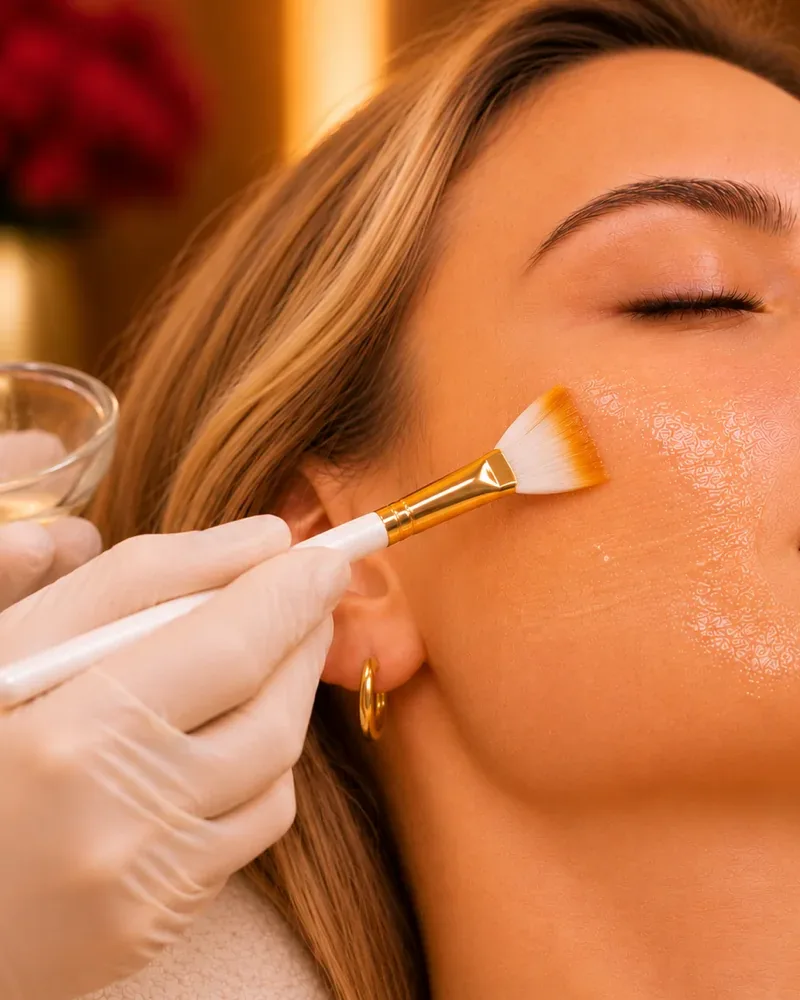
Chemical peel: application with a brush to the face

How it works

Controlled exfoliation, selected for you

A chemical peel is not a single treatment: the acid, concentration and time on the skin change what it does. Select one of the stages to see what happens and what it means for you.

The acid

Peels use acids such as glycolic, salicylic, mandelic and lactic acid, and trichloroacetic acid in deeper peels. Applied to clean skin, they cause controlled exfoliation.

What happens

The acid acts for a few minutes and is then neutralised or removed, depending on the product. You may feel burning or stinging while it acts.

What this means

Each acid has its own profile. Salicylic acid is usually selected for oily and acne-prone skin, glycolic acid is the most studied for pigmentation, and mandelic acid, which penetrates more slowly, is generally better tolerated.

What the journey looks like

It all starts with an assessment

At Clínica Luxmed, no treatment is decided over the phone or from what is seen in a photograph. The first step is always an assessment consultation with the doctor.

The assessment fee is deducted. If you decide to go ahead with the treatment, the cost of the assessment is deducted. If you prefer not to go ahead, nothing further is asked of you.

Book an assessment
  1. 01At the clinic

    Assessment with the doctor

    The doctor listens to your history, examines your skin, asks about medication and previous treatments, and explains what it is realistic to expect.

  2. 02At the clinic

    A plan tailored to you, with no commitment

    The areas, the number of sessions, the intervals and the aftercare are defined. You can think it over calmly and come back whenever you wish: nothing is started until you have fully understood what is going to be done.

  3. 03At the clinic

    Sessions

    Studies generally use 4 to 6 superficial peel sessions, 2 to 3 weeks apart. The acid, number of sessions and interval are determined at the assessment and adjusted according to the skin’s response.

  4. 04Over time

    Result and maintenance

    Improvement accumulates over the course and depends on what is being treated. Results for pigmentation and acne vary and the concerns may return, so maintenance and sun protection matter. The doctor will tell you what is appropriate in your case.

Who it is for

When it makes sense and when it is necessary to wait

These are the situations in which a superficial peel is usually considered. The decision is always made by the doctor after examining the skin.

  • Dull, rough skin with uneven texture. When skin has lost its radiance and feels rough, controlled exfoliation may restore a clearer, more even appearance.

  • Superficial pigmentation. Sun spots and other mild pigmentation, once the doctor has determined what type they are. The evidence is heterogeneous and the effect may not be permanent.

  • Mild to moderate acne. Superficial peels, for example with salicylic or glycolic acid, are described as a supportive option, especially for oily skin with comedones, alongside medical treatment.

  • Marks left after acne. Dark or brown marks left by spots may improve with a course of superficial peels and strict sun protection.

  • Mild signs of sun damage and fine lines. Superficial peels are described in the literature for the appearance of mild photoageing: tone, texture and very fine lines.

  • People who accept a course and protect their skin from the sun. A commitment to several sessions, moisturising and wearing sunscreen every day, without exposing the skin in the following weeks.

Comparing options

Chemical peel or acids at home?

Many people start with over-the-counter acid products, and they are right to consider them: they are an option that the clinic does not provide as a treatment because they are used at home. We compare the two honestly. It is not a choice between ‘good’ and ‘bad’: it depends on what you want to treat, and the doctor decides with you at the assessment.

At LuxmedChemical peel
5of 8
criteria
Peels and over-the-counter productsAcids at home
3of 8
criteria
The doctor, at the clinic
The person themselves
Greater per session
Gentler and gradual
After examining the skin
By trial and error
Assessed before treatment
They may go unnoticed
Monitored by the doctor
Independently
Greater, but controlled
Less per application
A few days
Little or none
Scheduled sessions
At home, whenever you like
Luxmed does not provide this treatment at home

It marks the side with the advantage in each criterion. Tap a criterion to see the detail.

In summary. If you want to keep your skin radiant or have a mild concern, a carefully used over-the-counter product may be enough. If you have pigmentation, acne or uneven texture that does not improve, an in-clinic peel offers a greater effect selected for your skin, and we will tell you plainly at the assessment.

This is a comparison between types of treatment, not between professionals, clinics or brands. The scoring is simple and does not weight the importance of each criterion: for someone who only wants to maintain their skin, the convenience and gentleness of at-home products may matter more than anything else. Results and risks vary from person to person and depend on the technique and equipment used.

Where it can help

Facial concerns for which the clinic may consider it

A chemical peel is not suitable for every case or the only option. These are the concerns for which the clinic may suggest it, alone or combined with other treatments. Open each page to see the causes and other options.

What a session is like

From preparation to recovery

Each session has three stages. The timings and care are those normally used, and the doctor adapts them to your case: the final protocol is only established at the assessment.

Book an assessment

Swipe to see the three stages →

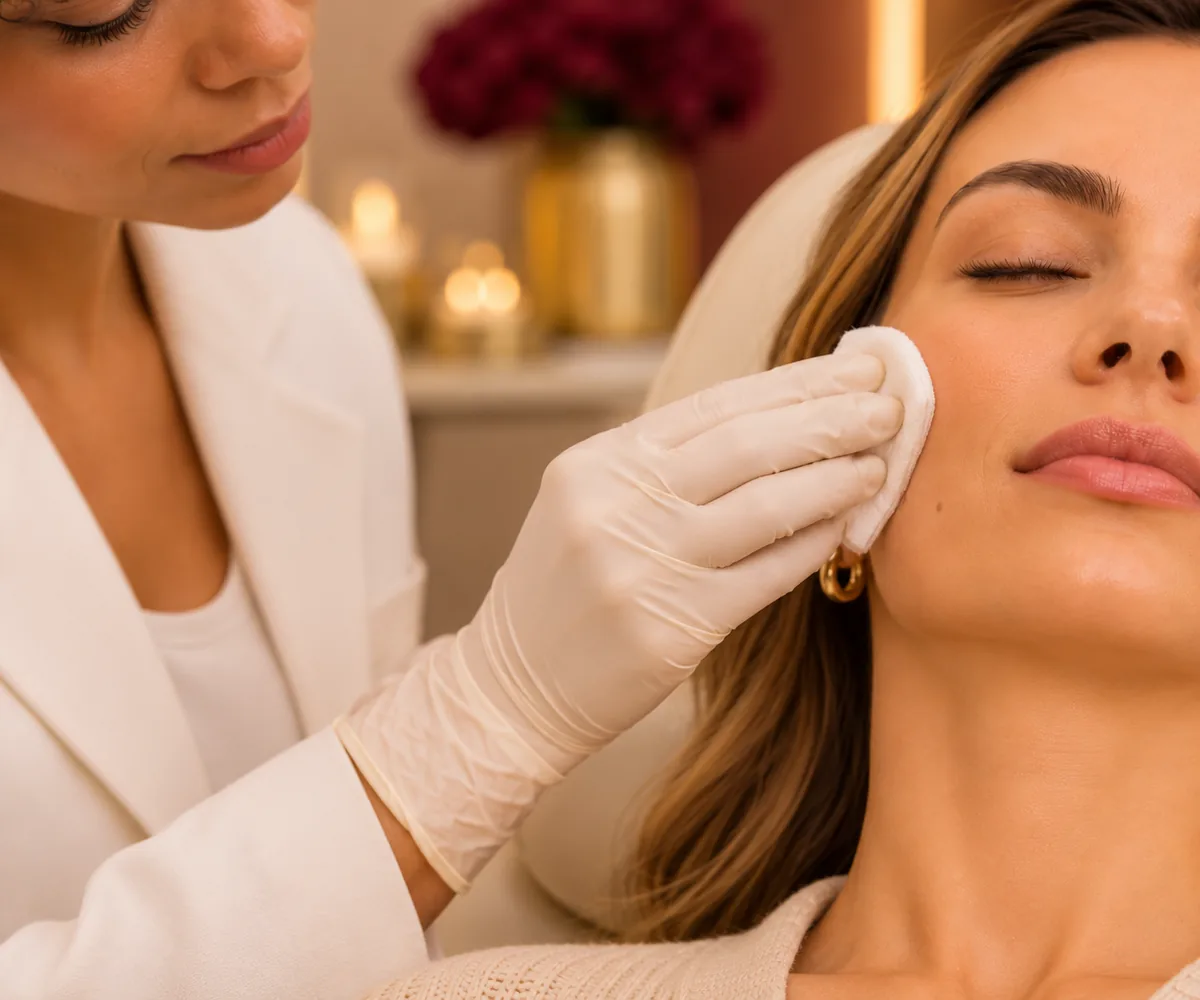
The doctor's gloved hand cleaning a woman's cheek with a gauze pad before the treatment

Before

Preparation

The skin is cleansed and degreased so that the acid acts evenly. The doctor confirms the acid, concentration and application time, and asks again about herpes, medication and products you use at home.

Worth remembering

Arrive without make-up, wear sunscreen every day in the weeks beforehand, and report any changes in your health or the products you use. Only stop retinoids or acids if the doctor tells you to.

Book an assessment
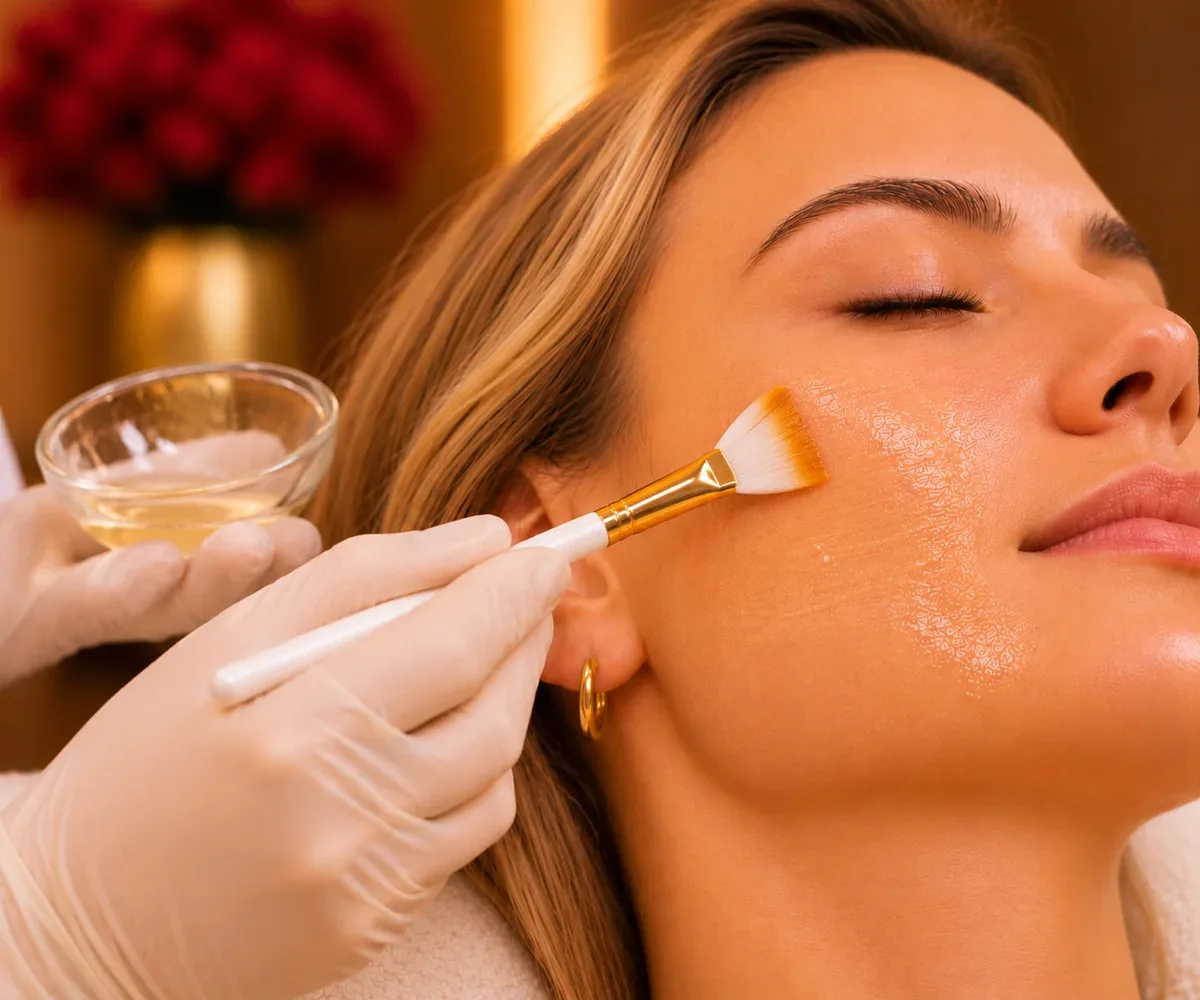
Chemical peel: application with a brush to the face

During

Administration

The acid is applied with a brush or gauze pad and remains on the skin for a few minutes, depending on the type of peel. It is then neutralised or removed. You may feel burning, stinging or heat, which subsides quickly.

What you feel

Burning and warmth, more noticeable around the nose and mouth. If it is excessive, say so: the doctor will remove the product and adjust the treatment.

Book an assessment
Woman lying in the treatment chair with her eyes closed and a hand on her face after the treatment

Afterwards

Recovery

Moisturise, wear sunscreen every day and do not pull off peeling skin. After superficial peels, the skin may become pink and tight, with fine flaking over the following days, and return to normal in about a week.

When to return to your routine

You can generally work, with pink or peeling skin. Avoid sun, intense heat, exfoliants and irritating products while peeling continues, and speak to the doctor before resuming acids or retinoids.

Book an assessment
Dr Michelle Campagnoli, clinical director of Clínica Luxmed

Who will look after you

An assessment carried out by the doctor

At Luxmed in Algés, the first step is always an assessment with Dra. Michelle Campagnoli. She examines the skin, determines whether a chemical peel is the right option for you, and agrees the plan with you before any procedure. The cost of the assessment is deducted if you decide to proceed with treatment.

  • Physical examination and medical historyA conversation about your skin, medication, previous treatments and what you would like to improve, and a careful examination of the area to be treated.
  • A plan tailored to youAreas, number of sessions, intervals and aftercare, explained clearly and without promises.
  • Deducted if you go aheadIf you decide to go ahead with the treatment, the cost of the assessment is deducted. If you prefer not to go ahead, nothing further is asked of you.
Book an assessment

Book a consultation

Book your consultation

Choose how you prefer to get in touch. We will arrange the assessment consultation with Dr Michelle Campagnoli.

Booking through the websiteAssessment consultationTalk to our assistant on WhatsApp and ask for the current price of the assessment.

New Life Miraflores, Algés · Office Center, R. Santa Teresa do Menino Jesus n.º 6, 9.º C, 1495-048

Your details are used only for this contact. Any treatment depends on a prior medical assessment.

Request an appointmentIt takes less than a minute.
Speciality
You do not need to go into detail. The doctor will talk to you during the consultation.
Request received. Our team will contact you as soon as possible.
What is a chemical peel and what types are there?

This treatment involves applying an acid to the skin to cause controlled exfoliation: the surface layers shed and are replaced by new skin. Peels are divided into superficial peels (which act on the epidermis, using acids such as glycolic, salicylic, mandelic or lactic acid), medium peels (which reach the upper dermis, for example using higher concentrations of trichloroacetic acid), and deep peels (which reach the middle dermis and involve a long recovery). The deep peel is a separate treatment, LuxFusion, with its own page. This text mainly discusses superficial peels; the doctor decides the level and acid to use at the assessment.

How is the acid selected? Glycolic, salicylic, mandelic…

It depends on the concern being treated and the skin type. Salicylic acid is generally selected for oily skin with comedones and acne because it penetrates the pores. Glycolic acid is the most studied acid for pigmentation and texture. Mandelic acid penetrates more slowly and is usually better tolerated, while lactic acid is gentle. These are the usual applications described in the literature, not a guarantee of results: the doctor makes the selection at the assessment.

Chemical peel or microneedling: which should you choose?

They work differently. A peel is chemical: an acid exfoliates the surface layers and renews tone and texture. Microneedling is mechanical: very fine needles create microchannels that stimulate the skin. Clínica Luxmed provides both and does not favour one by default. In general, peels are used more for tone, superficial pigmentation, acne and surface texture, while microneedling is used for texture, pores and scars. They may also be combined in separate sessions with the correct interval, determined by the doctor. There are articles about these subjects on the blog.

Is a peel at the clinic better than acids at home?

It is not a choice between good and bad. Over-the-counter products have lower concentrations, are gentler and more practical, and may be enough to maintain the skin. An in-clinic peel has a greater effect per session, is selected for your skin and is performed by someone who can examine the skin beforehand and treat a reaction. At home, incorrect use or combining too many acids can cause irritation and pigmentation. At the assessment, the doctor will tell you which is appropriate for you.

Does it hurt?

Superficial peels usually cause burning, stinging or heat while the acid is on the skin, followed by a feeling of tightness. This is generally well tolerated and passes quickly, but varies from person to person. If the burning is excessive, the doctor removes or neutralises the product.

How long does each session take and how many are needed?

Applying the acid generally takes a few minutes and the appointment is short. In studies of superficial peels for acne and pigmentation, the most common course involves 4 to 6 sessions, 2 to 3 weeks apart (Castillo and Keri, 2018; Rendon et al., 2010). The clinic may follow a different protocol: the number of sessions and the interval are determined at the assessment.

Chemical peel before and after: what is the daily peeling process like?

It depends on the acid and the depth. After a superficial peel, it is normal for the skin to be pink and feel tight on the first day; any peeling is usually fine and resolves within a few days. It is minimal with mandelic acid, while with glycolic, lactic or salicylic acid the skin usually returns to normal in about a week (Soleymani et al., 2018). After a medium peel, redness peaks around the fourth or fifth day and sheet-like peeling takes about two weeks to complete (Soleymani et al., 2018). In all cases, do not pull off peeling skin; moisturise and use sunscreen.

When will I see results, and do they last?

Many people notice brighter, smoother skin when peeling ends, but the full effect accumulates over the course of sessions. Results vary from person to person and are not permanent because the skin continues to age and be exposed to the sun: maintenance and sunscreen help preserve them. Some protocols described in the literature continue with one peel a month for six months and then approximately every three months, and the doctor will tell you what is appropriate for you.

Chemical peels for pigmentation: which acids are used and what should you expect?

For pigmentation, glycolic acid is the most studied. A 2024 systematic review of peels for melasma (24 studies involving more than one thousand people) concluded that peels were safe and effective and that glycolic acid was the safest and most effective agent, but also noted that the studies differed greatly. Melasma is a chronic condition that tends to return, and peels do not cure it: they help improve it alongside sunscreen and medical treatment. Before treating pigmentation, the doctor determines what type it is, because pigmentation that has not been assessed must never be treated with a peel.

What are the risks and side effects?

Frequent, mild effects of superficial peels include redness, burning, itching and peeling. Dark pigmentation may develop after a peel, especially on darker skin or with sun exposure, and, less often, herpes may reactivate or infection or scarring may occur, which are more common after deeper peels. If you experience severe pain, pus, fever, blisters or spreading redness, contact the clinic and, if it is serious, call 112; outside opening hours, you can call SNS 24 (808 24 24 24).

Can it be performed on brown or black skin?

It may be considered with precautions. Darker skin (Fitzpatrick types IV to VI) has a higher risk of pigmentation after inflammation, so superficial peels are selected, sometimes with prior skin preparation, and deeper peels are avoided. Superficial salicylic or glycolic acid peels are described as safe and effective for acne and pigmentation in darker skin (Castillo and Keri, 2018), but the risk is not zero, which is why assessment is essential.

What is the best time of year to have it, and how should I protect myself from the sun?

There is no official season. What matters is being able to protect the skin from the sun in the following weeks, because sun exposure immediately afterwards can cause pigmentation. In practice, many people prefer months with less sun; in summer, sessions, holidays and beach trips need careful planning. Wear broad-spectrum sunscreen every day, avoid intense sun, and mention any planned travel or events at the assessment.

Who should not have it?

People who are pregnant or breastfeeding; those with irritated or sunburnt skin, infection or active herpes; those prone to keloids; those with conditions such as rosacea, dermatitis or psoriasis in the area; or those who have recently used isotretinoin, depending on the assessment. A lesion that has changed, is growing, bleeding or not healing must first be examined by a doctor. The doctor will explain each case.

Is an assessment needed first? Is there a charge?

Yes. All treatments at Clínica Luxmed begin with an assessment consultation with the doctor, to determine whether a peel is appropriate for you and which one. The cost of the assessment is deducted if you decide to proceed with treatment.

How should I prepare for the peel?

Arrive with clean skin and preferably without make-up. Wear sunscreen every day in the weeks beforehand, avoid tanning and intense sun, and mention herpes, recent isotretinoin and any acids or retinoids you use. Only stop these products if the doctor tells you to; she will say when.

Can I work and carry on with my normal life afterwards?

After superficial peels, many people return to work straight away, with pink skin or fine flaking. Avoid sun, intense heat, exfoliants and irritating products while the skin is peeling. If you have an important event, mention it at the assessment so that we can plan the sessions in good time.

We could not find that question. Ask us on WhatsApp

Scientific references

This page is based on the sources below. Updated on .

  1. Soleymani T, Lanoue J, Rahman Z. A practical approach to chemical peels: a review of fundamentals and step-by-step algorithmic protocol for treatment. J Clin Aesthet Dermatol, 2018.
  2. Rendon MI, Berson DS, Cohen JL, Roberts WE, Starker I, Wang B. Evidence and considerations in the application of chemical peels in skin disorders and aesthetic resurfacing. J Clin Aesthet Dermatol, 2010.
  3. Castillo DE, Keri JE. Chemical peels in the treatment of acne: patient selection and perspectives. Clin Cosmet Investig Dermatol, 2018.
  4. Sarkar R, Lakhani R. Chemical peels for melasma: a systematic review. Dermatol Surg, 2024.
  5. Sarkar R, Bansal S, Garg VK. Chemical peels for melasma in dark-skinned patients. J Cutan Aesthet Surg, 2012.
CallAssistantAvailableBook