What is the treatment of complications affecting the body?
It is the medical assessment of a complication or reaction that developed on the body after an aesthetic treatment, followed by a decision on what to do next. The doctor looks for warning signs first, then investigates the cause and recommends monitoring, treatment or referral to another specialty. Reversal cannot be promised, and the recommendation depends on what is observed in each case.
What is normal after treatment and what is a complication?
Some redness, swelling and small bruises at injection sites are common and usually resolve within days. It is a concern if they increase rather than decrease, if the area becomes hard, hot or very painful, or if the skin changes colour. A 2018 expert consensus groups complications according to when they appear: within the first 24 hours, between 24 hours and 4 weeks, or after 4 weeks (Urdiales-Gálvez et al., 2018). If in doubt, ask the doctor who treated you or book an assessment.
When is it an emergency? When should I call 112?
Call 112 if, after an injection in the body, you develop white, purplish or dark skin, shortness of breath, a sudden cough, chest pain, very severe pain, rapid swelling with difficulty breathing, or a high fever with spreading redness or pus. Time matters: an area without blood flow may lose tissue. For other concerns outside the clinic's opening hours, you can call SNS 24 (808 24 24 24).
What happens at the appointment?
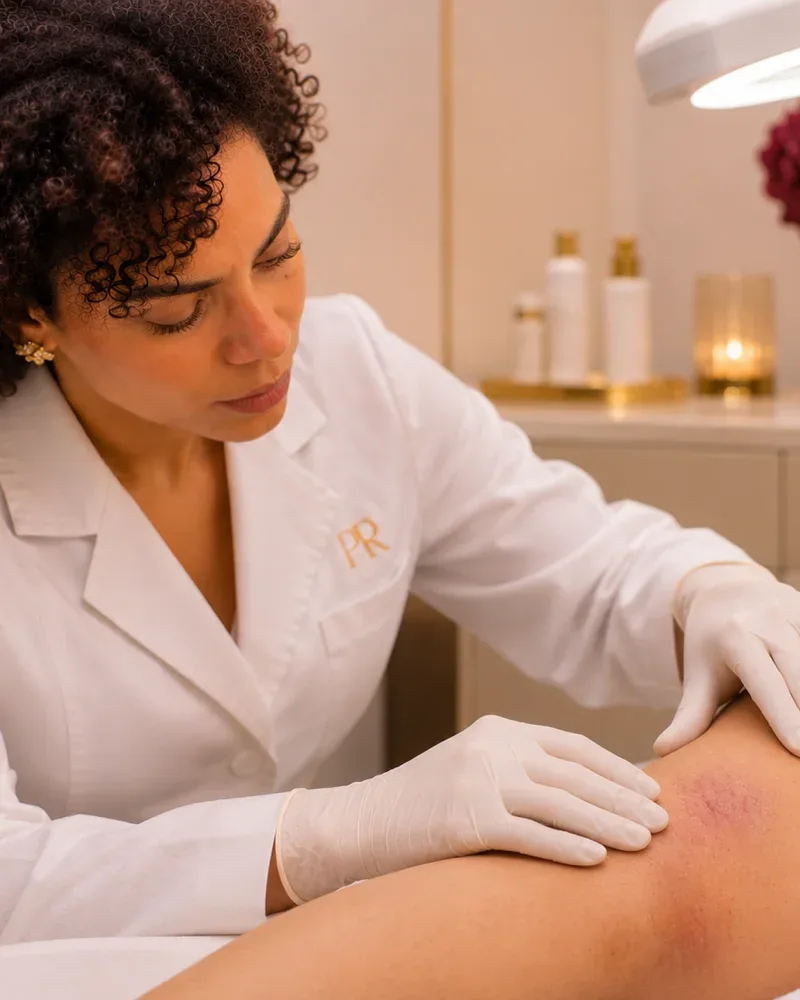
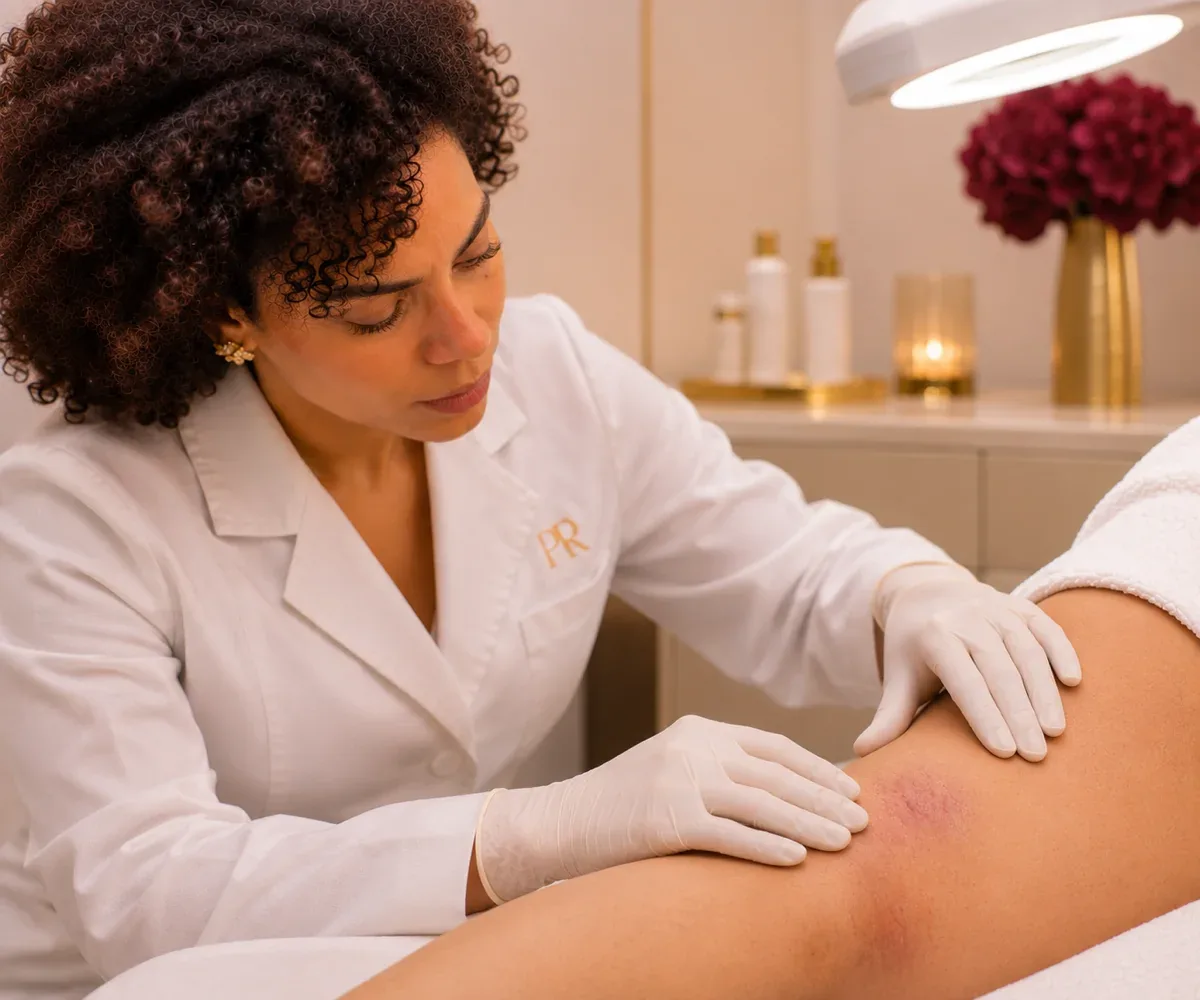
The doctor asks what treatment was carried out, when and where, which product was used, when the problem began and what has changed. She asks about your health, allergies and medication, examines the area and looks for warning signs first. If it is not an emergency, she explains what is happening, what can be done and what to expect, and agrees the next step with you. If there are warning signs, she refers you to the emergency department.
I have PMMA, hydrogel or silicone in my buttocks and there are problems. What can be done?
These are permanent or semi-permanent products: the body does not absorb them, and months or years later they can cause nodules, pain, infection or deformity and may sometimes migrate to other areas. In a case series of 13 people with biopolymers in the buttocks, all had a local foreign-body reaction and many had systemic symptoms suggestive of ASIA syndrome, an autoimmune reaction to foreign substances, with the caveat that the study was small and does not prove causation (Montealegre et al., 2021). Removal is complex, may require several operations and is not always complete. Clínica Luxmed neither uses nor recommends these products. The doctor assesses the case, provides appropriate follow-up and, when necessary, refers the patient for plastic surgery; Hyaluronidase does not resolve these products.
I have lumps after collagen biostimulators, mesotherapy or enzymes. What could they be?
They may be nodules of the product itself, an inflammatory reaction by the body, a low-grade infection or, more rarely, a foreign-body granuloma, which the 2018 consensus reports in 0.01 to 1.0 percent of cases (Urdiales-Gálvez et al., 2018). Many mild lumps improve over time, but telling them apart requires an assessment, sometimes with tests or an ultrasound scan. Treatment varies (monitoring, anti-inflammatory medication or an antibiotic, and an enzyme only if the product is Hyaluronic acid). Do not squeeze or massage them yourself.
How are burns and pigmentation changes assessed after radiofrequency, laser or a peel?
Treatments that use heat or acid can, if the skin reacts badly, leave prolonged redness, blisters, scabs or changes in pigmentation. In a review of 35 studies on radiofrequency and Radiofrequency microneedling in skin types III to VI, seven studies reported temporary skin darkening and one reported permanent scarring; the authors concluded that the risk was low, but that the quality of many of the studies was limited (Syder et al., 2023). Pigmentation changes are usually treated with prescription creams and rigorous sun protection. Blisters, severe pain, scabs with pus or signs of infection should be assessed by a doctor; avoid squeezing them or applying home remedies.
Infection after mesotherapy or injections in the body: what are the warning signs?
Fever, severe pain, pus, warmth and spreading redness, or an area that swells and does not improve, require a medical assessment on the same day: contact the clinic that treated you or SNS 24 (808 24 24 24) and, if it is serious, call 112. Late infections caused by environmental mycobacteria can develop weeks or months later and do not respond to the usual antibiotics. A systematic review of 30 articles involving 423 people with this type of infection after mesotherapy reported lesions mainly on the abdomen, buttocks and thighs, treatment with several courses of antibiotics, and frequent scarring (Singsing et al., 2022). Do not wait or self-medicate.
What is Hyaluronidase and when is it used for complications?
It is an enzyme that dissolves hyaluronic acid and acts only on that substance. Expert consensus documents describe it as one of the options when a complication, such as impaired blood flow to the skin or a nodule, is caused by this product, and the sooner it is used, the better. It is only administered by a doctor, carries risks (such as allergy) and does not guarantee skin recovery. It does not work on PMMA, hydrogel, silicone or collagen biostimulators. When there are severe symptoms, hospital emergency care takes priority. There is a dedicated page about hyaluronidase.
I had a complication at another clinic. Can I book an assessment? What should I bring?
Yes. The doctor will assess what can be seen today and what to do next, without judging whoever performed the treatment. Bring: the name and date of the treatment, where it was performed, the product card or proof of treatment if you have it, surgical or emergency-department reports, a list of medications and allergies, and photographs of the area from the outset. If there are serious warning signs, do not wait: call 112.
Can the complication be reversed? How long does it take to resolve?
It depends on the cause. Some effects resolve on their own within days (mild swelling), others take months (some late-onset nodules or pigmentation changes), and some may leave a mark. In one case described in the literature, a woman who had had a product injected into her buttocks ten years earlier required two-stage surgery, and the authors emphasised that there are no standardised treatment protocols (Pérez Tristán et al., 2021). Reversal cannot be promised and no timeframe can be given before an assessment: the doctor will explain what is realistic in your case.
Should I go to the clinic or the emergency department?
If there are warning signs (white, purplish or dark skin, shortness of breath, severe pain, high fever, spreading redness or pus), go to the emergency department or call 112. Without these signs, you can book an assessment, and outside opening hours you can call SNS 24 (808 24 24 24) for advice. Clínica Luxmed is not an emergency service. Emergency departments are better equipped for serious cases, while the clinic is an option for non-urgent cases and follow-up.
Is an assessment needed first? Is there a charge?
Yes. All treatments at Clínica Luxmed begin with an assessment consultation with the doctor, to understand what is happening and what course of action makes sense. The cost of the assessment is deducted if you decide to proceed with treatment. If there are serious warning signs, do not wait for this consultation: call 112.
Can I wait to see whether it settles on its own?
In some cases, yes: mild swelling and redness that decrease from day to day usually pass. However, you should not wait if the area is getting worse rather than better, if it is very hard, hot or painful, or if its colour has changed. If in doubt, contact the clinic that treated you or book an assessment; if there are serious warning signs, call 112.
Can I have other treatments while I am recovering?
As a rule, no: it is prudent to allow the area to recover and only decide on further treatments after an assessment. The doctor will tell you when it is appropriate to resume treatment, what interval should be observed and whether the approach needs to change. You should also avoid using irritating or exfoliating products on the area unless advised by a doctor.
How can complications from body treatments be avoided?
Choose a licensed doctor and facility, ask which product will be used and keep the documentation. Be wary of permanent products, very low prices or injections performed outside a clinical setting. Tell the doctor about allergies, medication and medical conditions, and do not undergo injections or energy-based treatments if there is an active infection in the area. The treatment and product are selected during the assessment, and the clinic does not claim that any treatment is risk-free.